China’s CNPC reports first one-million-ton CO2 injection oilfield in Xinjiang region
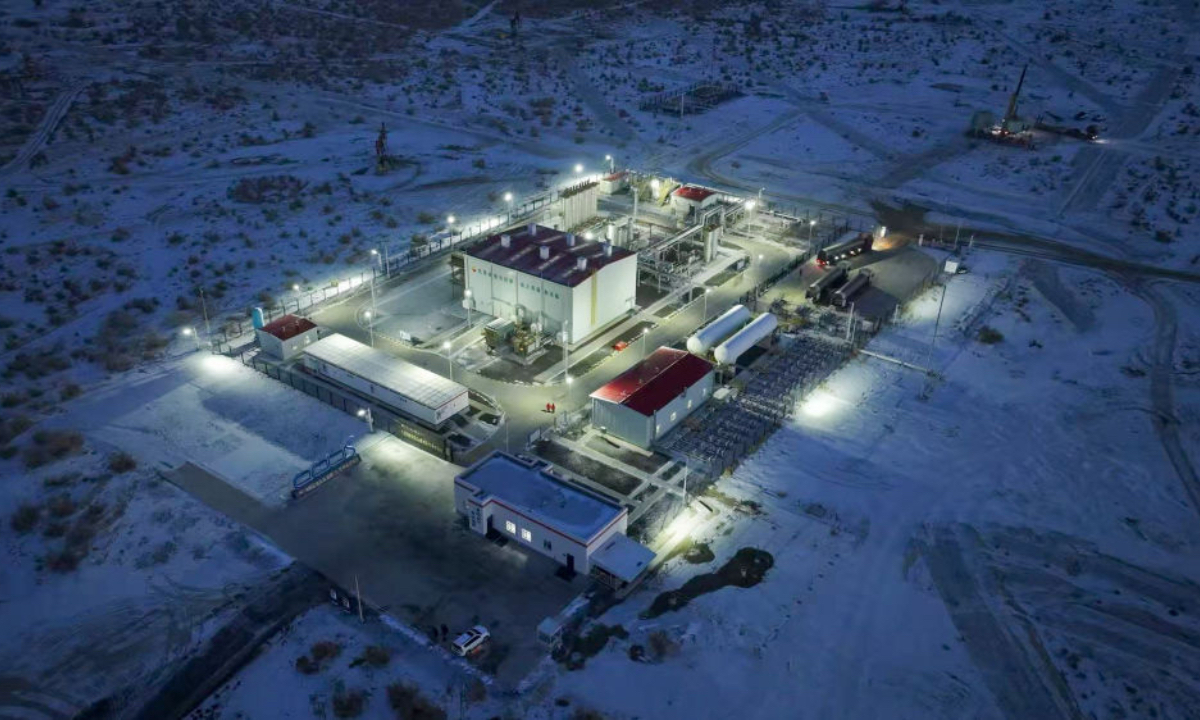
Workers at a CO2 miscible flooding pilot station in Xinjiang Oilfield’s No 2 production plant conduct a late-night equipment inspection on December 24, 2025. Photo: Xinhua News Agency
The milestone marks a key step forward in the large-scale application of CCUS (carbon capture, utilization and storage) technology at the Northwest China's Xinjiang Uygur Autonomous Region, providing important technological support and a practical pathway for China's oil and gas sector to advance toward its carbon peaking and carbon neutrality goals, Xinhua reported.
Located in the Junggar Basin, the Xinjiang Oilfield is the first major oilfield developed after the founding of the People's Republic of China. CCUS involves capturing and purifying carbon dioxide emitted during production before reusing or storing it.
According to the oilfield's estimates, injecting 1 million tons of carbon dioxide is equivalent to planting nearly 9 million trees. "Since taking the lead in exploring CO2-enhanced oil recovery at the beginning of this century, we have overcome a series of tech bottlenecks—including reservoir geology and process compatibility—through a three-pronged approach of management, technology and industry," said Shi Daohan, executive director of CNPC Xinjiang Oilfield. He added that the oilfield has gradually established a "Junggar model" featuring secure CO2 supply, efficient displacement and safe storage, Xinhua reported.
According to Shi, the oilfield's annual CO2 injection rose from 126,000 tons in 2022 to 1 million tons in 2025, with cumulative injection exceeding 2 million tons.
"Developing CCUS serves China's dual carbon goals while significantly boosting oil recovery, carrying strategic importance for national energy security," said Ding Chao, head of the development division at Xinjiang Oilfield. He added that CO2-enhanced oil recovery delivers markedly higher efficiency than traditional water flooding, achieving a win-win of emissions reduction and output growth.
The Junggar Basin is a key energy base in China, with Xinjiang Oilfield's production area having an estimated carbon storage capacity of up to 2 billion tons. Coupled with a dense cluster of nearby industrial enterprises and strong industrial synergies, the region is well positioned to develop a large-scale CCUS industry cluster, Xinhua reported.
Lin Boqiang, director of the China Center for Energy Economics Research at Xiamen University, told the Global Times that the project follows a well-established CCUS pathway, with its key strength lying in carbon "utilization" rather than simple storage. By injecting carbon dioxide into oil reservoirs to enhance recovery, it aligns emissions reduction with energy production.
Compared with standalone storage, this utilization-based approach is more cost-effective and helps lower overall costs.
He added that reaching an annual injection scale of 1 million tons is the project's most notable breakthrough. While the technology itself is not new, it had previously been deployed mainly on a limited scale. Achieving one-million-ton injection marks a shift from pilot validation to large-scale application, providing strong support for China's clean energy development and green transition.
Located in the Junggar Basin, the Xinjiang Oilfield is the first major oilfield developed after the founding of the People's Republic of China. CCUS involves capturing and purifying carbon dioxide emitted during production before reusing or storing it.
According to the oilfield's estimates, injecting 1 million tons of carbon dioxide is equivalent to planting nearly 9 million trees. "Since taking the lead in exploring CO2-enhanced oil recovery at the beginning of this century, we have overcome a series of tech bottlenecks—including reservoir geology and process compatibility—through a three-pronged approach of management, technology and industry," said Shi Daohan, executive director of CNPC Xinjiang Oilfield. He added that the oilfield has gradually established a "Junggar model" featuring secure CO2 supply, efficient displacement and safe storage, Xinhua reported.
According to Shi, the oilfield's annual CO2 injection rose from 126,000 tons in 2022 to 1 million tons in 2025, with cumulative injection exceeding 2 million tons.
"Developing CCUS serves China's dual carbon goals while significantly boosting oil recovery, carrying strategic importance for national energy security," said Ding Chao, head of the development division at Xinjiang Oilfield. He added that CO2-enhanced oil recovery delivers markedly higher efficiency than traditional water flooding, achieving a win-win of emissions reduction and output growth.
The Junggar Basin is a key energy base in China, with Xinjiang Oilfield's production area having an estimated carbon storage capacity of up to 2 billion tons. Coupled with a dense cluster of nearby industrial enterprises and strong industrial synergies, the region is well positioned to develop a large-scale CCUS industry cluster, Xinhua reported.
Lin Boqiang, director of the China Center for Energy Economics Research at Xiamen University, told the Global Times that the project follows a well-established CCUS pathway, with its key strength lying in carbon "utilization" rather than simple storage. By injecting carbon dioxide into oil reservoirs to enhance recovery, it aligns emissions reduction with energy production.
Compared with standalone storage, this utilization-based approach is more cost-effective and helps lower overall costs.
He added that reaching an annual injection scale of 1 million tons is the project's most notable breakthrough. While the technology itself is not new, it had previously been deployed mainly on a limited scale. Achieving one-million-ton injection marks a shift from pilot validation to large-scale application, providing strong support for China's clean energy development and green transition.
RELATED ARTICLES