China to apply lower tariff rates on certain imports in 2026 to promote green transformation, improve people's wellbeing
By Published: Dec 29, 2025 06:05 PM

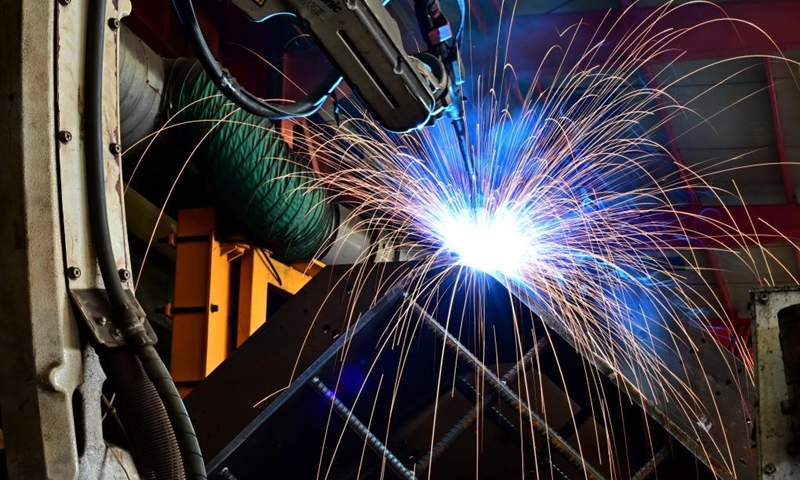
This photo taken on December 28, 2025 shows an intelligent welding device working at an auto parts company in Fengnan District of Tangshan, North China's Hebei Province. In recent years, Fengnan District of Tangshan has actively pursuing opportunities to develop new quality productive forces, boosting high-quality development. Photo: Xinhua
China will adjust tariff rates on certain products, including applying provisional import tariff rates lower than the most-favored-nation (MFN) rates to 935 items in 2026, to drive greater self-reliance, boost the green transformation of economic and social development, and improve public wellbeing, effective on January 1, 2026, the Customs Tariff Commission of the State Council announced on Monday.
The move is aimed at better leveraging the strengths of both domestic and international markets and resources, and to expanding the supply of high-quality goods, the commission said in a post on the website of the Ministry of Finance on Monday. After the adjustment, the number of items enjoying provisional import tariff rates remains unchanged from 2025, the Global Times found.
Chinese analysts said on Monday that these measures demonstrate China's commitment to accelerating and deepening regional economic and trade integration by adopting an open approach to connecting with global resources, and to the country's role as a major open global economy with efforts to foster a new economic development pattern.
Import tariffs on key components and advanced materials such as computer-controlled hydraulic cushions for presses and heteromorphic composite contact strips will be lowered, to drive greater self-reliance and strength in science and technology and promote the building of a modern industrial system, according to the Tariff Adjustment Plan for 2026, released on Monday.
Furthermore, import tariffs on resource-based goods such as recycled black powder for lithium-ion batteries and unroasted iron pyrites will be lowered to boost the green transformation of economic and social development, the plan said.
Also, to improve public wellbeing and strengthen the Healthy China initiative, import tariffs on medical products such as artificial blood vessels and diagnostic kits for certain infectious diseases will be lowered.
Moreover, to increase the momentum of endogenous growth of the domestic economy, and in line with changes in industrial development and supply-demand dynamics in China, provisional import tariff rates on certain goods such as micromotors, printing machines and sulfuric acid will be canceled and MFN rates will be re-imposed, within the scope of China's WTO commitments.
Chen Fengying, a research fellow at the Beijing-based China Institutes of Contemporary International Relations, told the Global Times on Monday that the tariff adjustments are in line with the nation's overall goal of promoting high-quality development and high-level opening-up.
"The adjustments are clearly aimed at better assisting national economic and trade growth amid the new round of technological revolution and the changing geopolitical landscape. The adjustments will provide support to a wide range of sectors including but not limited to artificial intelligence-related sectors," Chen said.
"Resource sectors that will play a key role in fostering continued green transformation and sectors related to the silver economy for an aging demographic will also receive support."
Agreeing with Chen, Wan Zhe, a professor at Beijing Normal University, told the Global Times on Monday that the 2026 tariff plan is precisely anchored in the core objectives set for 2026, including fostering new quality productive forces, the green transformation and people's livelihoods.
"Research and development costs for high-end equipment are expected to be lowered with the lower tariff rates on key components and materials," Wan predicted.
Wan noted that the canceling of provisional import tariff rates on some products is aimed at prompting domestic companies to move up the value ladder and increase the competitiveness of the domestic economy.
According to the commission, China will introduce new national subheadings for items such as intelligent bionic robots, bio-aviation kerosene, and forest-cultivated ginseng in 2026 to promote technological advances, support the circular economy and develop the under-forest economy. After the adjustments, the number of national tariff lines will increase to 8,972.
To deepen international economic and trade cooperation and promote regional integration and development, China will continue to implement agreed tariff rates on some imported goods from 34 trade partners in 2026 in accordance with 24 free trade agreements and preferential trade arrangements concluded between China and these trade partners, the commission said.
To advance economic and trade cooperation with the least-developed countries (LDCs) and assist in their development, China will continue to grant zero-tariff treatment on 100 percent of tariff lines to 43 LDCs having diplomatic relations with China in 2026, under the plan.
In line with the Asia-Pacific Trade Agreement and exchange of notes between the Chinese government and certain ASEAN member states, China will continue to implement preferential tariff rates on some imported goods from Bangladesh, Laos, Cambodia and Myanmar.
The science-based adjustments to provisional import tariff rates, and improvement of the setting of tariff lines, as well as the continual implementation of agreed tariff rates and preferential tariff rates, will be conducive to facilitating the development of new quality productive forces, meeting people's growing needs for a better life, expanding high-standard opening up, and promoting high-quality development, according to the commission.
RELATED ARTICLES