China’s central bank rolls out digital yuan action plan
Move expected to enhance nation’s influence in global finance: expert
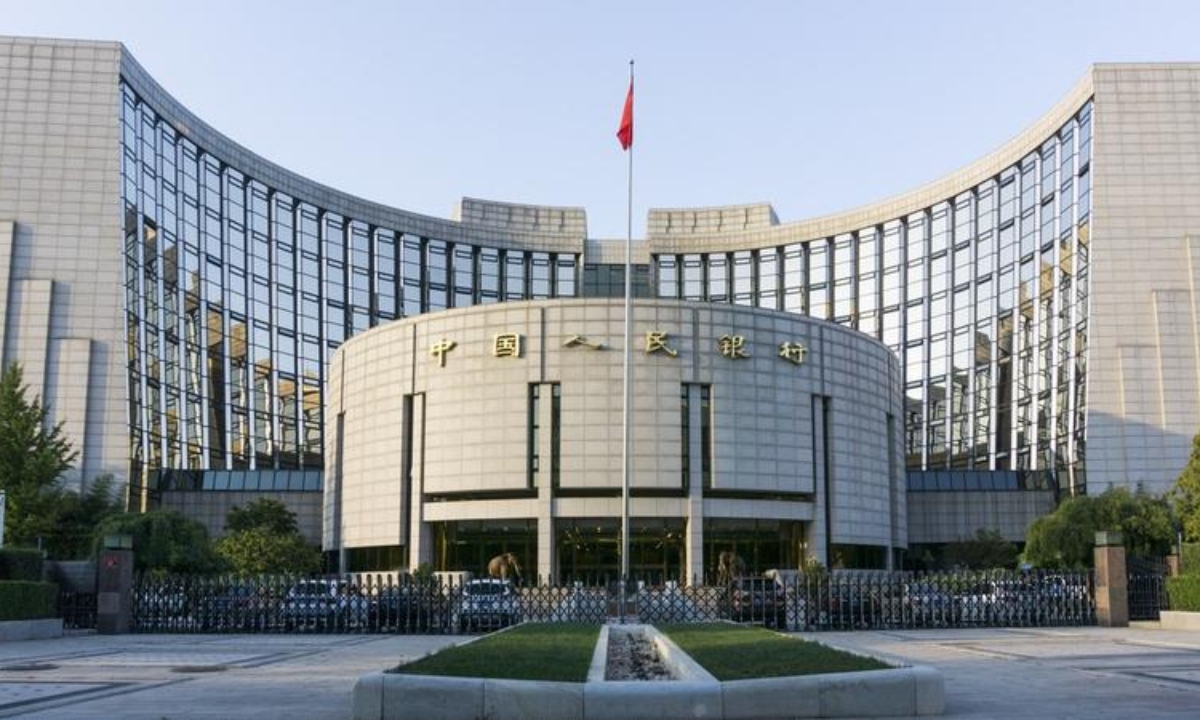
The headquarters of the People's Bank of China in Beijing Photo: IC
Experts said that the move represents an important step in the development of the digital yuan, and will help strengthen the safety, stability and efficiency of China's digital yuan sector, while providing an open and inclusive Chinese solution for improving cross-border trade and investment.
"The Recommendations of the Central Committee of the Communist Party of China (CPC) for Formulating the 15th Five-Year Plan for National Economic and Social Development state that 'we should work faster to boost China's strength in finance' and 'the digital yuan should be steadily developed,' which provides guidance for the development and improvement of the digital yuan in the coming period," Lu Lei, deputy governor of the PBC, wrote in an article published in the Financial News on Monday.
The new generation of the digital yuan measurement framework, management system, operational mechanism, and ecosystem will be officially launched and implemented on January 1, 2026, Lu wrote.
The move responds to new demands from the real economy and the financial system for the issuance, circulation, and use of the digital yuan, keeps pace with the historical evolution of the international monetary system, and effectively enhances the quality, efficiency and service capabilities of the digital yuan's management, according to Lu.
"Considering intense international financial competition during the 15th Five-Year Plan period (2026-30), the rollout of the action plan marks an important step in the development of the digital yuan," Dong Shaopeng, a senior research fellow at the Chongyang Institute for Financial Studies at Renmin University of China, told the Global Times on Monday.
It will help strengthen the safety, stability and efficiency of China's digital yuan, contribute to enhancing China's influence in the international financial system and provide an open and inclusive Chinese solution for improving cross-border trade and investment, Dong said.
Pilot programs for the digital yuan have yielded positive results, with the digital yuan taking the lead among the trial projects undertaken by various central banks.
China's digital yuan ecosystem has taken preliminary shape, with the cumulative transaction value reaching 16.7 trillion yuan ($2.38 trillion) as of the end of November, according to the PBC.
A total of 3.48 billion transactions had been processed by the end of November, with 230 million personal wallets opened via the digital yuan app, official data showed.
The multi-Central Bank Digital Currency Bridge (mBridge) - a platform jointly developed by the PBC, the Hong Kong Monetary Authority, and other central banks to facilitate faster cross-border settlements using their respective currencies - has handled a cumulative total of 4,047 cross-border payment transactions, with a cumulative transaction amount equivalent to 387.2 billion yuan, the PBC said.
The digital yuan accounts for approximately 95.3 percent of the transaction amounts in various currencies, according to the PBC.
"The digital yuan serves as a significant and strategic solution to the revolutionary landscape of global trade and investment. The high efficiency of the digital yuan will not only enhance the swiftness and convenience for global traders and investors, but also streamline the entire business chain while closely integrating new forms such as smart contracts with the digital currency," Bian Yongzu, executive deputy editor-in-chief of Modernization of Management magazine, told the Global Times on Monday.
As China's high-standard opening-up deepens in the finance and services sectors, progress in the cross-border use of the digital yuan is highly aligned with the demand to ensure capital security and improve capital utilization efficiency, and thereby further contribute to the country's opening-up, Bian added.
In September, China's international operation center for the digital yuan officially began operations in Shanghai, the country's financial hub, according to the local government.
Along with its launch, the center unveiled three major platforms - a cross-border digital payment platform, a blockchain service platform and a digital asset platform.
"The cross-border use of the digital yuan will continue to expand its access scope, reduce service costs, and support the facilitation of cross-border trade and investment through technological iteration. It will also back the innovation of offshore financial services and promote high-level, institutional opening-up," Lu wrote in the article.
RELATED ARTICLES