China-Cambodia-Thailand FMs' meeting reaches 3-point consensus in Yunnan
Guided by Global Security Initiative, China actively facilitates peace talks
By Published: Dec 29, 2025 10:37 PM

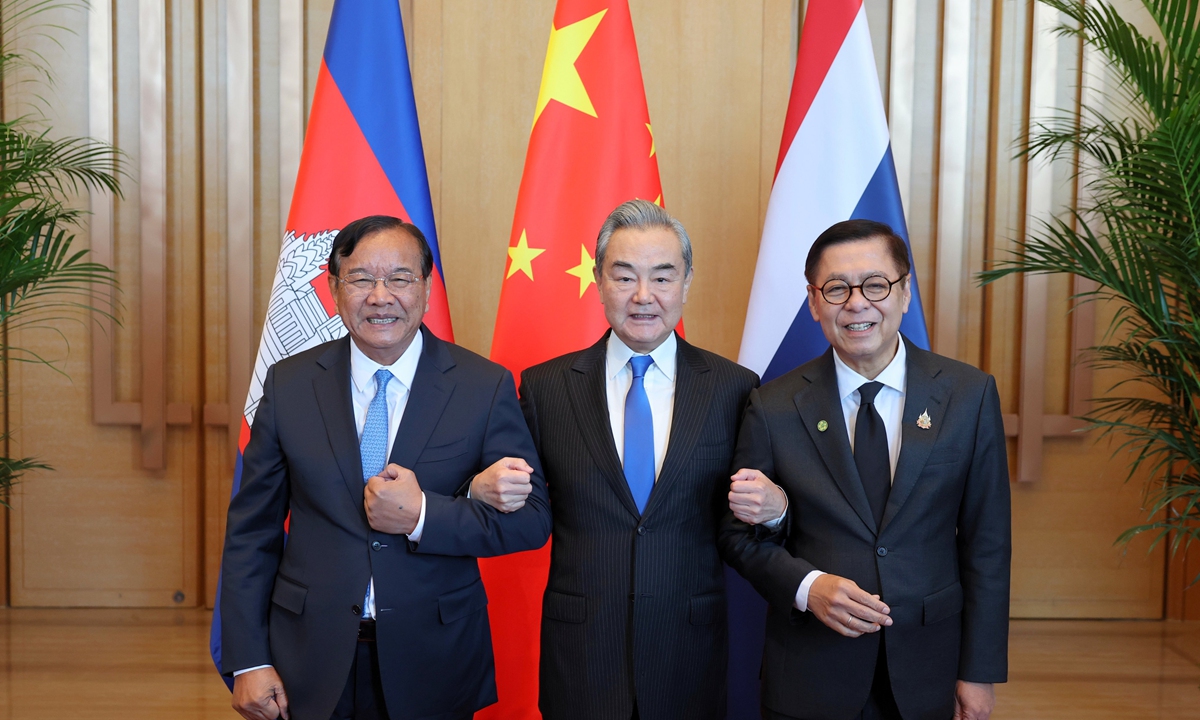
Photo: Chinese Foreign Ministry
The China-Cambodia-Thailand foreign ministers' meeting was successfully held in Yuxi City, Southwest China's Yunnan Province on Monday.
Wang, also a member of the Political Bureau of the Communist Party of China Central Committee, said the foreign affairs and military authorities of Cambodia and Thailand have held in-depth exchanges on this matter, and both sides are committed to de-escalating the situation and are willing to improve bilateral relations on the basis of the ceasefire, Xinhua News Agency reported.
Wang added that the discussions among the three parties have been constructive and productive, leading to important consensuses as following:
First, all parties should look ahead and move forward together. Second, progress should be steady and incremental, avoiding stagnation. Third, rebuilding mutual trust is paramount.
After the trilateral meeting, a press communique was issued, which made it clear from five aspects that Cambodia and Thailand will further enhance communication, deepen understanding, and gradually consolidate the ceasefire situation, restore mutual exchanges, rebuild political mutual trust, achieve a turnaround in relations, and maintain regional peace, Xinhua reported.
Following the signing of a joint statement agreeing to a ceasefire, Cambodian and Thai foreign ministers led delegations to meet in Yunnan from Sunday to Monday at the invitation of Wang.
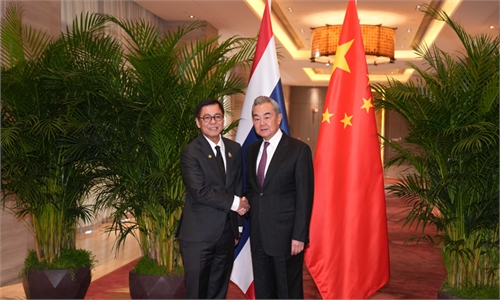
On Sunday, Wang also held separate bilateral meetings with Prak Sokhonn, Cambodian Deputy Prime Minister and Minister of Foreign Affairs and International Cooperation and Minister of Foreign Affairs of Thailand Sihasak Phuangketkeow, during which Wang noted that China supports ASEAN in playing its due role and stands ready to provide assistance to the ASEAN observation mission in monitoring the ceasefire.
Sokhonn said that the Cambodian side highly appreciates the positive role played by China in mediating the conflict, including the meeting of the foreign ministers of Cambodia, China and Thailand, as well as shuttle mediation conducted by the Chinese special envoy.
Thailand's Sihasak also spoke highly of China's active efforts in mediating the Thailand-Cambodia conflict in an Asian way, noting that the ceasefire agreement newly signed by Thailand and Cambodia marks a fresh start, Xinhua said.
China will always work to promote Cambodia-Thailand relations, and stand ready to offer all necessary facilitation and support, including ceasefire monitoring, humanitarian assistance and de-mining cooperation, Foreign Ministry spokesperson Lin Jian said on Monday in response to an inquiry about whether China would send peacekeepers to the Thailand-Cambodia border areas.
China is heartened by the ceasefire reached between Cambodian and Thai militaries under the joint efforts of various parties. Since the border conflict began, China has, guided by the Global Security Initiative put forward by President Xi Jinping, worked actively to facilitate talks for peace, the spokesperson added.
From December 18 to 23, Deng Xijun, the Chinese Foreign Ministry's Special Envoy for Asian Affairs visited Cambodia and Thailand and engaged in shuttle diplomacy over the recent border clashes between the two countries, the Chinese Foreign Ministry said in a release on December 23.
Thanks to the joint efforts of China and other parties, Cambodia and Thailand convened a General Border Committee meeting, and the two militaries signed a ceasefire agreement, Sokhonn said, per Xinhua.
Some Chinese observers reached by the Global Times on Monday hailed that by hosting the two Southeast Asian countries that had been engaged in weeks of deadly border clashes marked China's latest efforts to consolidate the just-signed yet still fragile ceasefire, promoting consultations on border issues, and thereby contributing to the overall restoration of regional stability.
Judging from the current situation, the ceasefire following the deadly clashes remains in a relatively fragile stage. Although a ceasefire was signed on Saturday, if long-term peace and stability are to be achieved, the involvement of both sides' militaries in negotiations is crucial. The military forces of both countries should recognize the importance of the ceasefire for both parties, Gu Xiaosong dean of the ASEAN Research Institute of Hainan Tropical Ocean University, told the Global Times on Monday.
By hosting trilateral talks on its home ground, China is facilitating this process without overstepping its role in encouraging the two countries to return to dialogue. We are well aware that ASEAN plays a significant role in the ceasefire process between Thailand and Cambodia this time. China has promoted the two countries' return to the ASEAN framework for negotiations—or, in other words, resolving disputes in the ASEAN way while respecting ASEAN's central position, Ge Hongliang, vice dean of the ASEAN College at the Guangxi Minzu University, told the Global Times on Monday.
At the same time, China is committed to helping the two countries further restore and consolidate the ceasefire, promoting consultations on border issues, and thereby contributing to the overall restoration of regional stability. Through talks and meetings, promoting mutual trust at the political, security, and military levels in the border regions will be crucial in the next phase. This will help ensure substantive continuity of the ceasefire and avoid repeated cycles of "ceasefire followed soon by renewed fighting," Ge said.
The trilateral foreign ministers' meeting focused on policy coordination and the rebuilding of political mutual trust. At the same time, the Cambodia-Thailand border conflict involves more complex military and security issues. Therefore, the participation of military representatives from the three countries in direct discussions on ceasefire monitoring, border management, and other military topics has formed a complete communication chain. This helps propose more specific and feasible solutions at the military level to continuously promote lasting border peace, Song Qingrun, a professor from the School of Asian Studies at Beijing Foreign Studies University, told the Global Times.
Song also highlighted that Yunnan Province is adjacent to both Cambodia and Thailand and enjoys convenient transportation links, providing a neutral and accessible meeting environment for representatives of the three nations, while demonstrating the affinity and approachability of China's "home-field diplomacy."
Calm in hold
Both authorities of Thailand and Cambodia updated that the calm of border areas was holding after the ceasefire agreement.
Cambodian state news agency AKP reported on Monday that as of 8 am Monday, the frontline situation in Military Regions 4 and 5 along the Cambodia-Thailand border remains calm. The situation was confirmed by Maly Socheata, spokesperson of the Ministry of National Defense, during a press briefing on Monday morning.
Thailand's Second Army Area said the Thai-Cambodian border is calm with no firing, urging residents to return home under provincial security plans and report suspicious objects, local media The Nation reported on Monday.
While tensions have eased, the situation remains fragile and requires close, ongoing monitoring, the report noted.
According to the Reuters on Saturday, the ceasefire agreement was a second one in recent months in the worst fighting in years between the Southeast Asian countries.
And per BBC, almost three weeks of deadly clashes have forced nearly one million people from their homes. In a joint statement, the defense ministers of the two countries agreed to freeze the front lines where they are now, ban reinforcements and allow civilians living in border areas to return as soon as possible.
The ceasefire took effect at noon local time on Saturday. Once it has been in place for 72 hours, 18 Cambodian soldiers held by Thailand since July will be released, the statement said.
In a statement on Saturday, the UN Secretary-General Antonio Guterres welcomes the ceasefire agreement between Cambodia and Thailand as a positive step toward alleviating the suffering of civilians, ending current hostilities, and creating an environment conducive to achieving lasting peace.
China's constructive approach
From the previous round of shuttle diplomacy by China, it can be inferred that this is a process in which China seeks to understand the demands and concerns of both sides, carrying out practical actions to earnestly persuade them toward peace and promote negotiations, Ge said.
China has adopted a more flexible and balanced mediation style: on one hand, maintaining strategic composure through high-level communications; on the other, actively promoting multilateral meetings - such as previous negotiations and the trilateral meeting of foreign ministers and military representatives from the three countries in Yunnan, Ge said.
As a major regional power with very close ties to both Cambodia and Thailand, China has played an important role in shuttle mediation during the border conflict between the two countries. China has consistently maintained a strictly neutral stance, without interference or pressure, focusing instead on persuading peace and promoting talks as the core approach, thereby fostering more sustainable political mutual trust between the two nations, the expert added.
RELATED ARTICLES