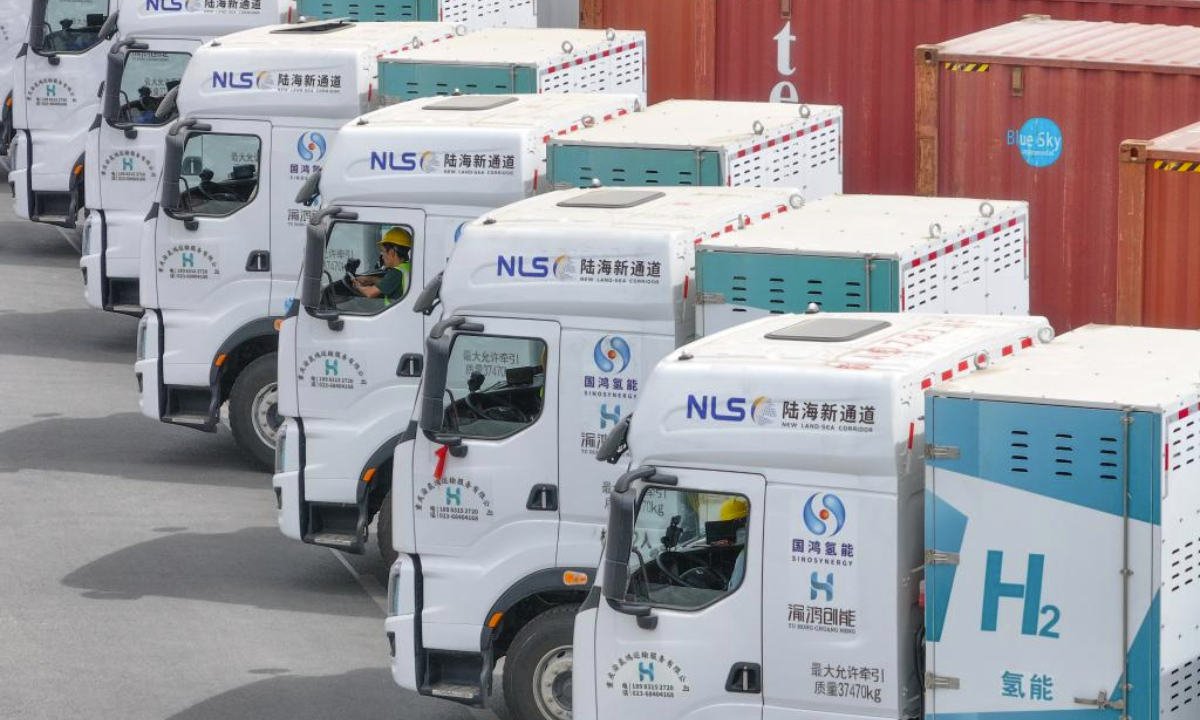
An aerial drone photo taken on April 14, 2025 shows hydrogen-powered heavy-duty trucks awaiting departure from the dry port of the New International Land-Sea Trade Corridor in Chongqing, southwest China. China's first cross-region hydrogen heavy-duty truck route was launched on Monday, marking a milestone in terms of advancing hydrogen energy development in China's western regions. The route, now operational for regular freight services via hydrogen-powered heavy-duty trucks, spans 1,150 kilometers from southwest China's Chongqing Municipality to Qinzhou Port in south China's Guangxi Zhuang Autonomous Region, passing through southwestern Guizhou Province. (Photo: Xinhua)
The recommendations for formulating Gansu Province's 15th Five-Year Plan (2026-30) for economic and social development call for closer integration between the New International Land-Sea Trade Corridor and the China-Europe Railway Express, as both routes run through Gansu, according to the Gansu Daily. This is not intended solely for Europe, yet in practice it may intersect with European trade participants in multiple ways, creating potential opportunities.
From January 1 to November 19, a total of 10,131 China-Europe (Asia) freight trains were handled at the Lanzhou North railway station in Northwest China's Gansu Province, marking a milestone of more than 10,000 trains, China News Service reported.
These services have brought substantial volumes of imported goods from Eurasian economies into China, supporting export growth from those countries and regions. Over the next five years, as the China-Europe Railway Express becomes more closely linked with the New International Land-Sea Trade Corridor, these imports are expected to reach a wider range of markets along the corridor, providing additional commercial touchpoints.
Gansu Province, according to media reports, was among the earliest provinces to participate in the construction of the New International Land-Sea Trade Corridor. The corridor links western Chinese regions through an integrated network of rail, road and maritime transport, extending southward via Guangxi, Yunnan and other Chinese provinces to global markets. Strengthening the connection between the China-Europe Railway Express and this corridor could further extend the reach of European exports, particularly in China's inland western provinces, as well as in Southeast Asia and other economies. This is not intended to replace existing routes, but to add new options and capacity.
The growing integration of the China-Europe Railway Express with the New International Land-Sea Trade Corridor helps to strengthen the transportation network across Eurasia, supporting the ongoing optimization of complex supply chains. As production across the region increasingly takes advantage of comparative strengths, goods are often manufactured in different locations before being assembled into final products. Improved transport connectivity can facilitate this process, promoting trade and economic cooperation in ways that are mutually beneficial for the economies involved in these supply chains.
Over the next five years, efforts in Gansu, an inland Chinese province, could create additional opportunities for European exporters, supporting trade flows to China. Such exports may become more deeply integrated into regional supply chains and reach a broader range of markets along the New International Land-Sea Trade Corridor.
Gansu's efforts are not unique. Both the China-Europe Railway Express and the New International Land-Sea Trade Corridor traverse multiple Chinese provinces, each actively enhancing the transport infrastructure. For instance, in June this year, an ASEAN Express carrying maternal and infant products, cosmetics, and medical supplies departed Duisburg, Germany, passed through Chongqing in China, and reached ASEAN countries such as Thailand roughly 19 days later, according to the Xinhua News Agency. The service illustrates a seamless integration between the two major trade routes, and according to Xinhua, achieves transport efficiency more than 50 percent higher than conventional maritime shipping.
In recent years, China's central and western provinces have been strengthening connectivity across their transport networks, complemented by supporting measures such as streamlined customs procedures. These efforts have contributed to the ongoing optimization of the Eurasian transportation network and form part of a broader effort by these provinces to pursue high-level opening-up and further integrate into global supply chains. To some extent, such efforts have created new opportunities for international partners, including European exporters.
It may be difficult to quantify the immediate impact of these measures on Eurasian trade. Nonetheless, the ongoing development of transport networks could provide new logistical options and create additional commercial opportunities. If these opportunities are fully utilized, they could have a positive effect on European exports to China and other parts of Asia.
These developments offer a tangible perspective on mutually beneficial China-Europe trade. In reality, the dynamics of China-Europe commerce may be more complex than some Western media outlets portray, with emerging opportunities, new business models, and evolving supply chain linkages. The story of Gansu, a Chinese province still relatively unfamiliar to some in Europe, provides a useful case in point, illustrating new developments in China-Europe trade and the concrete opportunities for European exporters.
The author is a reporter with the Global Times. bizopinion@globaltimes.com.cn
RELATED ARTICLES