Beijing Tongzhou Railway Station opens, boosting Beijing-Tianjin-Hebei connectivity
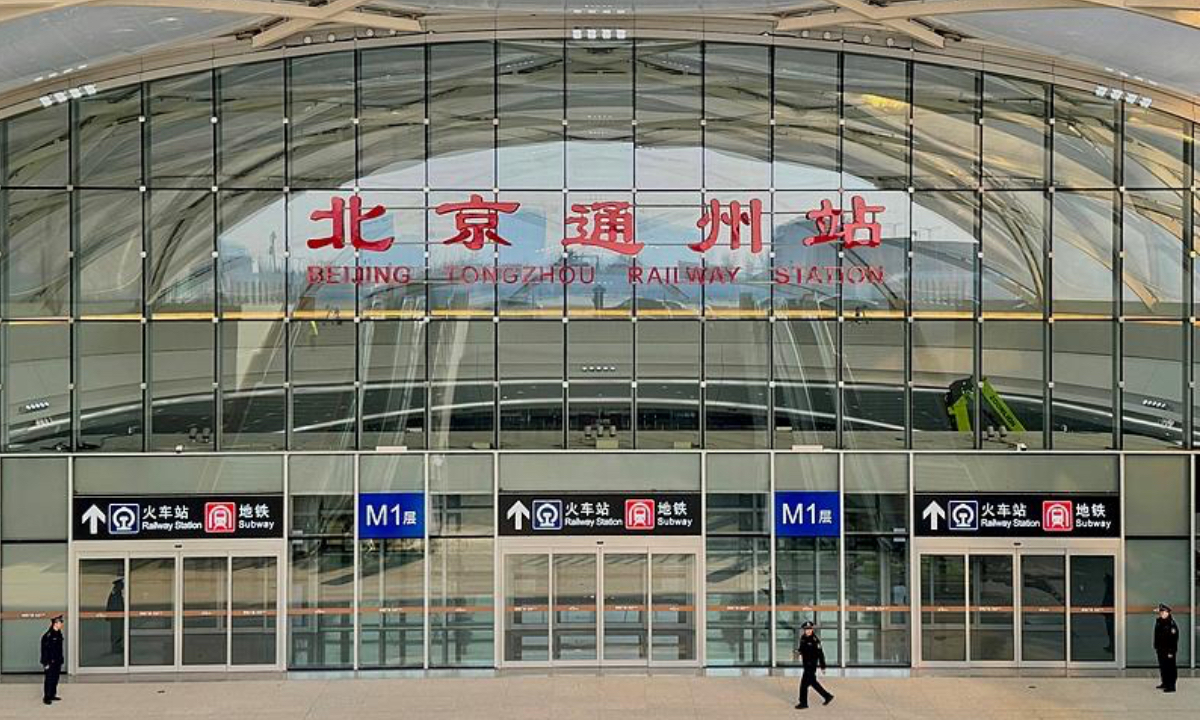
Beijing Tongzhou Railway tation, a key node in the Beijing-Tianjin-Hebei rail network and part of the capital's southeastern integrated transport hub, opens to traffic on December 30, 2025. Photo: screenshot of CMG's report
The Beijing Tongzhou Railway Station, a key node in the Beijing-Tianjin-Hebei rail network officially opened to traffic on Tuesday. Located within the capital's southeastern transport hub, this new facility will integrate high-speed, intercity and commuter rail services, according to a statement China Railway Group Co sent to the Global Times.Departing from the new station, travelers can now reach Baodi in Tianjin within just 26 minutes, with Beichen 56 minutes away and Qinhuangdao in Hebei Province accessible in under 90 minutes by intercity train. The new line expands cross-provincial travel options and brings cities in the Beijing-Tianjin-Hebei region closer, filling a critical gap in regional connectivity and boost coordinated development of the region, per the statement.
The Beijing Tongzhou Station is designed as a key hub for multi-network integration, with plans to link metro lines, intercity and suburban railways and bus services, while reserving for future cruise and airport check-in facilities, said Qin Baolai, a deputy chief engineer of China Railway Design Co, the China Media Group (CMG) reported.
The opening of Beijing Tongzhou Station marks the launch of a new "eight stations and two airports" transport hub layout for the Chinese capital. A 1-1.5 hour travel circle connecting major cities in the Beijing-Tianjin-Hebei region has taken shape, complemented by a one-hour commuter belt around Beijing, injecting fresh momentum into area's development, according to CMG.
Covering about 216,000 square kilometers and home to more than 100 million people, the Beijing-Tianjin-Hebei region is served by a rail network built around four main corridors and eight radial lines, a layout well suited to its scale and mobility needs, according to CMG.
Wang Peng, an associate researcher at the Beijing Academy of Social Sciences, told the Global Times that the Beijing Tongzhou Station will generate tangible economic benefits for the Beijing-Tianjin-Hebei region. Sharply reduced travel times are expected to strengthen industrial linkages, facilitate the spillover of high-end factors from Beijing to surrounding areas, and accelerate the division of labor in which research is concentrated in Beijing while production expands in Tianjin and Hebei.
He noted that improved rail connectivity lowers barriers to the cross-regional flow of talent, capital, and technology, helping cut operating costs for businesses and improve the efficiency of resource allocation, thereby supporting deeper industrial collaboration.
From a market perspective, Wang said the station shortens the economic distance between cities, advances regional market integration and expands firms' market accessibility. Greater connectivity is also likely to attract more external investment, injecting fresh momentum into regional growth and strengthening the region as a key economic engine.
Bian Yongzu, a senior researcher at the China Institutes of Contemporary International Relations, told the Global Times that unlike Beijing's rail hubs serving nationwide routes, the Tongzhou Station is designed to strengthen intra-regional links within the Beijing-Tianjin-Hebei region, especially connections with Tianjin and Hebei.
As Beijing's development focus shifts eastward, Tongzhou has emerged as a major hub for government bodies, businesses and talent, he noted. The station's opening sharply reduces travel times, easing cross-regional commuting constraints and supporting more efficient flows of people and resources.
RELATED ARTICLES