India invites China to AI summit, eyes balance between global tech powers: expert
By Published: Dec 30, 2025 05:17 PM

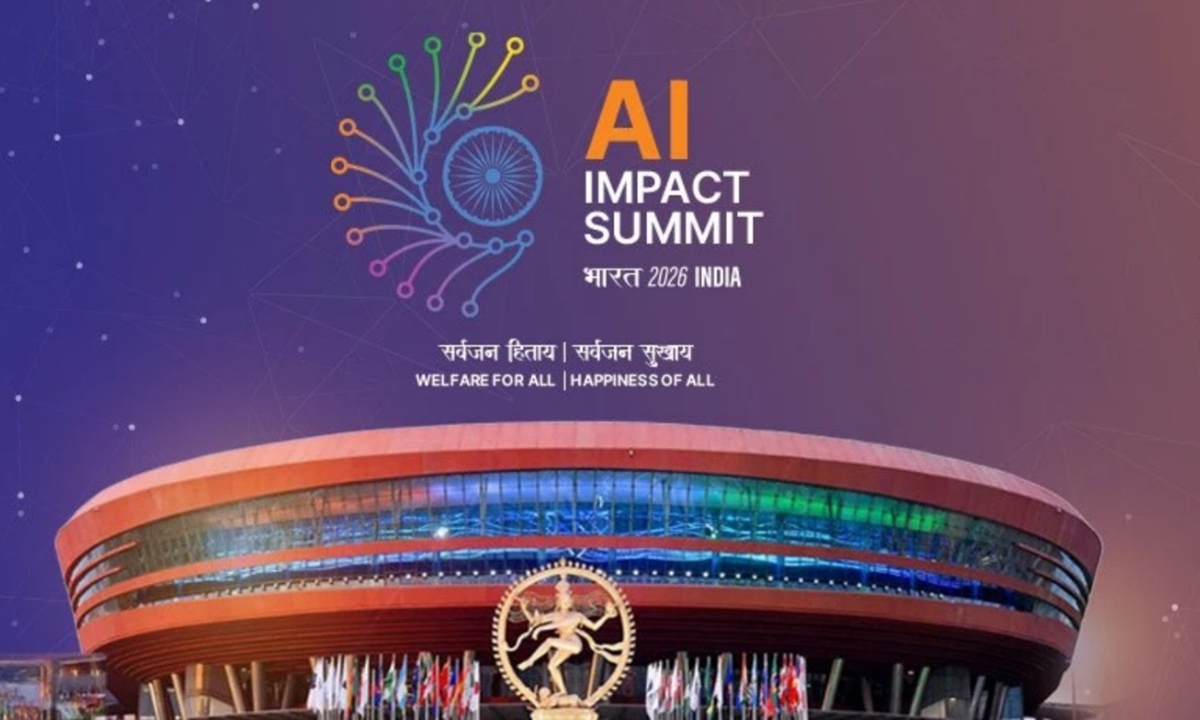
AI Impact Summit will take place from February 15 to 20, 2026 in Delhi. Photo: official website of IndiaAI
India has extended an official invitation to China to participate in its weeklong 2026 AI Impact Summit in New Delhi, Indian media reported, citing a senior government official. Analysts said the invitation reflects India's diplomatic push to engage a major player in global AI development.
The five-day India AI Impact Summit will take place from February 15 to 20, 2026. Over 50 heads of state are expected to be in attendance, said S. Krishnan, secretary of India's Ministry of Electronics and Information Technology, according to media outlet Live Mint.
"We've invited numerous nations around the world, particularly with a focus on the global south, to participate in the AI Impact Summit—and have already received confirmations from many, including France, to have them as part of it. We have also sent a formal invitation to China to take part as well," said the Indian official. Krishnan did not confirm if China will attend or not.
The report also noted that this marks the first time China has been invited as a partnering nation to India's annual AI event.
In a report published Monday, The Hindu Business Line described the invitation as "another important step in improving bilateral relations between India and China following the resumption of flights."
According to The Hindu Business Line, the AI summit in February will be inaugurated by Indian Prime Minister Narendra Modi who will also meet with and host a gala dinner for global technology leaders such as those from Microsoft, Anthropic, Google DeepMind.
India's extensive media coverage of its invitation to China—despite Beijing not yet confirming its participation—stems from a mix of practical calculations and nuanced intentions, Zhu Rongsheng, a researcher at the AI Insight Think Tank, told the Global Times.
"It reflects India's pursuit of greater diplomatic influence and a stronger voice on the international stage," Zhu explained. By inviting both China and the US, two leading AI powers, India aims to elevate its stature and influence. This move also highlights its aspiration to integrate into the core of global AI governance and position itself as a neutral, key player among major nations.
India's AI capabilities are generally viewed as belonging to the global second or third tier, Lin Minwang, deputy director of the Center for South Asian Studies at Fudan University, told the Global Times on Tuesday.
The country nevertheless holds distinct advantages in certain areas, such as a sizable pool of entry-level technical talent and a favorable international geopolitical environment. These factors contribute to its unique strengths in the field, Lin said.
The summit follows the 2023 AI Safety Summit in the UK, the 2024 AI Seoul Summit, and the 2025 AI Action Summit in France. It also aligns with India's ongoing efforts to advance its national AI strategy under the IndiaAI mission.
Live Mint also noted that China's participation in global AI discussions has become a "much-discussed factor," especially after China-origin models such as DeepSeek and Qwen rose to prominence with cost-effective AI models.
India's AI development is currently in a crucial early stage characterized by extensive strategic deployment, but Zhu said it comes with significant core deficiencies.
The progress of India's AI has consistently been constrained by multiple core challenges, including a severe shortage of computing power, with the government possessing far fewer GPUs than the US or China, further compounded by US technology export restrictions, Zhu noted. This reality is also the primary driver behind its necessity to seek external cooperation, he said.
On the question of how India can cooperate with China, Lin noted that from the perspective of application scenarios, India possesses abundant resources and vast datasets, all of which present viable opportunities for cooperation.
Zhu noted that the invitation —much like the media coverage surrounding it— also signals India's desire to improve bilateral ties with China, especially following the recent resumption of direct flights.
RELATED ARTICLES