ARTS / THEATER
Young ‘theater commandos’ ignite innovation by embracing tradition onstage
Passion over playhouse
By Li Yuche and Published: Dec 30, 2025 06:12 PM

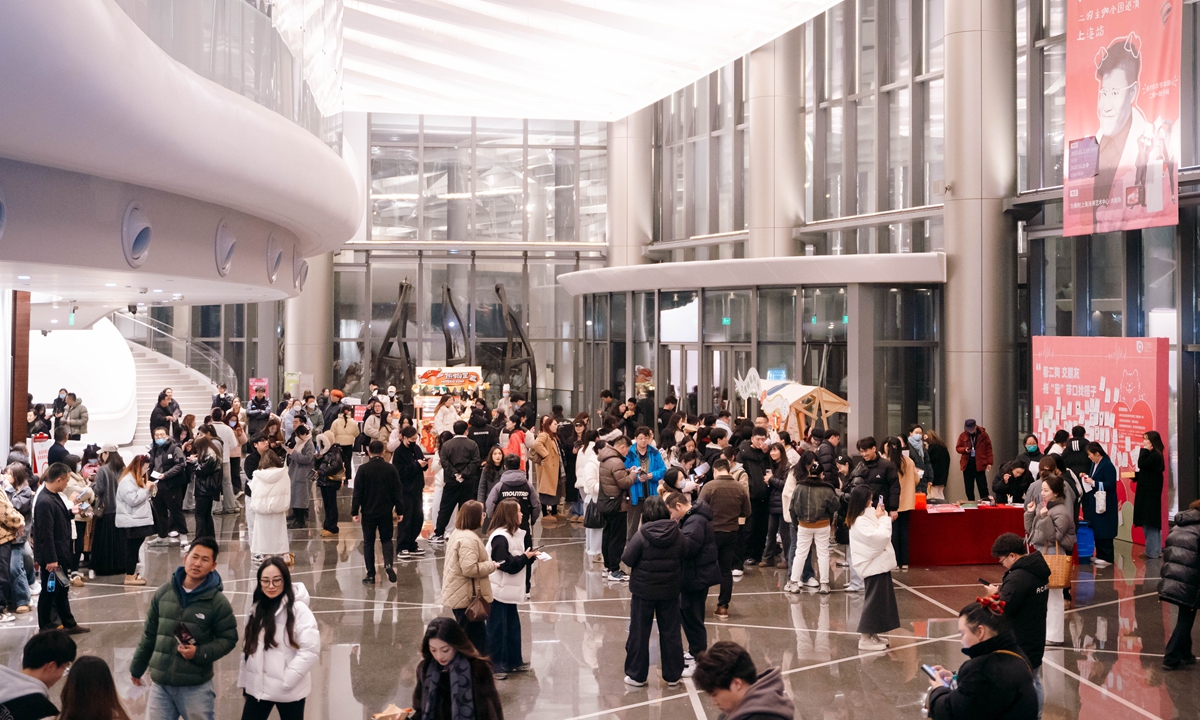
Visitors at the Nine Trees (Shanghai) Future Art Center in Shanghai Photo: Courtesy of the Nine Trees (Shanghai) Future Art Center
Starting from early December, 25-year-old illustrator Cheng Yue was busy traveling. She first arrived at Hangzhou, Zhejiang Province to watch her long-awaited musical Phantom of the Opera. Barely pausing to catch her breath after the final curtain call, Cheng hurried onward to Shanghai. There, she watched another piece in theater. It was a Chinese play called The Stage, a show Cheng had long bookmarked on her Xiaohongshu (RedNote) account.Online, "theater commando" is a term used by netizens to describe young stage art enthusiasts like Cheng. In fact, the number of them is growing in China. According to a recent report jointly released by the China Association of Performing Arts and related show organs, China's post-00s generation (born between 2000 and 2009) makes up over 23 percent of the audience for stage productions like stand-up comedy and musicals. Taking musical, the popular category as an example, audiences under the age of 35 even account for 80 percent of the entire market in 2025.
'Theater brings true friends'
As one contributor to the young consumer market, Cheng told the Global Times that dashing to the theater sometimes can harvest arts while also building her social lives.
At first, she said she often traveled alone to other cities for shows, but along the way, she discovered many fellow solo fans who shared her passion for the stage. "Just at Hangzhou this month, I made a friend with a girl sitting beside me during the performance. We compared notes and also swapped contacts," said Cheng, she also adds that theater is likely bringing her "true friends" since they "share a meeting of minds."
"Live performances can instantly foster a sense of belonging and identity among young audiences. It's a way for them to construct their cultural identity and serves as their 'social currency,'" said Chen Xijia, a performing arts expert who is also the general manager of the Nine Trees (Shanghai) Future Art Center.
Aside in real-life social circles, young people also use the "social currency" obtained from theater to carve out a distinct online social image. Born in 1998 and now based in Shanghai, Lu Xiaowei is a devoted musical fan. Her passion for stage arts has even led her to a job working in theater. As her understanding of the works deepens, she channels her reflections into words and shares them on her Xiaohongshu account.
Under the theme "A decade of youth carried by the French original version of 'Roméo et Juliette,'" Lu shared her experience about watching the musical repeatedly from 2015 to the present. She told the Global Times that without this musical, her life might have always remained "far from the stage and the live experience." For her, every visit to the theater is about receiving "love, redemption, and courage."
"Compared to bite-sized entertainment forms like short videos, theater offers both amusement and deeper humanistic educational value. It helps young people to ultimately express themselves," cultural sociologist Chu Xin told the Global Times.
Though 43, Chu admits that, like many young people, he is also an "even more dedicated theater commando." With around 25 years of experience to theater, the expert told the Global Times that it is the "fresh twists on traditional culture" that have captured a new generation of audiences.
New twists on tradition
Be it established playhouses or emerging art spaces, show organs nationwide are now mining diverse cultural niches to develop performing arts IP.
Taking the dance drama Five Stars Rising in the East that has staged at the established Beijing Tianqiao Performing Arts Center as an example, its inspiration is rooted in an archaeological discovery. In 1995, a piece of Han Dynasty (206 BC - AD 220) brocade bearing the Chinese characters for "Five Stars Rise in the East" was unearthed at the Niya ruins in Northwest China's Xinjiang Uygur Autonomous Region.
Rather than presenting an archaeological chronicle, the dance drama uses human stories and dance choreography infused with the aesthetics of western region to showcase how a piece of brocade bore witness to ethnic integration.
In Shanghai, a stage piece titled Sleep No More interprets its red-culture theme through experiential storytelling. Staging at the Nine Trees (Shanghai) Future Art Center, the show employs a multi-threaded narrative and interactive staging, allowing the audience to engage with the story by interacting directly with its characters such as the detective.
Noting that she has seen an audience watch Sleep No More as many as 11 times, Zhao Mengmeng, the centre's publicity director, told the Global Times that a traditional stage performance alone is no longer enough; theaters must provide a fully immersive experience. This sensation, she said, "cannot be replicated on a mobile device, nor can it be reproduced once you leave the theater."
"Beyond the stage, we've also developed many experiential activities, like backstage visits and behind-the-scenes tours, to help extend the audience's passion for the arts," she added.
In Beijing, venues like the Beijing Tianqiao Performing Arts Center are also upgrading their offline offerings to deliver a richer audience experience.
"At first, we just set up a simple backdrop to sell cultural merchandise. Beyond watching the show, taking photos, and buying a few products, the audience didn't have much of an experience. But now, we've recreated the actual scenes from the play in the outer lobby, allowing the audience to immerse themselves before even entering the auditorium," Yang Shucong, the general manager of Beijing Tianqiao Performing Arts Center, told the Global Times.
The evolving demands of theater commandos are also sparking innovation across the industry especially on the sector of "smart theater."
Take the Guangzhou Opera House as an example, it has pioneered the concept of an online theater since 2020, the show of Waiting for Godot 2.0 was launched as the country's first original online drama. The opera house has also developed a "Cloud Theater" powered by 5G and VR technologies.
"Technology is not an add-on for theaters, but a tool to reinvent the experience and push the boundaries," Huo Jianhua, General Manager of the Guangzhou Opera House, told the Global Times.
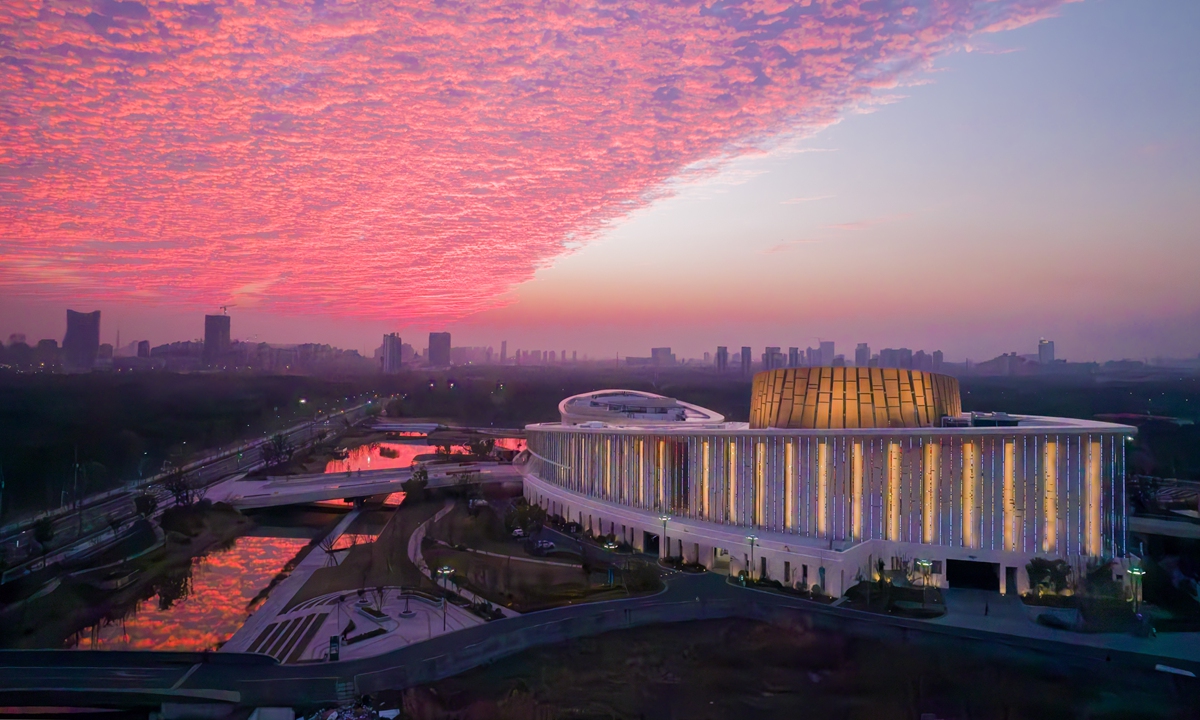
A view of the Nine Trees (Shanghai) Future Art Center in Shanghai Photo: Courtesy of the Nine Trees (Shanghai) Future Art Center
RELATED ARTICLES