Central rural work conference maps out 2026's work priorities
It is imperative to focus on agricultural and rural modernization: Xi
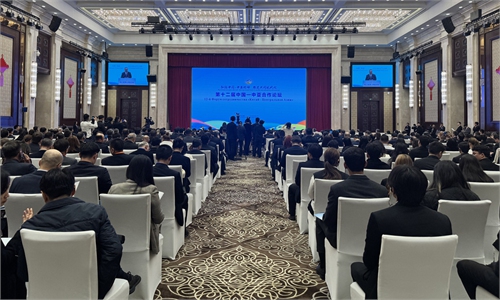
The annual central rural work conference was held from Monday to Tuesday in Beijing, mapping out priorities for the country's rural work in 2026, the Xinhua News Agency reported on Tuesday.
Prior to the conference, a meeting of the Standing Committee of the Political Bureau of the Communist Party of China (CPC) Central Committee put forward requirements for the conference and work related to agriculture, rural areas and farmers.
Xi Jinping, general secretary of the CPC Central Committee, Chinese president and chairman of the Central Military Commission, made instructions, according to Xinhua.
Xi said that the year 2026 marks the beginning of the 15th Five-Year Plan period (2026-30), and it is of vital importance to do a good job in the work related to agriculture, rural areas and farmers.
It is imperative to focus on agricultural and rural modernization, solidly advance rural revitalization across the board, and promote integrated urban-rural development, Xi said.
Efforts should be made to ensure grain production and enhance the efficacy of policies that strengthen agriculture, benefit rural residents, and enrich rural areas, Xi said.
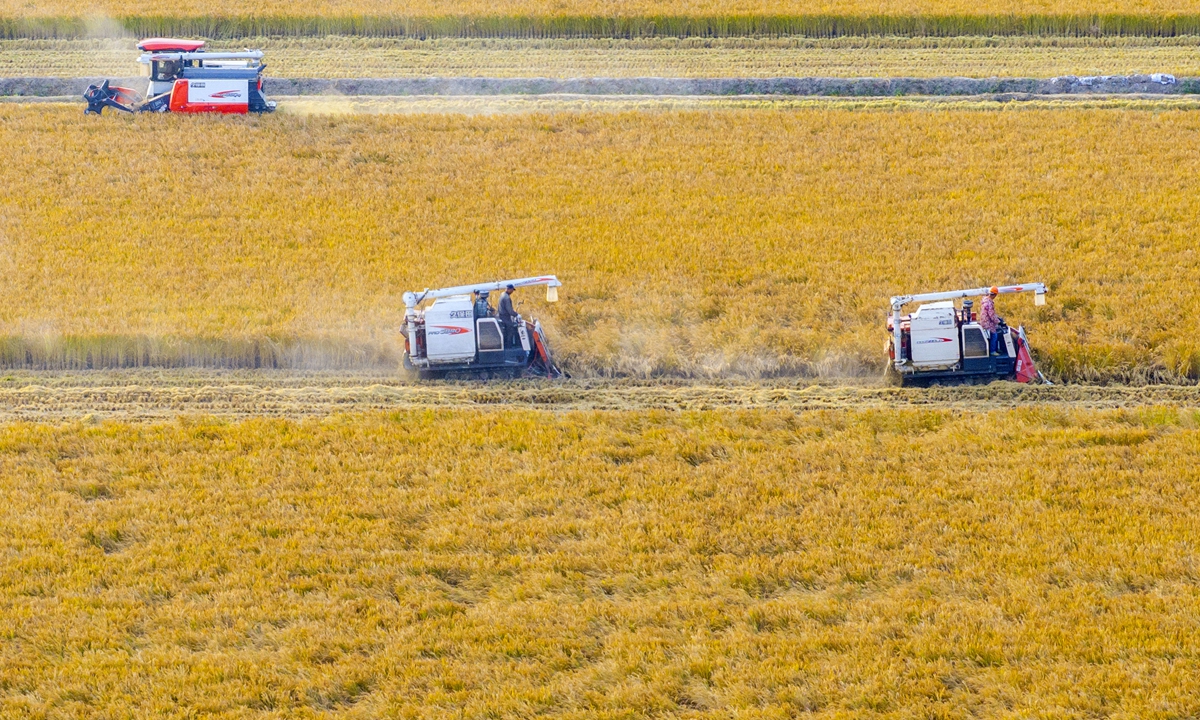
Farmers harvest rice with automatic machinery in Nantong, East China's Jiangsu Province on November 2, 2025. China has been in a rush to harvest autumn grain crops, the mainstay of the country's annual grain production, as it seeks to achieve another bumper harvest this year despite unfavorable weather conditions affecting some regions. Photo: VCG
The meeting came after this year's Central Economic Work Conference, which emphasized coordination in development to facilitate integrated urban-rural development. It also came as recommendations for the 15th Five-Year Plan called for securing "faster progress in building up China's strength in agriculture."The policy signals underscore China's sustained push toward higher-quality rural development as it prepares to enter the 15th Five-Year Plan, Chinese economists said, adding that with food security remaining the foundation, greater emphasis on technology application and farmers' income growth is expected to enhance economic resilience amid global uncertainty.
Agricultural foundation
According to Xinhua, the conference on Tuesday reviewed a draft of the opinions issued by China's central authorities on anchoring agricultural and rural modernization and advancing all-around rural revitalization.
China usually releases its annual "No.1 central document" at the beginning of each year. As the first policy document issued by the country's central authorities, it is seen as an indicator of policy priorities.
Cong Yi, a professor at the Tianjin School of Administration, said that work related to agriculture, rural areas and farmers has long been placed high on the central policy agenda. "The top-level policy arrangements outlined at Tuesday's conference will lay the groundwork and set the tone for the 2026 'No.1 central document,'" Cong told the Global Times on Tuesday.
Stabilizing and safeguarding grain production capacity remains central to China's agricultural modernization, in line with the priorities underscored at this year's meeting, Cong said, adding "China has long stressed the need to safeguard the food security baseline, with steps such as protecting arable land, building high-standard farmland and supporting major grain-producing regions seen as basic, long-term tasks.
This year's central rural work conference called for steps to stabilize grain and oil production, advance a new round of the grain production capacity enhancement initiative, and strengthen diversified food supply capacity, according to Xinhua.
Li Guoxiang, a research fellow at the Rural Development Institute of the Chinese Academy of Social Sciences, further pointed to the meeting's greater emphasis on improving high-quality development in rural works. "While ensuring the supply of key agricultural products remains a priority, future efforts will focus more on upgrading quality and efficiency to better meet consumption demand driven by rising living standards," he added.
Tuesday's conference also stressed the necessity to take all possible measures to ensure steady growth in farmers' incomes and improve income support mechanisms for grain growers.
Such priorities echo China's 2025 No.1 central document, released in February, which called for every effort to enhance agricultural efficiency, invigorate rural areas and increase farming incomes, thereby laying a solid foundation for the advancement of Chinese modernization.
Innovation in action
Among the policy priorities, the conference also called for stepped-up efforts to secure breakthroughs in critical agricultural technologies, accelerate the translation of scientific research into practical application, and develop new quality productive forces in agriculture in light of local conditions.
"This policy direction reflects the growing role of technological empowerment in the agricultural sector," Cong said. "It is manifested through measures such as increased investment and stronger institutional support to improve seed security, as well as the broad potential for applying digital technologies."
He noted that digital empowerment can enhance the efficiency of resource allocation, support a shift toward more intensive and efficient production models, and facilitate coordinated upgrading across related industrial chains.
In 2025, China made a series of notable advances in revitalizing its seed industry. The country's seed security continued to strengthen, with domestically bred crop varieties accounting for more than 95 percent of those in use, reinforcing the security of agricultural seed supply, Xinhua reported on December 17.
Meanwhile, innovation in smart agriculture continued to gain momentum in 2025. Breakthroughs were achieved in 62 types of intelligent equipment, including phenotyping robots for field crops, precision feeding systems and feed-pushing robots, according to China Central Television (CCTV).
China's agricultural sector is transitioning from traditional factor-driven development to a stage that relies more on technology, efficiency, and structural optimization, Li said, adding that this shift will serve as a vital foundation for advancing agricultural and rural modernization and supporting Chinese modernization."
"The development of new quality productive forces can drive the transformation and upgrading of agricultural production, boosting comparative returns while providing a more solid basis for sustained income growth among farmers," he added.
Pillar of resilience
Agricultural and rural modernization has a major bearing on Chinese modernization as a whole and the outcomes it delivers, according to the CPC Central Committee's recommendations on formulating the 15th Five-Year Plan for National Economic and Social Development. It calls to give top priority to the issues related to agriculture, rural areas, and rural residents, and promote integrated urban-rural development.
As a country with a large population, China's grain production and food security serve as critical pillars in mitigating external risks, Cong said. China's rising food security, built on a push for agricultural modernization and steadily increasing grain output, has emerged as a key buffer against global instability, Cong added.
According to official data, as of 2024, China's total grain output surpassed the milestone of 1.4 trillion jin for the first time. In the same year, the country had also cumulatively developed over 1 billion mu (66.7 million hectares) of high-standard farmland.
Both Cong and Li said the achievements in agricultural and rural modernization during the 14th Five-Year Plan period will lay a solid foundation for the development of related areas in the upcoming next five-year plan.
RELATED ARTICLES