US’ divestment order on HieFo's acquisition of Emcore assets highlights anxiety, harms its innovation: expert
By Published: Jan 03, 2026 01:57 PM

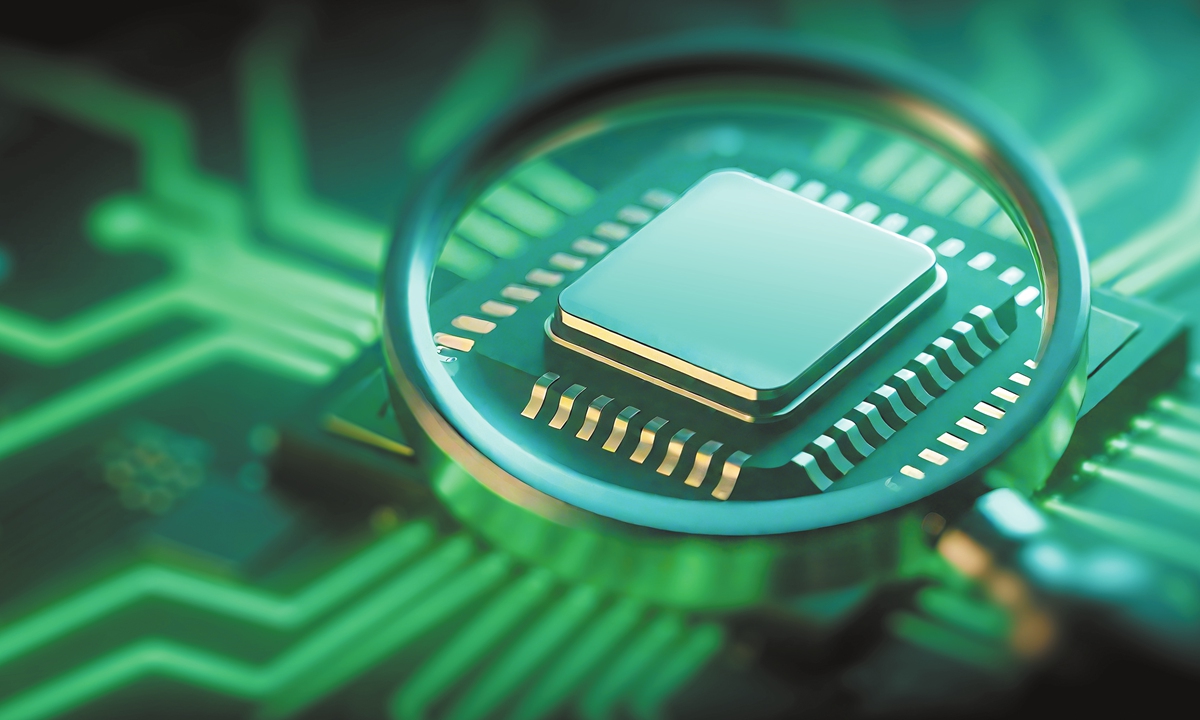
Chip Photo: VCG
The US' divestment order on HieFo's acquisition of Emcore assets reflects Washington's anxiety over technology competition with China, and as the order is made on national security grounds without providing convincing rationale, it will dampen the merger and acquisition landscape for small and medium-sized US tech companies, harming US competitiveness in innovation, a Chinese expert said on Saturday.US President Donald Trump on Friday ordered the unraveling of a $2.9 million computer chips deal that he claimed threatened US security interests if the current owner, HieFo Corp, remained in control of the technology, the Associated Press (AP) reported.
The US executive order cast a spotlight on a business deal that drew scant attention when it was announced in May 2024. The deal involved aerospace and defense specialist New Jersey-based Emcore Corp selling its computer chips and wafer fabrication operations to Delaware-based HieFo for $2.92 million — a price that included the assumption of about $1 million in liabilities, according to the AP report.
But the executive order is now demanding that HieFo divest that technology within 180 days, citing "credible evidence" that the current owner is a citizen of China, according to a statement on the White House website. The Committee on Foreign Investment in the United States, in a statement on Friday, claimed that it identified a national security risk arising from the transaction.
Zhou Mi, a senior research fellow at the Chinese Academy of International Trade and Economic Cooperation, told the Global Times on Saturday the move is reflective of the anxiety among some US politicians about losing in a tech competition with China and of their attempt to crack down on China with baseless claims.
HieFo Corp is a US company whose main market and clients are all based in the US. It stepped in when the Emcore Corp asset in question ran into financial difficulties, and now the US administration intervenes in this deal, causing operational difficulties for the companies as they are ordered to divest in such a short period of time, Zhou said.
Overall, the case will set up a bad example for the merger and acquisition landscape in the US, sending jitters among potential investors of smaller US innovation companies that are in financial trouble, and hence affect the overall innovation in the US, Zhou said, adding that it will also have a negative impact on the global semiconductor industrial and supply chain as well.
Notably, the US has implemented a series of chip export restrictions in an effort to contain and suppress China's technological development in recent years.
When asked to comment on a US trade representative investigation which claimed it had found that China has employed unfair tactics to dominate the semiconductor industry and that China should be punished for this in the form of tariffs that will take effect in 2027, Chinese Foreign Ministry spokesperson Lin Jian told a regular press conference on December 24 that China firmly opposes the US slapping tariffs and going after Chinese companies and the US practice destabilizes global industrial and supply chains, stifles other countries' semiconductor industry, and serves no one's interests.
"We urge the US to correct its wrongdoings at once, act according to the important common understandings reached between the Chinese and US presidents, uphold the principles of equality, respect and mutual benefit, resolve each other's concerns through dialogue, properly manage differences, and keep China-US relations on a steady, sound and sustainable track," Lin said.
If the US continues down the wrong path, China will take corresponding measures to firmly safeguard its legitimate rights and interests, said Lin.
RELATED ARTICLES