China’s tourism market sees robust growth in New Year holidays
Sustained consumption momentum expected for 2026: expert

Tourists greet the first rays of sunlight of the New Year at the Mutianyu section of the Great Wall in Beijing, capital of China, on January 1, 2026. Photo: VCG
China's consumer market saw a strong start during the 2026 New Year holidays, which ran from Thursday to Saturday, with the tourism sector posting robust growth, highlighted by rising flight volumes, hotel bookings and shopping activity, according to industry data.
The trend underscores improving consumer confidence in the tourism sector, a bellwether for household spending, as well as a gradual shift toward services-led consumption, with travel, dining and cultural activities translating into sustained spending momentum, industry insiders and analysts said.
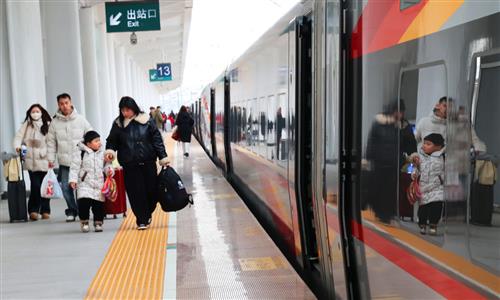
This year's three-day New Year holidays are two days longer than in 2025, with nearby trips, extended long-distance travel, and inbound tourism overlapping to push overall travel demand to a record high, according to data sent to the Global Times by travel platform Qunar on Saturday.
Hotel bookings at popular destinations during the New Year holidays rose 50 percent year-on-year, while hotel and homestay reservations made by Qunar users covered more than 1,000 county-level regions nationwide, excluding county-level cities and urban districts, according to Qunar data.
Qunar data also show that air ticket bookings to popular destinations during the New Year holidays increased 20 percent year-on-year, with flights to smaller airports in cities such as Pu'er in Southwest China's Yunnan Province surging by more than twofold.
Rising travel activity has been accompanied by stronger shopping demand. On Saturday, Chinese travel platform Fliggy released its 2026 New Year Holiday Travel Snapshot, which showed that both consumers' willingness to travel and their spending power increased during the holiday period. The average number of items purchased per traveler increased by more than 20 percent year-on-year, while average spending per traveler climbed by over 30 percent from a year earlier, according to the report.
Another travel service provider, Tongcheng, told the Global Times on Saturday that bookings for major products, including air tickets, hotels and homestays recorded increases in both volume and prices around the New Year holidays. The strong supply and demand dynamics seen during the first holidays of the year have also provided a solid start for the growth of China's cultural and tourism consumption market in 2026.
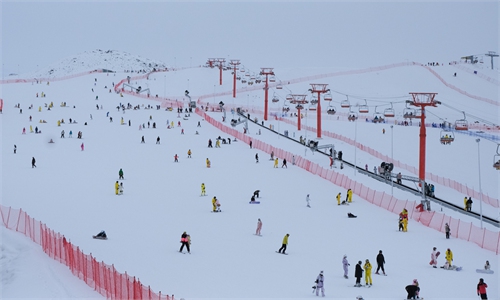
As a key barometer of winter travel trends, ice and snow tourism firmly took center stage during the New Year holidays. According to Tongcheng, routes related to ice and snow tourism accounted for about 40 percent of the top 20 most popular domestic flight routes during the holiday period. Bookings for one-day tour products at Harbin Ice and Snow World in Harbin, Northeast China's Heilongjiang Province, rose by more than 45 percent month-on-month.
"Visitor numbers rose about 50 percent from a year earlier. Compared with previous years that included a short holiday, traffic was also up by at least 20 percent," Liu Yu, a public relations manager at the Wanlong Ski Resort in Chongli, Zhangjiakou, North China's Hebei Province, told the Global Times on Saturday. He noted that attendance reached around 12,000 on Friday alone, and while total figures are still being compiled, overall visitor growth is conservatively estimated at more than 30 to 40 percent.
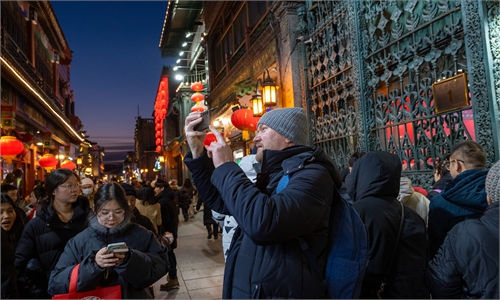
Notably, a growing number of foreign travelers are choosing to spend the New Year in China. Data from Qunar showed that during the holiday period, travelers holding non-Chinese passports booked domestic flights to destinations across 97 cities nationwide. South China's Hainan's cultural and tourism market gathered momentum, with the number of foreign visitors entering Hainan's Sanya surging fivefold year-on-year.
Another report from Trip.com showed that the inbound tourism market maintained strong growth during the New Year holidays, with attraction ticket bookings surging 110 percent year-on-year and reservations for experiential inbound travel products jumping more than 30-fold. Popular destinations included Shanghai, Beijing, Shenzhen, Guangzhou, and Hangzhou.
The New Year holidays can be seen as a window through which the effects of pro-consumption policies are becoming increasingly visible, including measures to facilitate inbound travel as well as polices such as island-wide special customs operations in the Hainan Free Trade Port, Yang Jinsong, an expert with the China Tourism Academy, told the Global Times on Saturday, noting that these measures are continuing to drive growth.
"As cultural and tourism consumption is gradually transforming into sustained spending power, the consumption structure is also shifting toward services-led consumption. At the same time, the industry is stepping up efforts for high-quality development to better meet these evolving demand patterns," Yang said.
The strong performance of the New Year holidays has given the tourism and consumption sectors a solid start to the year. With longer Spring Festival holidays in February, tourism consumption is expected to gain further momentum and could reach new records, Yang said.
RELATED ARTICLES