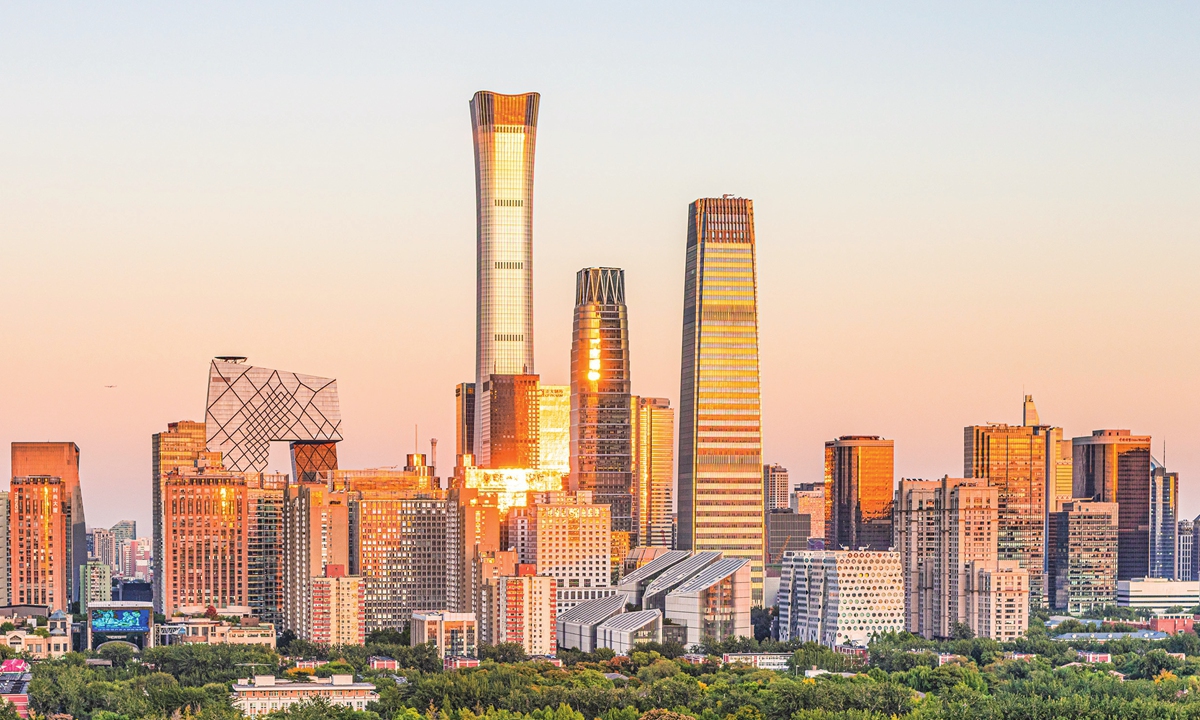
A view of the skyline of Beijing's CBD area. Photo: VCG
Looking ahead to 2026, China's economy is set to embrace multiple major opportunities. As the beginning of the 15th Five-Year Plan period (2026-30), the economy is expected to further overcome challenges and pressures, supported by positive trends and favorable conditions. Growth is expected to follow a steady upward trajectory across the quarters, remaining within a reasonable and stable range.China's economic momentum in 2026 is expected to be supported by at least three major drivers. First, the beginning of the 15th Five-Year Plan (2026-30), combined with moderately forward-looking strategic investments, will create fresh avenues for growth. Second, more proactive fiscal policies and accommodative monetary measures are poised to take effect, providing further support for economic recovery. Third, the ongoing repair of corporate balance sheets and early signs of reduced involution-style competition at the industry level are expected to unleash renewed vitality on the basis of a recovering macroeconomy.
These factors are expected to drive steady and positive growth in 2026. The implementation of proactive and effective macro policies to harness these opportunities will provide crucial support for achieving national economic and social development goals.
During the 15th Five-Year Plan period (2026-30), China's economy is expected to maintain steady and healthy growth. The focus of growth is gradually shifting from scale expansion toward higher quality and efficiency, with GDP growth likely to remain in the medium-to-high range. Economic development will become more sustainable, stable, and coordinated, laying a solid foundation for achieving the country's long-term vision for 2035, basically achieving socialist modernization.
Structurally, the industrial sector will continue to upgrade, and investment will remain a key driver, with composition and efficiency improving. Investment vitality is expected to further strengthen in 2026. Fiscal policy will increasingly emphasize quality and effectiveness, enhancing both the precision and sustainability of proactive measures. The balance of international payments is likely to remain broadly stable, providing stronger resilience against external risks.
The recent Central Economic Work Conference set the tone for China's economic agenda in 2026, outlining major priorities. At the core of these priorities is the emphasis on domestic demand as the main driver, building a strong domestic market, promoting domestic circulation, and expanding new space for internal consumption growth. The conference stressed that proactive and effective macroeconomic policies should be implemented to sustain the expansion of domestic demand while improving the quality of supply.

Liu Xiaoguang Photo: Courtesy of Liu Xiaoguang
Currently, China's economy is at a critical stage of transformation and high-quality development. Among the major priorities set for 2026, the foremost is to uphold domestic demand as a key driver and build a robust domestic market. This clear policy guidance is based on a precise assessment of China's current economic conditions.
Unlocking domestic demand will play a central role in realizing China's economic potential. On the demand side, effectively boosting consumption and stabilizing investment can release substantial growth potential. On the supply side, improving the quality of supply while enhancing innovation will cultivate new sources of growth.
Multiple policy dividends and strategic initiatives are expected to open up new growth space. The beginning of the 15th Five-Year Plan period (2026-30), coupled with moderately forward-looking investment, will provide sustained momentum for growth. More proactive fiscal policies and moderately accommodative monetary measures will work in tandem to support the economy's recovery.
Regarding monetary policy, the Loan Prime Rate (LPR) has remained largely unchanged since a minor 10-basis-point cut in May 2025, indicating room for further easing in 2026. On the fiscal side, ongoing debt resolution, rising revenues, and improved balance sheets at the local level expands policy space.
During the 15th Five-Year Plan period (2026-30), significant investment is expected in building a modern industrial system, strengthening the domestic market, promoting regional coordination, advancing technological innovation and new quality productive forces, supporting high-quality population development initiatives. These forward-looking investments are expected to significantly bolster economic growth in 2026.
In 2025, macroeconomic adjustments have already shown positive results: asset prices have been reshaped, corporate balance sheets continue to repair, core CPI has steadily recovered, and the performance of the stock market assets is also improving. Monetary policy remains accommodative, and fiscal policy space is enhanced through continued debt resolution and revenue recovery, providing strong support for policy implementation.
Looking ahead, China will further build an efficient growth mechanism driven by domestic demand, enhance residents' consumption capacity and willingness, optimize the consumption environment, cultivate emerging consumption hotspots, and promote consumption upgrading. At the same time, new quality productive forces will lead industrial upgrading, accelerate the development of strategic emerging industries, transform and enhance traditional industries, and promote deep integration between manufacturing and services, providing sustainable momentum for high-quality development.
The author is Vice Dean of the National Academy of Development and Strategy, Renmin University of China. bizopinion@bizopinion.globaltimes.com.cn
RELATED ARTICLES