China’s transport sector indicators signal robust economic growth momentum in 2025: data
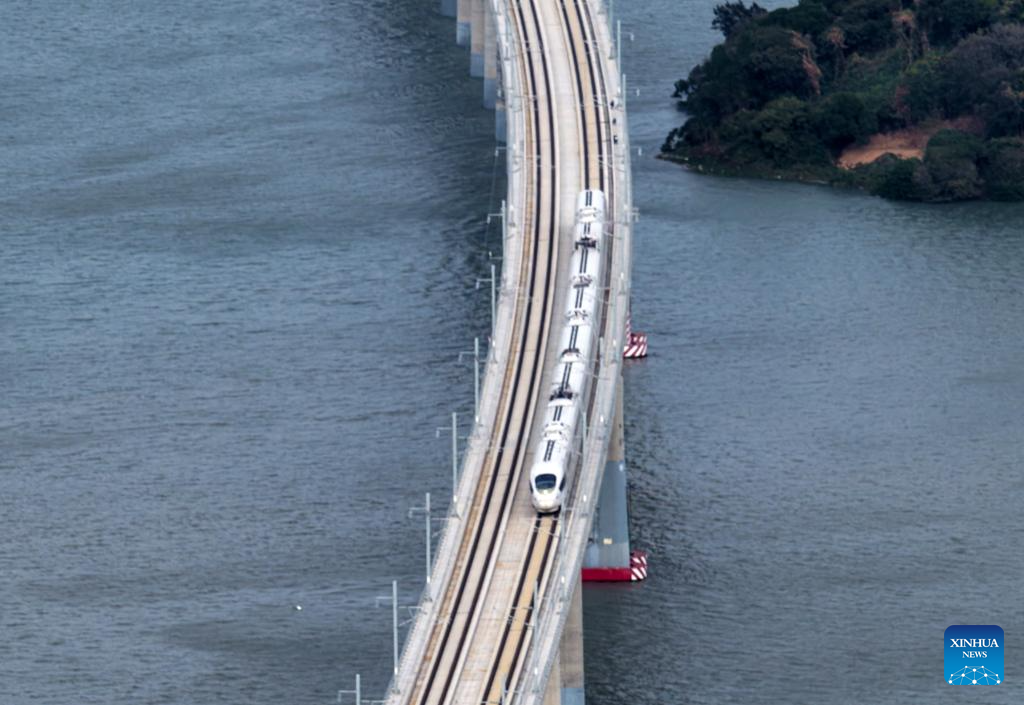
This photo taken on Dec. 22, 2025 shows a high-speed train running on the Haojiang grand bridge in south China's Guangdong Province. The Shantou-Shantou South section of the 162-km-long Shantou-Shanwei high-speed railway was completed and opened to traffic on Monday, marking the full-line operation of the railway. (Photo by Yao Jun/Xinhua)
China’s key transport development indicators posted steady growth this year, with cross-regional passenger trips exceeding 66 billion, official data showed. Experts said the strong figures underscore the economy’s robust momentum.
The nation’s commercial freight volume surpassed 58 billion tons, both rising by about 3.5 percent year on year, Li Yang, vice minister of transport, said at a press conference on Tuesday.
Li noted that the transport sector’s economic performance this year has remained generally stable, with steady progress. He added that the achievements are broadly in line with the country’s overall economic development.
A Chinese analyst said steady growth in passenger and freight flow points to resilient domestic demand and stable economic activity. Despite external uncertainties, the data shows supply chains remain smooth, services demand is holding up, and mobility and investment continue to underpin growth.
The steady growth of those indicators underscores the continued release of China’s underlying economic momentum, with production and consumption increasingly synchronized and cross-regional mobility of resources becoming more efficient, Wang Peng, an associate researcher at the Beijing Academy of Social Sciences, told the Global Times on Tuesday. “Amid lingering external uncertainties, the ability of transport indicators to maintain steady growth reflects the economy’s solid resilience to shock.”
He said the expansion of metropolitan transport networks and the strengthening of hub functions are further driving population and industrial clustering, fostering a virtuous cycle of coordinated regional economic development.
In particular, foreign trade container throughput at ports rose by about 9.6 percent, international air cargo surged 20 percent, and express delivery volumes increased by roughly 13.5 percent.
The nation is expected to complete more than 3.6 trillion yuan in fixed-asset investment in the transport sector this year, with over 2,000 kilometers of high-speed railway, about 8,000 kilometers of expressways, and roughly 900 kilometers of high-grade inland waterways newly added. Five newly certificated civil transport airports are also expected to enter operation.
Notably, China also saw faster development of new quality productive forces in the transport sector this year.
The Minister of Transport has issued an action plan on “AI plus transport” and launched the development of a comprehensive transport large-scale model, the vice minister said.
China has completed digital upgrades to about 1,700 kilometers of expressways and more than 2,200 road and waterway auxiliary facilities so far this year. The country has also built 60 automated container and bulk cargo terminals, while China’s domestically made C919 aircraft have safely carried more than 3 million passenger trips in total, Li said.
Strong performance reflects a continued improvement in the nation’s transport service capacity, Li said.
At present, 54 cities operate urban rail transit networks with a combined length exceeding 11,000 kilometers, carrying more than 90 million passenger trips per day on average. Eighty-three point three percent of hub airports are now connected to rail transit systems, he added.
To better meet the travel needs of elderly passengers, service quality has been upgraded, with 1,450 senior-friendly bus routes and more than 11,000 customized bus services launched in major cities nationwide.
The rebound in cross-regional passenger movements, freight volumes and international air cargo indicates smoother linkages across production, distribution and consumption, according to Wang.
Wang said the continued expansion of the transport system and gains in operating efficiency will provide greater support for economic recovery and balanced regional development. Large-scale transport infrastructure investment helps stabilize effective investment and generates strong spillover effects across industrial chains, while a more integrated network lowers logistics costs, improves factor mobility and strengthens inter-regional linkages, laying a firmer foundation for high-quality growth.
During the 14th Five-Year Plan (2021–25) period, China has invested substantial funds to enhance the overall strength of its transport system.
Guo Jingdong, another official from the ministry, said that the construction of a national integrated transport network has made outstanding progress during the period, with fixed-asset investment in transport totaling 18.8 trillion yuan, significantly boosting transport capacity and operational efficiency.
RELATED ARTICLES