2025 Yearender: China as a visionary power in a turbulent world
Strategic foresight serves as stabilizing anchor, injects much-needed certainty: expert
By Published: Dec 22, 2025 12:20 AM

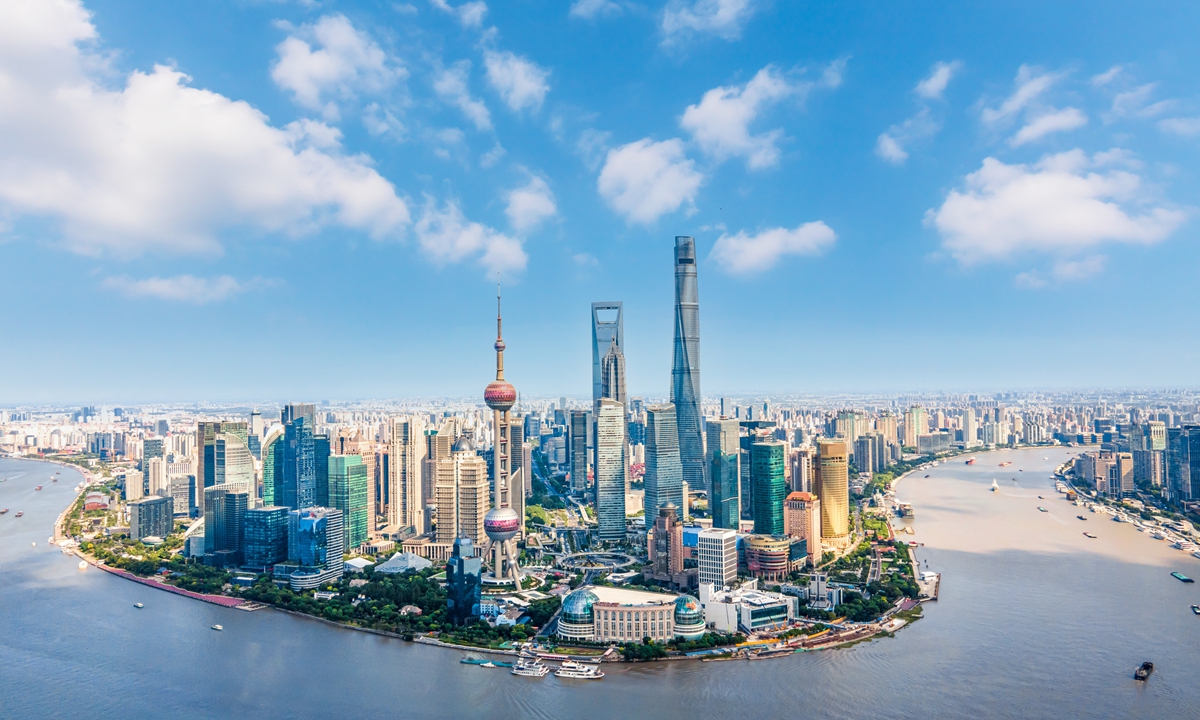
A view of the Lujiazui area in Shanghai Photo: VCG
As 2025 is ending, the world is still far from the tranquil place many had hoped for: conflicts in the Middle East and Ukraine, resurgent trade tariffs and protectionism, as well as unrelenting extreme weather events. Amid these challenges, China stood out as its governance philosophy and practices, spanning politics, economy, technology, green development and beyond, embody a vision that's both reality-based and future-oriented.The Global Times Annual Conference 2026 took place in Beijing on Saturday. During the discussion on the topic "A forward-looking country: how important is 'predictability' to the world," Erik Solheim, former under-secretary-general of the UN and former executive director of the UN Environment Programme, stated that in 2025 the world experienced a lot of global turbulence, but over the past year, China has stood up as a force for global stability.
On the same occasion, Wu Xinbo, Dean of the Institute of International Studies of Fudan University, said China's development has advanced through exploration. While the journey has not been smooth, China has clear goals and strong execution capabilities, and it can grasp the future direction of industries and the trend of international cooperation, thus winning growing trust from the world.
As China stood out as the major power clearly and systematically shaping the future, This strategic foresight has become a powerful antidote to global chaos, and China is increasingly seen as an "oasis of certainty" in a turbulent world, analysts noted.
Building bridges to shared future
Amid atmosphere of division and confrontation, China emerged as the actor determined in expanding stable, future-oriented partnerships. In 2025, China's diplomacy balanced neighborhood focus, major-country engagement, and Global South solidarity.
From the Southeast Asia visits to Vietnam, Malaysia and Cambodia in April, the state visit to Russia in May, and the China-Central Asia Summit in June to the APEC gathering in South Korea in the second half of 2025, it is evident that this year, neighboring countries were the clear priority of the Chinese leader.
In major-country engagement, Chinese President Xi Jinping held high-level meetings with the leaders of the US, Russia, and other countries.
In Busan on October 30, President Xi told US President Donald Trump that both sides should "think big and recognize the long-term benefits of cooperation." In Moscow on May 8, President Xi told President Putin that China and Russia should maintain strategic resolve and coordination as the world is entering a new period of turbulence and transformation, according to Xinhua.
For the Global South, Xi's calendar was packed with substantive summits with Global South countries around the world.
At a time when global governance is confronted with challenges, Xi proposed the Global Governance Initiative (GGI), calling on all countries to work in concert for a more just and equitable global governance system.
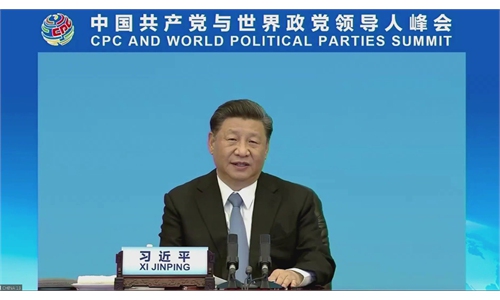
At a virtual BRICS summit, Xi noted that transformation unseen in a century is accelerating across the world. "BRICS countries, standing at the forefront of the Global South, should act on the BRICS Spirit of openness, inclusiveness and win-win cooperation, jointly defend multilateralism and the multilateral trading system, advance greater BRICS cooperation, and build a community with a shared future for humanity."
Amid heightened uncertainty in 2025, China has put dialogue first and pursued win-win cooperation, serving as a stabilizing anchor for the world, said Li Haidong, a professor at China Foreign Affairs University.
China's head-of-state diplomacy has injected strong confidence and much-needed certainty into today's turbulent environment, enabling more countries to form a clearer and more optimistic view of the global order's future, the expert noted.
Openness and innovation-driven growth
While many economies froze or scaled back long-term planning, China became the major economy that most decisively finalized and began executing its 2026-2030 blueprint.
The Fourth Plenary Session of the 20th Central Committee of the Communist Party of China (CPC) in October adopted the Recommendations of the CPC Central Committee for Formulating the 15th Five-Year Plan (2026-2030) for Economic and Social Development, stressing that China should steer the development of new quality productive forces and promote high-standard opening up, according to Xinhua.
In a written speech to the APEC CEO Summit on October 31, President Xi highlighted China's five-year plan. "We are vigorously developing future industries, strengthening emerging industries, and upgrading traditional industries. China is going green, digital and smart at a faster pace," Xi said, per Xinhua.
"Partnering with China means embracing opportunities. Believing in China means being optimistic about tomorrow. And investing in China means investing in the future," Xi said.
Former European Commission President Romano Prodi noted that China now holds a leading position in emerging industries such as solar energy, wind energy, batteries and electric vehicles, per Xinhua.
Li Changan, professor at the University of International Business and Economics, said China's political stability and policy continuity act as a "booster shot" against global economic anxiety. Its emphasis on self-reliance, new quality productive forces, and long-term planning offers a profoundly visionary model for developing nations.
In stark contrast to zero-sum mentalities elsewhere, China's development is characterized by mutual benefit, harmonious coexistence, and shared fruits, said Li Haidong. "This responsible, far-sighted vision explains why the world sees in China stronger hope for peace, brighter hope for prosperity, and firmer hope for stability."
Sustainable and inclusive devt
China has consistently demonstrated a style characterized by alignment between its words and deeds. Its concrete actions reflect a profound sense of responsibility and exceptional real-world effectiveness across diverse fields and issues, said Li Haidong.
In his video remarks delivered at the UN Climate Summit on September 24, President Xi announced China's new Nationally Determined Contributions (NDCs). China will, by 2035, reduce economy-wide net greenhouse gas emissions by 7 percent to 10 percent from peak levels; increase the share of non-fossil fuels in total energy consumption to over 30 percent; expand the installed capacity of wind and solar power to over six times the 2020 levels, striving to bring the total to 3,600 gigawatts.
Green and low-carbon transition is the trend of the time, Xi said, per Xinhua.
According to He Jianwu from the Development Research Center of the State Council, in the past five years, renewable energy installation has surpassed that of thermal power for the first time in history. In the first nine months of 2025, both the production and sales of new energy vehicles in China exceeded 10 million units.
Official data shows that in 2024, China's energy consumption per unit of GDP was 11.6 percent lower than in 2020, ranking the country among the global leaders in energy intensity decline.
This sustainable vision of development also underpins China's approach to global cultural engagement.
In a congratulatory letter to the Global Civilizations Dialogue Ministerial Meeting held in July, President Xi pledged that China will work with other countries to champion equality, mutual learning, dialogue and inclusiveness among civilizations, and implement the Global Civilization Initiative.
At the Global Leaders' Meeting on Women in Beijing on October 13, President Xi announced that in the next five years, China will donate another $10 million to UN Women; earmark a quota of $100 million in China's Global Development and South-South Cooperation Fund for implementing development cooperation projects for women and girls in collaboration with international organizations.
China has served as a positive exemplar for the world, providing an inspiring and constructive model on the pivotal questions of how countries should develop and toward what destination they should strive, Li Haidong stated.
Li Weilin contributed to the story
RELATED ARTICLES