IN-DEPTH / IN-DEPTH
‘I feel completely at ease in China’: Global content creators decode why China is one of the safest countries in the world

Vloggers, including Nepali influencer Garima Ghimire (left), share videos on social media platforms expressing their impressions of safety in China. Photo: Screenshots from Xiaohongshu and YouTube
Editor's Note:In the Recommendations of the Central Committee of the Communist Party of China (CPC) for Formulating the 15th Five-Year Plan for National Economic and Social Development made public in October 2025, China outlined major objectives for high-quality development over the next five years. These include significant achievements in high-quality development, substantial improvements in scientific and technological self-reliance and strength, fresh breakthroughs in further deepening comprehensive reform, notable cultural and ethical progress across society, further improvements in quality of life, major new strides in advancing the Beautiful China Initiative, and further advances in strengthening the national security shield. This blueprint not only guides China's own modernization, but also injects tangible certainty into a turbulent world.
Amid the surging "China Travel" boom, more international travelers are visiting China and witnessing real, tangible changes. These firsthand experiences and moments of awe have become, in their eyes, "the future in China's hands." The Global Times is launching a series titled "The world can trust in China," presenting stories of the "Chinese modernization" through the perspectives of foreign vloggers and ordinary Chinese people to show how China is fulfilling its promises for the future step by step. The fifth installment focuses on China's further advances in strengthening the national security shield.
"Things you can do in China at night: You can play ping pong, you can ride shared bikes, you can drink lemon tea, you can sleep on a park bench... No one will harm you."
This vivid observation from Nepali influencer Garima Ghimire posted on the lifestyle social media platform Xiaohongshu (RedNote) has raked in over 2,000 interactions, with comments echoing her sentiment. One Chinese netizen replied: "In China, drink and get drunk. If you don't want to go home, you can sleep in the park and nothing will be lost on the grass."
Another netizen based in Singapore commented in contrast: "If America, girl found dead and raped while falling asleep and drunk on a park bench."
This stark contrast has reignited global curiosity about China's safety record. Long a hot topic on platforms like Quora, the question "How safe is China?" has now taken on new life as expats and travelers share first-hand accounts - many highlighting a common refrain: "In China, girls can walk alone at night" and "I feel completely at ease in China."
Such details reveal a fundamental truth about China's safety: It is a pervasive sense of security that permeates daily life, allowing people to live and move freely without unnecessary fear.
Over the past five years, China has implemented a holistic approach to national security, fostering public well-being, social stability and long-term peace. "Safe China" has emerged as a bright calling card of the country.
This commitment was reinforced at the fourth plenary session of the 20th Central Committee of the Communist Party of China (CPC) convened in October 2025, which upheld "ensuring both development and security" as a guiding principle for the 15th Five-Year Plan period (2026-2030) and set "further advances in strengthening the national security shield" as a key goal, the Xinhua News Agency reported.
Strong sense of safety
For Garima, who has considered Chengdu in Southwest China's Sichuan Province her "second hometown" for over a year, China's safety is a tangible part of daily life - one that reshaped her understanding of public security. "Before coming, I only knew China as a neighboring country with some cultural overlaps," she recalled. "I never expected its culture, food, and especially public security, to be so rich and reliable."
Her first brush with China's distinctive sense of safety came upon arrival: Landing at Chengdu Tianfu International Airport late at night, she took a taxi with no haggling - prices were regulated, and the electronic payment system was seamless.
As a self-proclaimed "night owl," Garima has fully embraced her preferred lifestyle in China: Taking late-night walks, playing ping pong with friends, riding shared bikes through the city, or lounging on park benches - "all without a hint of anxiety." "The streets here are safe even at midnight, and late-opening shops let me explore street food freely," she told the Global Times, noting that "China's nightlife is defined by food, comfort, and absolute safety."
China is widely recognized as one of the safest countries in the world, Qi Yanjun, vice minister of public security, noted in July 2025 when discussing achievements in the public security sector during the 14th Five-Year Plan period (2021-2025) at a press conference held by the State Council Information Office, Xinhua reported.
According to Qi, public security organs have helped facilitate China's high-quality development by resolutely safeguarding public safety. As a result, China has maintained one of the lowest incidences of fatal criminal cases, the lowest rates of criminal offenses, and the fewest cases involving firearms and explosives.
Data from the Ministry of Public Security shows that in 2024, the homicide rate in China was 0.44 per 100,000 people, ranking among the lowest in the world.
Shen Yi, a professor at Fudan University, explained that this safety stems from systemic governance. He cites a popular experiment among foreign bloggers in China: Leaving valuables in public to see whether they will be taken, and the result is always the same: no theft. Indian business consultant Ram Niranjan Sharma, who has lived in China since 2019, shared a similar personal anecdote: "I once forgot to lock my apartment door and rushed back fearing the worst, but everything was intact. No one entered."
This sense of safety is actively cultivated through community-level governance. For example, in Dongtai, East China's Jiangsu Province, local authorities launched an autumn-winter security initiative. The program integrated targeted patrols, which added over 20 nighttime checkpoints, with rapid-response mechanisms. The Global Times learned from local authorities that this "proactive prevention" approach contributed to a year-on-year decrease of 31.7 percent in criminal cases and a 60 percent drop in street theft. Beyond enforcement, officers conducted proactive outreach, visiting more than 75,000 households to share safety information and mediate disputes.
"China has always adhered to people's safety as its fundamental purpose. In advancing the modernization of the national governance system and governance capacity, the country has continuously strengthened its ability to safeguard safety in accordance with relevant laws," Shen told the Global Times.
"This achievement not only reflects the firm determination of judicial and public security organs to combat crime, but also the relentless efforts of relevant departments to strengthen prevention and reduce recidivism - rooted in a proactive, pre-emptive governance philosophy that addresses risks before they escalate," he emphasized.
Human-centric approach
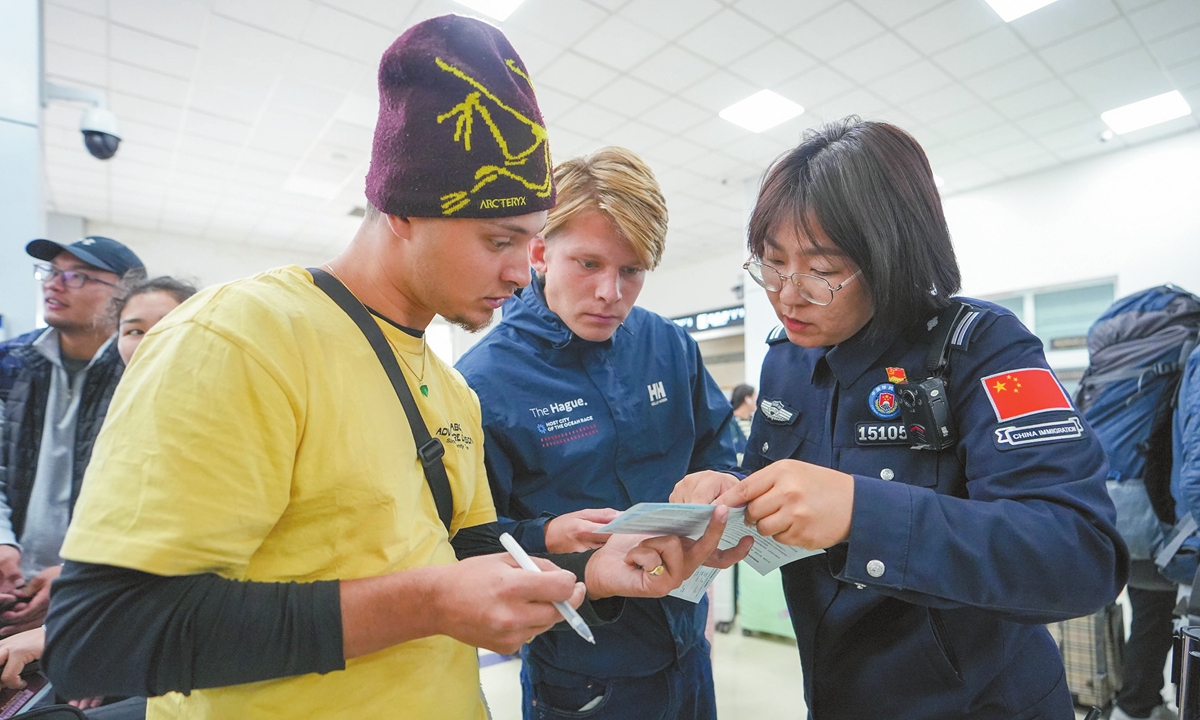
An immigration management police officer (right) provides customs clearance consultation for incoming travelers at an entry-exit border inspection station in Xilin Gol League, North China's Inner Mongolia Autonomous Region, on October 4, 2025. Photo: VCG
On a December afternoon in 2025, a foreign couple visiting the Qianlingshan Park in Guiyang, Southwest China's Guizhou Province, faced an unexpected dilemma: their baby's stroller could not be taken onto the cable car. Without hesitation, they entrusted their child to a park security guard, whose calm demeanor and willingness to help drew admiration from fellow visitors, news platform Jimu News reported. This incident sparked lively online discussion, with many netizens viewing the act as highlighting the trust and care that form the bedrock of China's approach to public safety.Garima, who has traveled across China, vividly described the security measures that make her feel at home: "Subway stations have security checks at every entrance, a visible sign of China's commitment to public safety." She also emphasizes the widespread presence of security cameras, and the approachability of police officers. "They're always ready to help when I have questions," she said.
Sharma offered a thoughtful perspective on this technological safety net: "These cameras were not there to control people, but to protect them - a perspective seldom mentioned in Western media reports that fixate on surveillance while overlooking the tangible feeling of security and liberty they foster in daily life."
Having personally experienced the warm and friendly community atmosphere, he believes China's model demonstrates that advanced technology, when integrated into public infrastructure and social norms, does not have to come at the cost of personal liberty. Instead, it can create a foundation for it, enabling a unique kind of round-the-clock security and social ease.
Currently, China is refining the role of advanced technology in public safety through urban governance innovations. At the 2025 Conference on High-quality Development International Cooperation of Cities held in Shenzhen, South China's Guangdong Province, on December 27, 2025, Zheng Wenxian, vice president of a Shenzhen-based technology innovation company, shared AI-driven governance insights with officials, entrepreneurs and scholars. "With mature AI technology, our data-intensive systems now provide guidance and support for over 80 percent of Shenzhen's urban management work, aiming to ease grass-roots management pressure and improve governance precision," he told the Global Times."
Yet technology alone doesn't define China's safety landscape. Sharma noted the human factor: From bustling cities to remote villages, he has encountered a consistent willingness among people to assist strangers, a sense of social trust that transforms into genuine warmth.
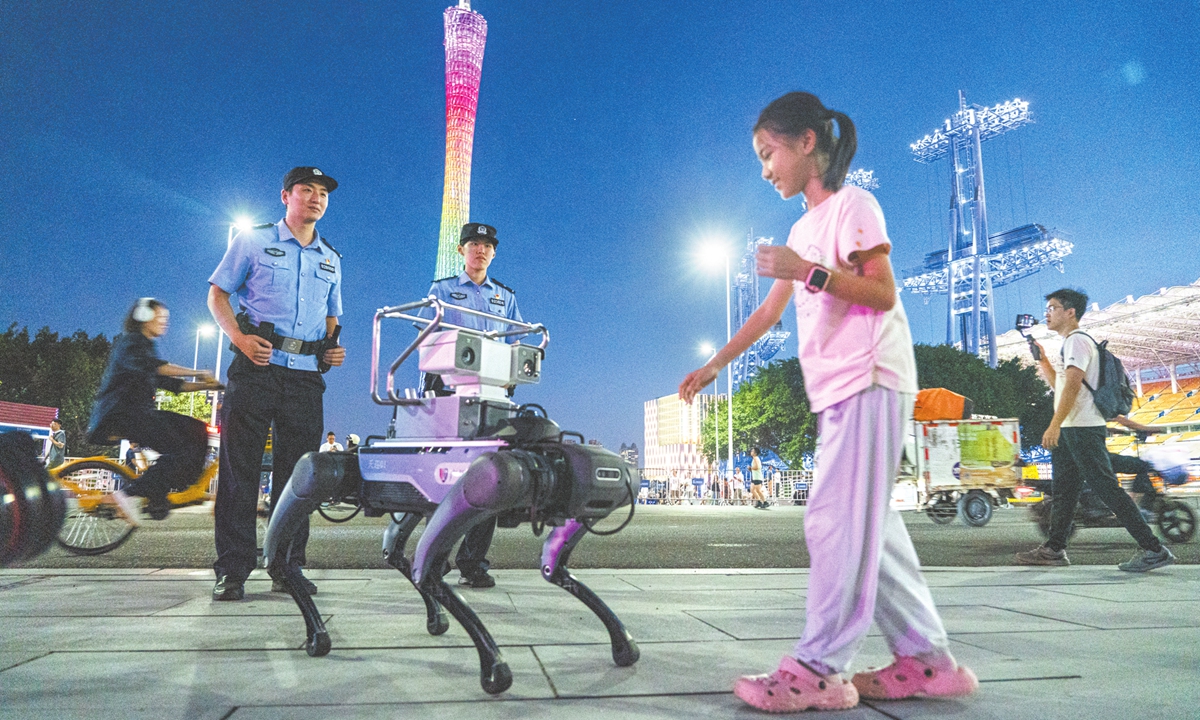
Police deploy a robot dog for patrols at the Huacheng Square in Guangzhou, South China's Guangdong Province, on September 22, 2025. Photo: VCG
Shen pointed out that the underlying strength of China's public safety model lies in its socialist system and comprehensive governance framework. The government focuses on mobilizing individual initiative, encouraging people to achieve self-improvement, and helping disadvantaged groups escape life's hardships, thereby addressing the root causes of crime at the source. Concurrently, the police are positioned as "servants of the people," the police-community relationship is not adversarial, but rather complementary, with both sides playing synergistic roles across different dimensions of public safety governance."China's safety isn't just about low crime rates," Sharma said. "The Chinese genuinely care about their country, which instills a strong sense of moral duty and care for its image. While governments in other countries often try their best to ensure safety, real change happens only when the public actively supports and participates in these efforts. It is the synergy between government planning and public cooperation that creates an environment like China's."
Today, both Garima and Sharma actively share their experiences online with friends and followers around the world, telling the globe that China is worthy of living, working, and investing in - a land where safety, opportunity, and human warmth converge. Their message resonates widely: China offers a model where security and liberty reinforce each other, creating an environment where communities thrive and the future is built with confidence.
RELATED ARTICLES

