Impact of US strike against Venezuela on global oil price limited in the short term, but long-term uncertainties heighten: analysts
Development carries major stakes for all oil-consuming countries, including China
By Published: Jan 04, 2026 10:25 PM

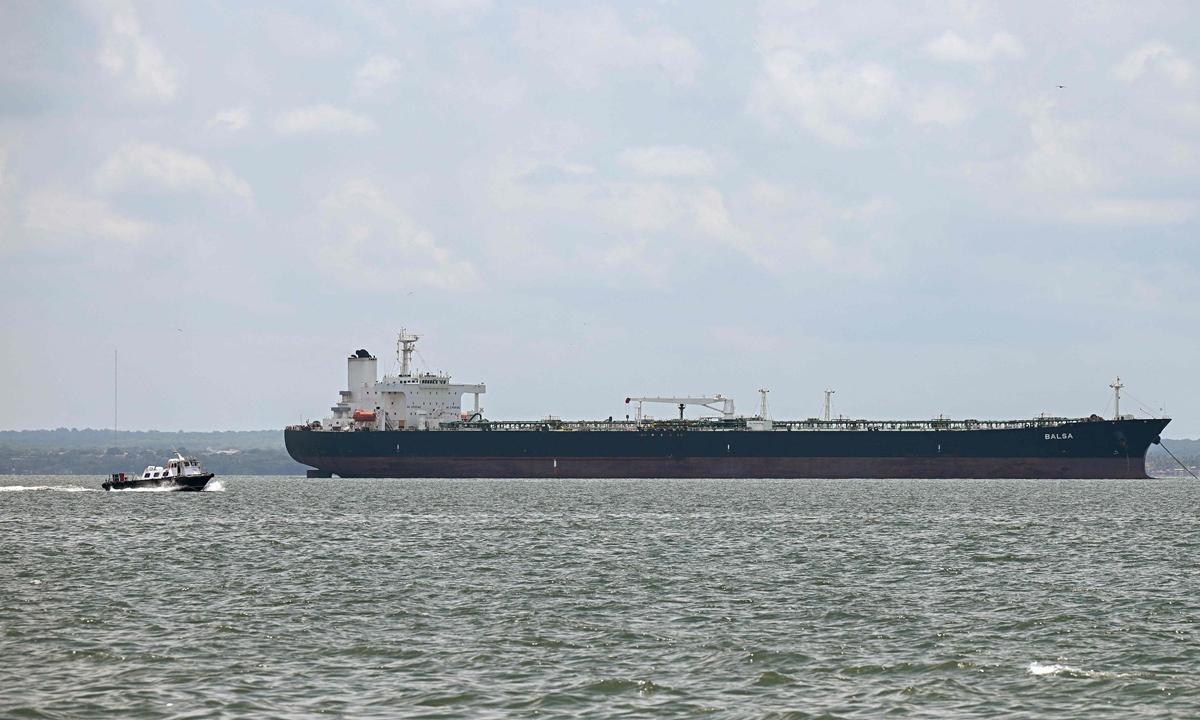
Panamanian crude oil tanker Balsa waits its turn to be loaded with crude oil at Lake Maracaibo in Maracaibo, Zulia State, Venezuela on May 9, 2025. Photo: VCG
Following the US strike against Venezuela, US President Donald Trump claimed that US oil companies will spend billions of dollars to rebuild Venezuela's "crumbling energy infrastructure," according to a Bloomberg report on Sunday. He also said that the embargo he imposed on Venezuelan oil "remains in full effect," according to a CNBC report.
Some Chinese analysts said that the global oil price may experience just a minimal impact in the coming days, considering the relatively small global share of Venezuela's oil production.
But they stressed that the price of the bulk commodity is likely to face heightened long-term uncertainty, depending on such factors as how the situation in Venezuela - which reportedly has the world's largest oil reserves - evolves and the extent to which the local exploitation work and refinery infrastructure develops. The uncertainty associated with the global energy outlook could carry high stakes for all countries that are consumers of oil resources, including China, analysts noted.
The global spotlight has been focusing on the massive local oil reserves in Venezuela and how global oil prices would move following the strikes on Saturday.
Reuters quoted sources close to the matter in a report on Sunday, who said that Venezuela's oil exports are now paralyzed as port captains have not received requests to authorize loaded ships to set sail.
A CNN report noted that Trump's plan could "eventually make Venezuela a much bigger supplier of oil and could create opportunities for Western oil companies and could serve as a new source of production. It could also keep broader prices in check, although lower prices might disincentivize some US companies from producing oil."
US oil giants have so far remained silent on Trump's energy plan in Venezuela. Chevron, the only US oil company still operating in Venezuela, committed only to following "relevant laws and regulations" after Trump's remarks, according to a Guardian report.
ExxonMobil, the biggest US oil company, did not respond to a request for comment. ConocoPhillips, another major player, said that it was monitoring developments, and added: "It would be premature to speculate on any future business activities or investments," the report noted.
Venezuela, a founding member of OPEC, has the largest proven oil reserves in the world. But the South American nation currently produces less than 1 million barrels of oil a day, which is less than 1 percent of global oil production, according to a CNBC report.
"In the short term, the price could edge up only to a small extent mostly due to psychological factors. The fluctuation won't be large due to the relatively small global share of Venezuela's oil, as the country's oil exports had been under sanctions [before the US strikes]," Jin Lei, a professor at the China University of Petroleum, told the Global Times on Sunday.
Wang Yongzhong, director of the Institute of Energy Economy at the Chinese Academy of Social Sciences, told the Global Times on Sunday that the impact of the suspension of Venezuela's oil exports will likely to be "limited" in terms of global prices.
"I expect the market to remain relatively stable. This also takes into account that global oil prices have fallen back from their highs recently," Wang said.
According to Chinese analysts, it is a matter of high stakes how the global oil price moves in the long term. They expressed concern that over the long term, US companies' involvement in Venezuela's oil resources would grant the country significant leverage over global oil prices, making it easier for the country to conduct manipulation for its own interests and gains.
"The US could potentially restrict production or employ other measures to coordinate with domestic oil sales in the US, thereby influencing international oil prices," Jin said. This would have profound effects on virtually every oil-consuming nation, analysts noted.
Dai Jiaquan, director of the Oil Market Research Institute at the China National Petroleum Economics and Technology Research Institute, told the Global Times that Venezuelan's heavy, high-sulfur grades are essential feedstocks for refining diesel, asphalt and other products, and they're especially well-suited to the refineries along the US Gulf Coast.
"Given Venezuela's geographic proximity to the US and the relatively low prices of its heavy crude, US refineries achieve exceptionally high profitability when processing Venezuelan oil," Dai noted. He added that because Venezuelan crude directly competes with Canadian oil sands crude in terms of quality, refinery compatibility and end markets, the exports of Canadian heavy oil producers will be affected in the long term as well.
Analysts diverge on how the global oil prices would fluctuate in the long term. According to Wang, if US companies do invest and have the capacity to bolster the oil industry in Venezuela, oil production and supply will be expanded in a gradual manner. Considering that the global economy is slowing down and the energy transition is accelerating - which all undercut global demand - the oil price is poised to decrease in such a scenario.
Lin Boqiang, director of the China Center for Energy Economics Research at Xiamen University, pointed out that the possibility of US companies reviving Venezuela's oil production could be slim, and the cost could be incredibly high.
"If Venezuela's oil resources do undergo large-scale development, this would increase global supply and exert downward pressure on international oil prices. However, this process is constrained by factors such as infrastructure construction and investment cycles, requiring a relatively long timespan, and the outlook remains subject to considerable uncertainty," Lin told the Global Times on Sunday.
Venezuelan state-owned oil and natural gas company PDVSA said that its pipelines haven't been updated in 50 years, and the cost to update the infrastructure to return to peak production levels would be $58 billion, according to the CNN report.
RELATED ARTICLES