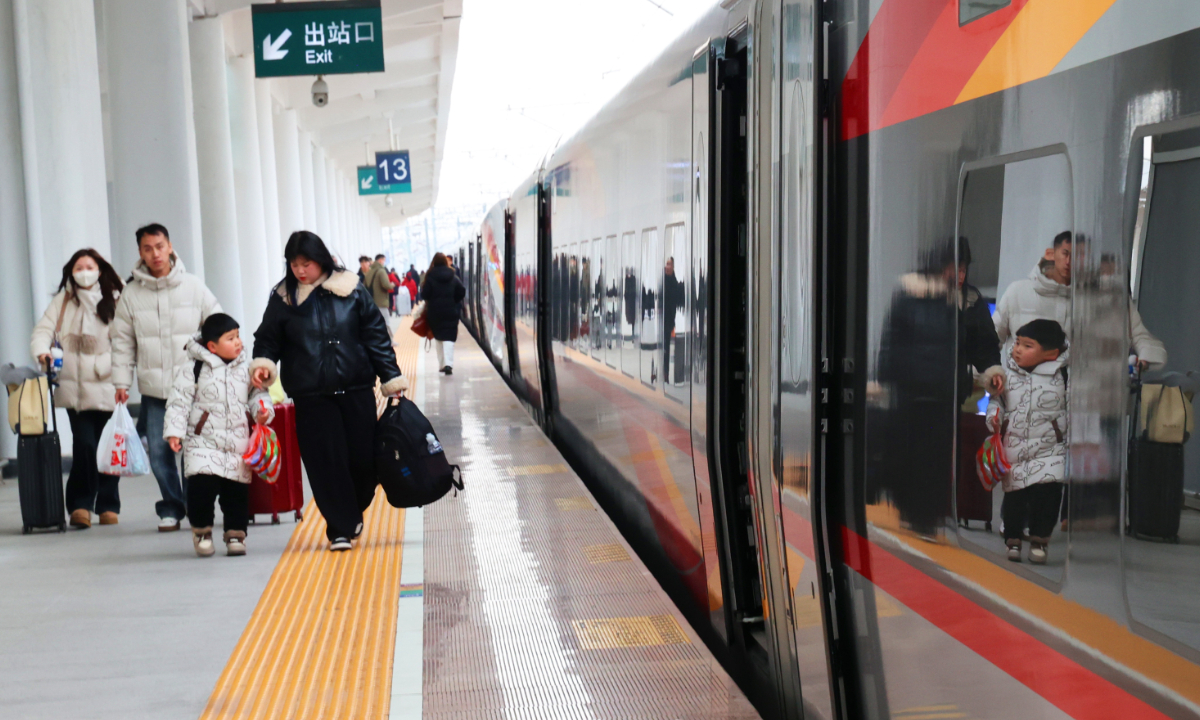
Passengers prepare to board an electric multiple unit train at a railway station in Lianyungang, East China's Jiangsu Province, January 1, 2026. Photo: VCG
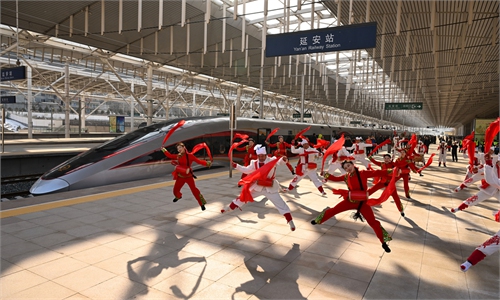
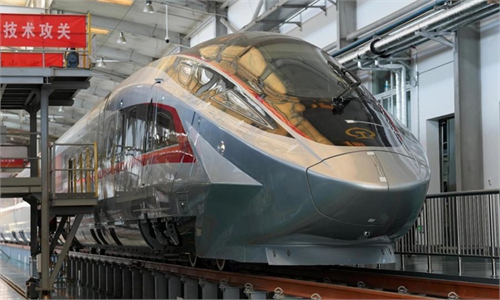
China's railway network reached a record of 165,000 kilometers as of the end of the 14th Five-Year Plan period (2021-25), with the high-speed rail system surpassing 50,000 kilometers. China has built the world's largest and most advanced high-speed railway network, according to data from China Railway Group Co on Sunday.
In 2025, China's railway sector reported 901.5 billion yuan ($128.9 billion) of investment, up 6 percent year-on-year. According to a company conference held Sunday in Beijing, 3,109 kilometers of new rail lines opened last year, with the bulk of 2,862 kilometers being high-speed rail, further demonstrating the driving force of such investment.
With a focus on the 102 major railway projects as well as projects and programs aligned with major national strategies, China Railway stepped up implementation efforts. The construction of a total of eight projects including the Changsha-Ganzhou High-Speed Railway commenced, while 25 projects including the Shenyang-Baihe High-Speed Railway began to operate.
During the 14th Five-Year Plan period, high-speed rail increased from 37,900 kilometers to 50,400 kilometers, up 32.98 percent, the Xinhua News Agency reported on Sunday.
During the 15th Five-Year Plan period (2026-30), China Railway will strive to achieve a world-class railway network in terms of scale and quality. By 2030, the national railway network will reach about 180,000 kilometers, including 60,000 kilometers of high-speed rail, with the double-track rate reaching 64 percent and the electrification rate reaching 78 percent.
Strategic backbone corridors will be comprehensively strengthened, with a national high-speed rail artery network consisting of eight vertical lines and eight horizontal lines. Regional interconnectivity will be significantly enhanced, freight network capacity will be substantially strengthened, and a world-class modern railway network will be basically built. The strategic support capacity of railways in serving major national strategies, promoting economic and social development, and safeguarding national security will be comprehensively enhanced.
Global Times
RELATED ARTICLES