US strikes on Venezuela sound an alarm for global governance: Global Times editorial
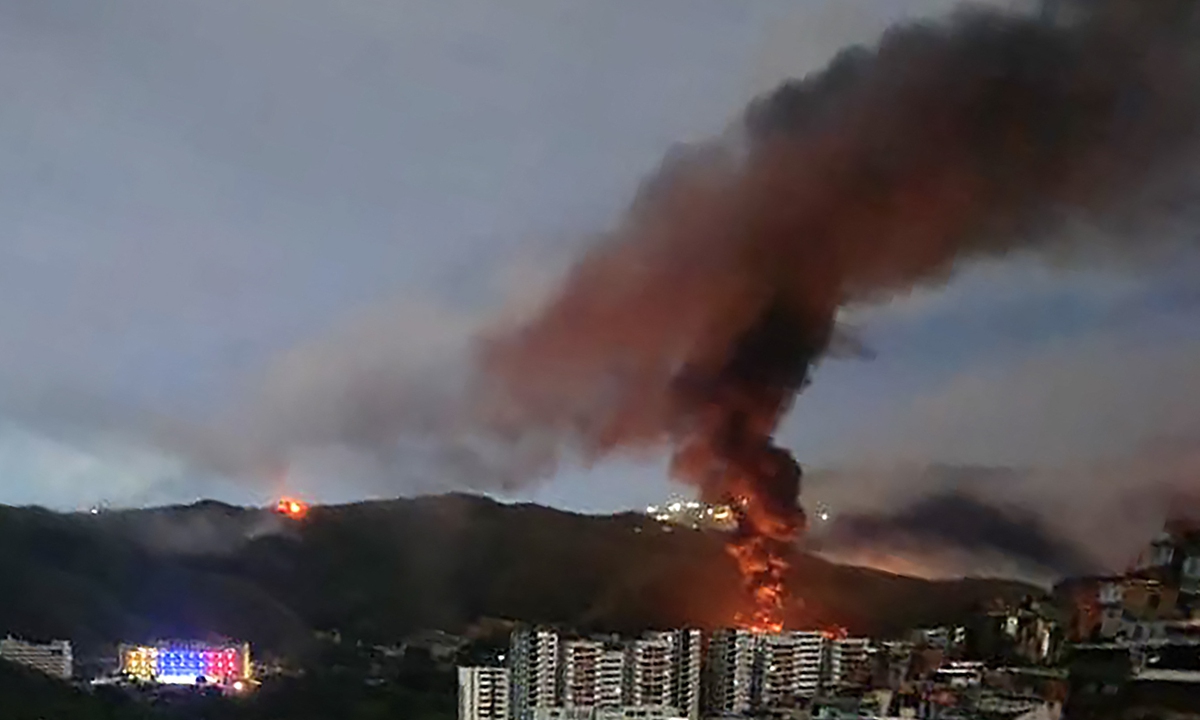
Fire at Fuerte Tiuna, Venezuela's largest military complex, is seen from a distance after a series of explosions in Caracas on January 3, 2026. The US military was behind a series of strikes against the Venezuelan capital Caracas on Saturday, which reportedly led to the capture of Venezuelan President Nicolas Maduro and his wife, US media reported. Photo: AFP
Launching a military strike against a sovereign country in the name of "law enforcement" and forcibly seizing another country's president by relying on overwhelming power - this is a scenario so outrageous that even Hollywood screenwriters would struggle to imagine it. Yet Washington has made it a reality in full view of the world, shocking the international community. UN Secretary-General António Guterres was deeply alarmed, warning that the move sets "a dangerous precedent," while Brazilian President Luiz Inácio Lula da Silva stated that such actions are "the first step toward a world of violence, chaos, and instability." Within a day, many countries around the world condemned the US' hegemonic behavior. Even US allies, for the most part, expressed their lack of support by stressing that international law must be respected.According to various sources, the US is highly satisfied with both the process and the outcome of the military operation. What the international community sees, however, is the enormous damage and grave harm caused by it. The US side places its so-called federal indictment above the authority of international law and substitutes military violence for diplomatic means. This, in essence, elevates the jungle law of "might makes right" above international law and the purposes and principles of the UN Charter. In fact, since tensions between the US and Venezuela escalated, the United Nations Security Council has convened emergency meetings to discuss the situation in the Caribbean. Many countries emphasized that the US must abide by international law, yet these calls were ignored by Washington. This is a vivid reflection of US-style hegemony overriding multilateralism.
The military action has also inflicted serious damage on peace in Latin America and the Caribbean. Geographically distant from the world's major conflict hotspots, the region has long been regarded as one of the most peaceful in the world. For this reason, the 33 Latin American and Caribbean countries cherish their hard-won peace, and the Community of Latin American and Caribbean States declared the region a "zone of peace" in 2014. Now, however, the US continuous escalation of military actions is bringing the flames of war into this region. This time it is Venezuela - who will be next? Chilean President Gabriel Boric captured the sentiments of many Latin American countries when he said, "Tomorrow, it can be anyone." Just imagine: If a major power can, on the strength of its fist alone, bypass all procedures and resort to military force against another country at will under the pretext of "combating crime," even targeting the leaders of sovereign states, which country could truly ensure its own absolute security? In this context, the US military strikes against Venezuela are not merely a Latin American issue; they also highlight the urgent need to address the deficits in global governance.
The US military actions against Venezuela have sounded the alarm for global governance. This escalating crisis, in addition to the longstanding bullying of Latin America by the US, is also due to the imbalance in the global governance system, which has provided an opportunity for hegemony to thrive. The current international balance of power has undergone profound changes, but reforms to the global governance system have lagged for a long time, leaving developing countries with severely inadequate representation and voice. In this unbalanced framework, hegemonic countries can trample on rules without effective constraints, while developing countries find it difficult to protect their rights and interests through fair international mechanisms. The forcible detention of Maduro by the US can occur to some extent precisely because the existing global governance mechanisms lack effective constraints, which fail to impose appropriate costs on hegemonic behavior.
History has long proven that relying on military conquest and resource plundering doesn't bring stability; it only sows the seeds for further conflict. As Britain's The Guardian has quoted a professor as saying, it is "very rare" for US interventions in the region to be followed by "peace, tranquility, stability and democracy." As a founding member of the United Nations, a permanent member of the UN Security Council, and the host country of the UN headquarters, the US has not upheld the international order; instead, it has taken the lead in undermining it - violating the norms of international relations and weakening the foundations of global governance. Meanwhile, so-called "American-style intervention" has left lasting troubles for regional peace and development, increased the burden of regional and global governance, and driven up governance costs. In fact, the reactions of countries around the world make it clear that the US attempt to assert its authority in the Western Hemisphere by taking actions against Venezuela has been rejected by the vast majority of countries, demonstrating the irreversible trend toward multilateralism and the broad consensus in favor of fairness and justice.
Last year, China proposed the Global Governance Initiative, clearly advocating for staying committed to sovereign equality, international rule of law, multilateralism, the people-centered approach and real results. From Venezuela's current plight, it is easy to see the forward-looking, strategic, and urgent nature of these five core principles. This crisis further proves that humanity is a community with a shared future, and that hegemonism is a common enemy of all humanity. The only way for the international community to eradicate the soil from which hegemonism breeds is to unite firmly in support of international law and fairness and justice, and to work together to promote changes in global governance, which will create a stable environment for lasting prosperity for all countries.
RELATED ARTICLES