We never believe that any country can play the role of world policeman: Chinese FM on Venezuela situation
US military strike on Venezuela, seizing of Maduro widely criticized
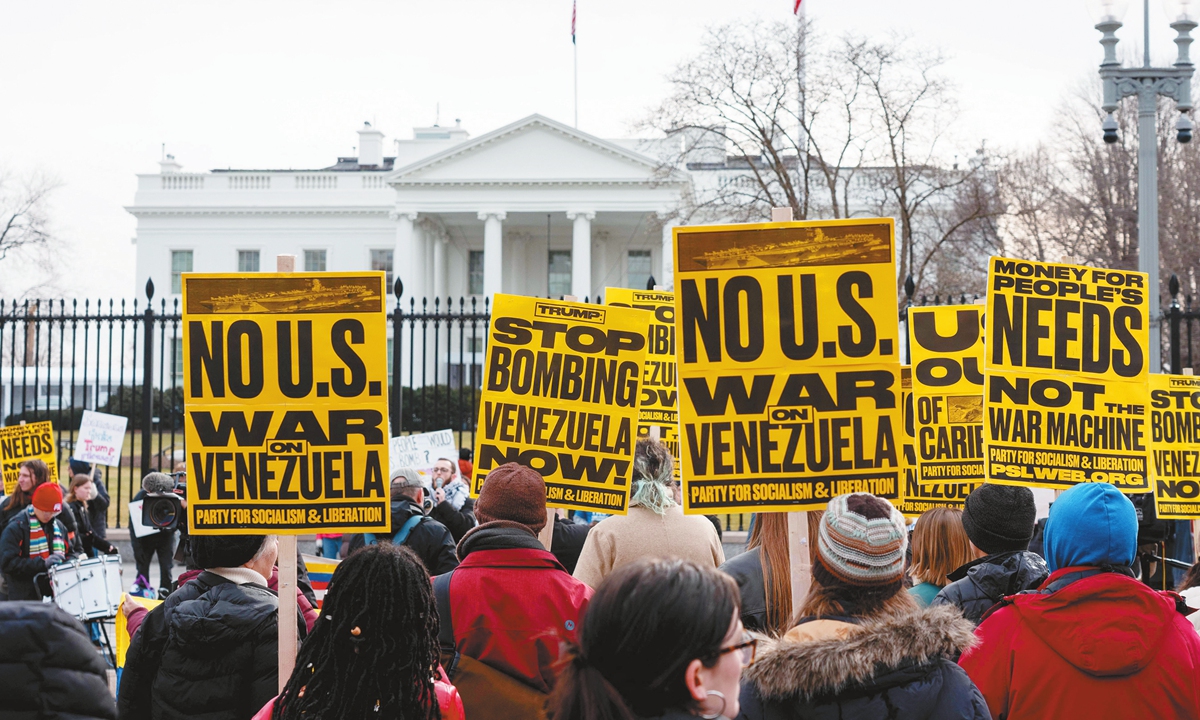
People carrying banners gather to protest the US attacks on Venezuela, in Washington DC, the US, on January 3, 2026. Photo: VCG
China always opposes the use or threat of force, as well as any imposition of one country's will on another, Chinese Foreign Minister Wang Yi said on Sunday when speaking of the situation in Venezuela, according to Xinhua News Agency.
Wang, also a member of the Political Bureau of the Communist Party of China Central Committee, made the remarks when holding the Seventh Round of China-Pakistan Foreign Ministers' Strategic Dialogue with Pakistani Deputy Prime Minister and Foreign Minister Mohammad Ishaq Dar in Beijing.
Wang said the current international situation is more volatile and intertwined, with unilateral bullying becoming increasingly severe.
The sudden change of situation in Venezuela has drawn high attention from the international community, Wang said.
"We never believe that any country can play the role of world policeman, nor do we agree that any country can claim itself to be an international judge," Wang said, adding that the sovereignty and security of all countries should be fully protected by international law.
Following the US' large-scale strike against Venezuela and its seizing of President Nicolas Maduro and his wife Cilia Flores and their transfer out of the country, a Chinese Foreign Ministry spokesperson said on Sunday that the US' move is in clear violation of international law, basic norms of international relations, and the purposes and principles of the UN Charter.
China calls on the US to ensure the personal safety of President Nicolás Maduro and his wife, release them at once, stop toppling the government of Venezuela, and resolve issues through dialogue and negotiation, the spokesperson said.
In the hours prior to the Chinese Foreign Ministry's statement, multiple countries already voiced their positions via official channels in response to the US' military strike and its seizing of Maduro and his wife. Opposition within the US itself was also formidable, with demonstrations planned in over 100 cities, media outlets reported.
Experts said that the US moves constitutes a typical example of hegemonic unilateralism and delivers a systemic shock to the international order, noting that such action accelerates the fragmentation of the international legal system and deepens the global trust deficit in the rule of international law.
Latest development
Maduro arrived at the Metropolitan Detention Center in Brooklyn after he was brought by helicopter to Manhattan, New York City. He was escorted to the facility by a motorcade of law enforcement vehicles, according to law enforcement officials, CNN News reported.
In a video posted by the White House's official rapid response account on X on Sunday, Maduro was seen handcuffed as he was escorted by Drug Enforcement Administration (DEA) agents in New York. The tweet was accompanied by the text: "Perp walked."
As Maduro was taken inside the US drug agency office, he offered calm New Year greetings to DEA officers escorting him. The Venezuelan President said, "Good night, Happy New Year," to those accompanying him.
In another circulated clip, shared by Russia's RT News, Maduro was seen walking past the camera as he got out of a truck shortly after landing in New York. Noticing the camera, he flashed a peace sign.
Maduro and his wife could appear in court in Manhattan as early as Monday, two sources familiar with the matter told CBS News.
US President Donald Trump said on Saturday that the US would "run" Venezuela at least temporarily and tap its vast oil reserves to sell to other nations, the Associated Press (AP) reported.
Speaking to reporters hours after Maduro's seizing, Trump revealed his plans to exploit the leadership void to "fix" the country's oil infrastructure and sell "large amounts" of oil to other countries, per AP News.
"The supermarkets are crowded." resident José described Caracas on the first day after the US raid on Venezuela in one sentence. "Most people are hiding at home, afraid of a possible second attack. Some are constantly on their phones, anxiously sharing messages."
Another resident from the capital city shared similar observation. He told the Global Times that many Venezuelans are now thinking the same thing: "What if food supplies run out tomorrow?"
He also queued at a gas station, "There is still fuel available today, but who knows if there will be gasoline tomorrow amid this panic."
The US seizing of Maduro has made headlines in media outlets worldwide, with some European newspapers—including The Observer—devoting their entire front page to the story.
The photo of Maduro in handcuffs and a blindfold, taken after his seizing and shared by Trump on social media, appeared on the front page of The Observer alongside the headline "America's captive.
The Spanish newspaper El Confidencial noted that "if there is one word that was repeated to exhaustion during Donald Trump's press conference on the seizing of Nicolás Maduro, it was "oil" — 26 times. Neither "drugs," "gangs," or "drug trafficking" (14 times), nor "democracy," although these were also mentioned."
The New York Times ran headlines with "shock and skepticism" to cover the global reaction to the US' seizing of Maduro.
The Guardian ran headlines infused with tones of skepticism to cover the incident, saying that "Is there any legal justification for the US attack on Venezuela?" The report said that the legality of the operation has been called into question - with even some of Trump's allies suggesting it violated international law.
The New York Times and Washington Post learned of a secret US raid on Venezuela soon before it was scheduled to begin Friday night — but held off publishing what they knew to avoid endangering US troops, Semafor, a US news website, quoted two people familiar with the communications between the administration and the news organizations as saying. The scoop has since sparked a new wave of discussion on US social media.
The US indeed wants to "make an example" by toppling Maduro, Wang Yiwei, a professor at the School of International Studies at the Renmin University of China, told the Global Times. He added that the US hopes to use this military action to "strike" Venezuela and establish its hegemony in the Western Hemisphere.
Wide Condemnation
Politicians and the general public within the US have expressed their discontent. US Democratic lawmakers on Saturday showed their anger and distress in the aftermath of the US raid on Venezuela and the seizing of Maduro early Saturday morning, Xinhua reported.
They said that Congress had not been notified in advance and that Trump's administration had previously lied to Congress about its goals in the oil-rich South American nation. Meanwhile, they demanded an immediate briefing on the operation and on the White House's next move, per Xinhua.
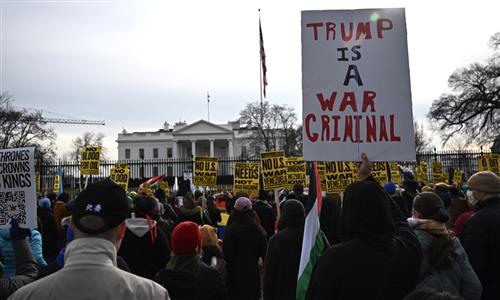
Across the US, Americans have taken to the streets to protest Trump's military operation in Venezuela and the seizing of Maduro and his wife. Demonstrations are planned in over 100 cities, with the main New York City protest set to begin at 2 pm in Times Square, Newsweek reported, citing organizers from The People's Forum and the ANSWER Coalition.
In Caracas, Maduro supporters raised clenched fists as they gathered in the streets of the Venezuelan capital on Sunday after US forces seized him, NBC News reported. Some burned a US flag during a gathering near the Miraflores Palace in Caracas after explosions and low-flying aircraft were heard in the early hours on Saturday, CBS News reported.
The UN Security Council will hold an emergency meeting on Monday on the US operation against Venezuela, the council presidency told Xinhua on Saturday.
In a Facebook post on Sunday, Malaysian Prime Minister Datuk Seri Anwar Ibrahim described the US action as a clear violation of international law and an unlawful use of force against a sovereign state.
The Foreign Ministry of the DPRK strongly denounces the US hegemony-seeking act committed in Venezuela as the most serious form of encroachment of sovereignty and as a wanton violation of the UN Charter and international laws with respect for sovereignty, non-interference and territorial integrity as their main purpose, a DPRK Foreign Ministry spokesperson said on Sunday in response to a question raised by KCNA.
Brazilian President Luiz Inacio Lula da Silva said on Saturday on his X that the bombings on Venezuelan territory and the seizing of its president cross an unacceptable line. These acts represent a most serious affront to the sovereignty of Venezuela and yet another extremely dangerous precedent for the entire international community.
Ukrainian President Volodymyr Zelenskyy weighed in Saturday on the US seizing of Maduro, telling reporters that Washington "knows what to do next," according to Fox News.
Prime Minister Benjamin Netanyahu said Sunday that Israel supported the US "strong action" in Venezuela.
Several experts the Global Times reached out to on Sunday said that the US' impact on international order is increasingly manifesting, and voiced their concerns about the country acting arbitrarily and unilaterally, which could see a regression of the world order back to the law of the jungle.
Wu Xiaofan, a research fellow at the Institute for American and Pacific Studies at Shanghai International Studies University, told the Global Times on Sunday that the military actions of the US reveal how it views international order, which is that sovereignty is no longer a hard boundary.
When rules become tools that can be easily appropriated, any rules-based order yields to an order governed by the law of the jungle, she added.
The US' move openly violated the principles of sovereign equality and non-interference in internal affairs enshrined in the UN Charter, completely undermines the bottom line of jurisdictional immunity enjoyed by a sitting head of state under international law, and represents yet another dangerous step in placing "domestic law above international law," Pan Deng, director of the Latin America and Caribbean Region Law Center of China University of Political Science and Law, told the Global Times.
By bypassing authorization from the UN Security Council and resorting to unilateral judicial and military means to handle international disputes, the US is, in essence, substituting multilateral rules with the will of power, seriously eroding the authority of the UN's core mechanisms, Pan said.
RELATED ARTICLES