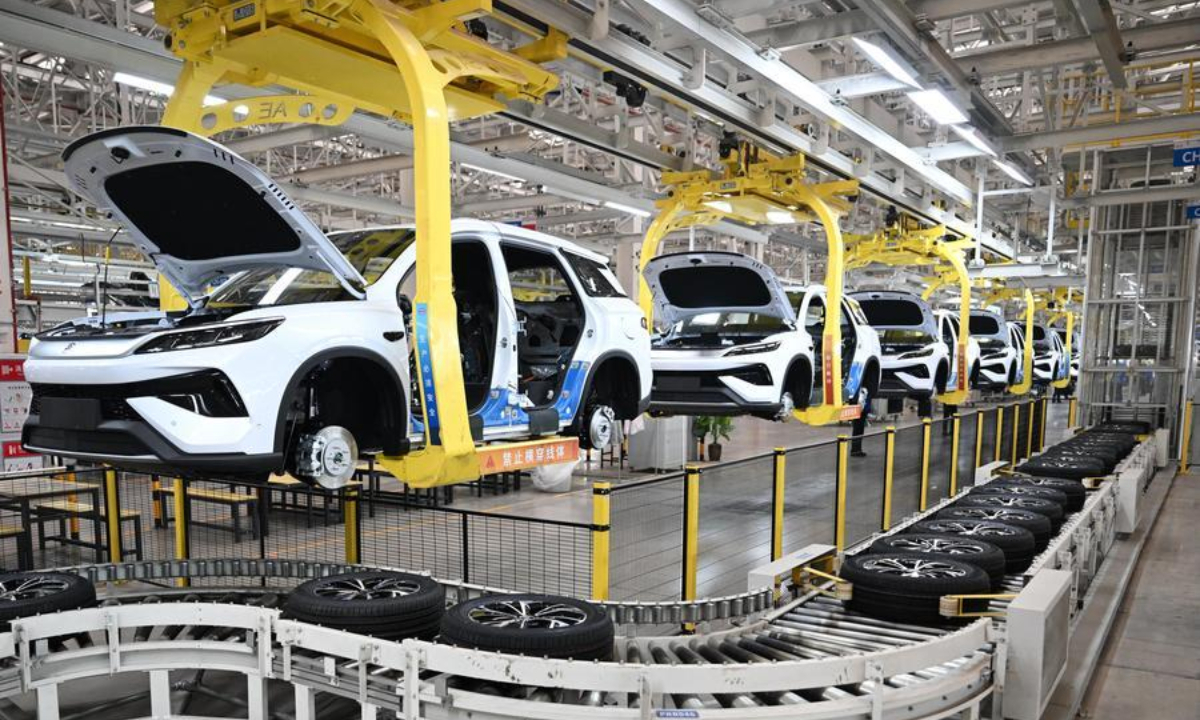
This photo taken on Nov. 3, 2025 shows a new energy vehicle (NEV) assembly line of BYD, China's leading NEV manufacturer, at the plant of BYD in Zhengzhou, central China's Henan Province. (Xinhua/Li Jianan)
Official industry data released on Monday showed that cumulative wholesale sales of new-energy passenger vehicles reached 15.33 million units in 2025, up 25 percent year on year, meeting expectations for NEV market growth under the 14th Five-Year Plan period (2021-25).
The results were based on statistical forecasts by the China Passenger Car Association (CPCA), which said that as the purchase-tax exemption for new-energy vehicles approached its expiry at year-end, the market entered a rush-buying phase in December.
Based on a preliminary monthly assessment combining CPCA data, nationwide wholesale sales of new-energy passenger vehicles totaled 1.57 million units from December 1 to 31 last year, up 4 percent year on year but down 8 percent month on month.
A step chart released by the CPCA also showed that four of the top five automakers by wholesale sales of new-energy passenger vehicles in December were Chinese brands, with BYD and Geely Auto leading by a wide margin, followed by Changan Automobile, Tesla China and Chery Automobile.
Strong performances by several leading new-energy automakers also contributed significantly to the nation's overall results, with a number of companies reporting record annual sales in 2025.
BYD overtook Tesla in full-year battery-electric vehicle sales for the first time to become the world's largest seller, the Xinhua News Agency reported on Saturday.
BYD sold about 4.6 million new-energy vehicles in 2025, including roughly 2.26 million battery-electric vehicles, Xinhua said, citing data that also showed Tesla delivered about 1.63 million vehicles worldwide during the year.
China-based carmaker Geely Auto reported full-year sales of more than 3.02 million vehicles in 2025, exceeding its annual target, financial media outlet 36Kr reported on Sunday.
Meanwhile, the company's sales of NEVs reached 1.69 million units, a record high, and it has set a 2026 sales target of 3.45 million vehicles, including 2.22 million new-energy vehicles.
Another Chinese pure-electric vehicle leader, NIO, said it delivered 326,028 vehicles in the past year, a record high and an increase of 46.9 percent year on year, according its official Sino Weibo account.
Industry observers said that the strong performance of the NEV segment has become a key pillar of China's passenger-car sales, with some media predicting that Chinese carmakers surpassed Japan for the first time in passenger-vehicle sales last year, taking the global top spot.
Chinese carmakers are projected to take the top position in global new vehicle sales for the first time in 2025, surpassing Japanese players, which held the position for more than 20 years but are set to drop to second place, Nikkei Asia reported.
Global sales of Chinese vehicles are projected to increase 17 percent year-on-year to about 27 million units; in comparison, worldwide sales for Japanese automakers are projected to remain flat at 25 million units, according to Nikkei Asia, which noted that this means China, after becoming the world's top car exporter in 2023, is on track to take the top spot in overall sales this year.
China's rapid rise in the automotive sector has been driven largely by the boom in electric vehicles (EV), with the country now the world's largest EV producer and maintaining strong annual growth, said Bian Yongzu, an executive deputy editor-in-chief of Modernization of Management magazine.
This strength stems not only from intense competition among a wide range of domestic NEV brands, but more importantly from China's highly complete and competitive EV industrial chain. From batteries to electronic control systems, China has built an efficient, cost-effective supply chain that has sharply reduced production costs, he told the Global Times. "As global awareness of green, low-carbon development and environmental protection continues to grow, international demand for electric vehicles is expanding, creating strong momentum for China's EV exports."
Bian noted that as the global auto industry accelerates its shift toward NEVs, China has seized an early-mover advantage. With rapid technological advances, China has overtaken traditional auto powers such as Japan and Germany in the NEV segment, underscoring a profound structural transformation in the global auto industry.
RELATED ARTICLES