Lee’s visit places ‘China-South Korea ties on a more predictable and sustainable footing’

Views of Beijing (left) and Seoul. Illustration: VCG
Editor's Note:
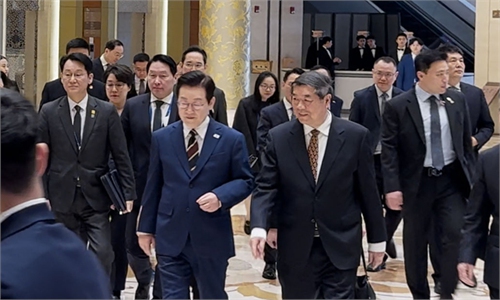
At the invitation of Chinese President Xi Jinping, South Korean President Lee Jae-myung arrived in Beijing on Sunday for a state visit to China from Sunday to Wednesday. This is President Lee's first visit to China since taking office. He is also the first foreign head of state to visit China in 2026. In an interview with Global Times (GT) reporter Qian Jiayin, Woo Su-keun (Woo), head of the Institute of East Asian Studies of Korea and president of the Korea-China Global Association, said that Lee's visit signals a more stable and manageable China-South Korea relationship.
GT: President Lee's visit marks the first visit to China by a South Korean president since 2019. In your view, what are the core objectives of President Lee's visit?
Woo: President Lee's visit to China should be seen as more than a routine diplomatic engagement. It is a strategic attempt to recalibrate the bilateral relationship after several years of accumulated uncertainty and misunderstanding. In a period of heightened geopolitical tensions and rapid systemic changes, the most immediate objective is to rebuild mutual confidence and normalize high-level communications. At a broader level, the visit signals a shift away from event-driven diplomacy toward a more stable and manageable relationship. The aim is not only to repair ties, but also to place the China-South Korea ties on a more predictable and sustainable footing, one that can manage differences while expanding space for practical cooperation.
GT: This year holds particular significance for China-South Korea relations. China succeeds South Korea as the host of APEC in 2026, and the China-South Korea Free Trade Agreement (FTA) will enter a new decade, with the second-phase negotiations accelerating. Against this backdrop, how do you assess the significance of President Lee's visit to China?
Woo: This year carries both symbolic and substantive weight for China-South Korea relations. The transition of the APEC chairmanship from South Korea to China underscores continuity in regional responsibility and leadership, at a time when the global economy faces fragmentation and uncertainty. It also highlights the shared interest in keeping multilateral economic cooperation functional and credible. At the same time, the China-South Korea FTA enters a new decade, with the second-phase negotiations expected to accelerate. This points to the need for more sophisticated, rules-based cooperation beyond traditional trade. Against this backdrop, President Lee's visit offers a timely opportunity to review the existing frameworks and set clearer directions for deeper, future-oriented economic engagement.
GT: China-South Korea interactions have intensified in recent months, with frequent high-level exchanges and visits by special envoys. What shared demands or strategic assessments do you think are driving the diplomatic engagement?
Woo: The recent intensification of high-level exchanges is best understood as a response to the structural shifts in the international environment. Prolonged major-power competition, supply-chain restructuring, technological rivalry and growing regional security uncertainties have increased the strategic value of stable and predictable relations between China and South Korea. In this context, both sides appear to have recognized that unmanaged frictions are costly, while pragmatic cooperation remains mutually beneficial. Dense diplomatic engagement therefore reflects a shared judgment: Differences should be contained through dialogue, and cooperation - where feasible - should be preserved and expanded through practical arrangements.
GT: Economic and trade cooperation has long served as the ballast stone of China-South Korea relations. It is reported that a business delegation of around 200 executives is accompanying President Lee on his visit. What signals does such a large scale business delegation send?
Woo: A business delegation of this scale conveys a clear message: Economic cooperation remains the most resilient and practical pillar of China-South Korea relations. It does not necessarily imply a return to the past patterns of interdependence; rather, it suggests a renewed effort to adapt cooperation to a more complex global environment. In particular, it signals a strong interest in forward-looking areas - advanced manufacturing, the digital economy, green transition and supply-chain stability - where tangible outcomes are possible. In effect, the delegation underscores a shared priority: to strengthen predictability and confidence in economic engagement regardless of short-term political fluctuations.
GT: President Lee had stated that South Korea can no longer return to the traditional model of relying on the US for security and relying on China for economic benefits. How do you evaluate President Lee's efforts and effectiveness since taking office in balancing the relations between China and the US?
Woo: President Lee's statement that South Korea can no longer rely on the traditional model of security dependence on the US and economic dependence on China reflects a realistic reading of today's strategic constraints. The South Korea-US alliance remains a central pillar of Seoul's security posture, while cooperation with China is indispensable for economic vitality and regional stability. Since taking office, President Lee appears to have pursued continuity in the alliance framework while signaling that China-South Korea relations should not be treated as a zero-sum variable. Rather than abrupt shifts, his approach seems incremental - aimed at widening diplomatic autonomy and strategic flexibility over time. Given the complexity of the current environment, such calibrated balancing can be considered a prudent course.
GT: Due to Japan's recent erroneous remarks on the Taiwan question and provocative actions, the China-Japan-South Korea trilateral summit has been postponed, and Japan's recent moves are widely seen as a constraint on deeper regional cooperation. In your view, how might Japan's words and deeds affect trilateral cooperation?
Woo: Trilateral cooperation among China, Japan and South Korea depends fundamentally on political will and responsible conduct by all three parties. When historical issues or inappropriate remarks and actions undermine trust, they inevitably slow coordination and complicate efforts to deepen cooperation. That said, these constraints do not eliminate the underlying need for trilateral engagement. Climate action, economic stability, supply-chain resilience and regional security all continue to require coordination among the three countries. In practice, progress may proceed in a gradual and differentiated manner, with cooperation advancing first when political conditions and readiness are most favorable.
GT: Looking ahead, in your view, to move China-South Korea relations from the current recovery phase toward sustained and stable development, in which key areas do both sides most urgently need to build consensus?
Woo: To move from recovery phase to stable development, the most urgent task is to institutionalize mutual trust. First, clearer rules and greater predictability are needed in economic and technological cooperation - both to reduce uncertainty for businesses and to support longer-term investment decisions. Second, on security-related affairs, strengthened communication mechanisms are essential to prevent misperception and to manage sensitivities in a disciplined way. Finally, expanding exchanges among youth, local governments and civil society can broaden the social foundation of the relationship. When consensus accumulates across these layers, China-South Korea relations will be better positioned to enter a phase of stable and sustainable development.
RELATED ARTICLES