Xi meets Irish Taoiseach, noting multilateralism, international fairness, justice
By and Li Yu Published: Jan 06, 2026 01:12 AM
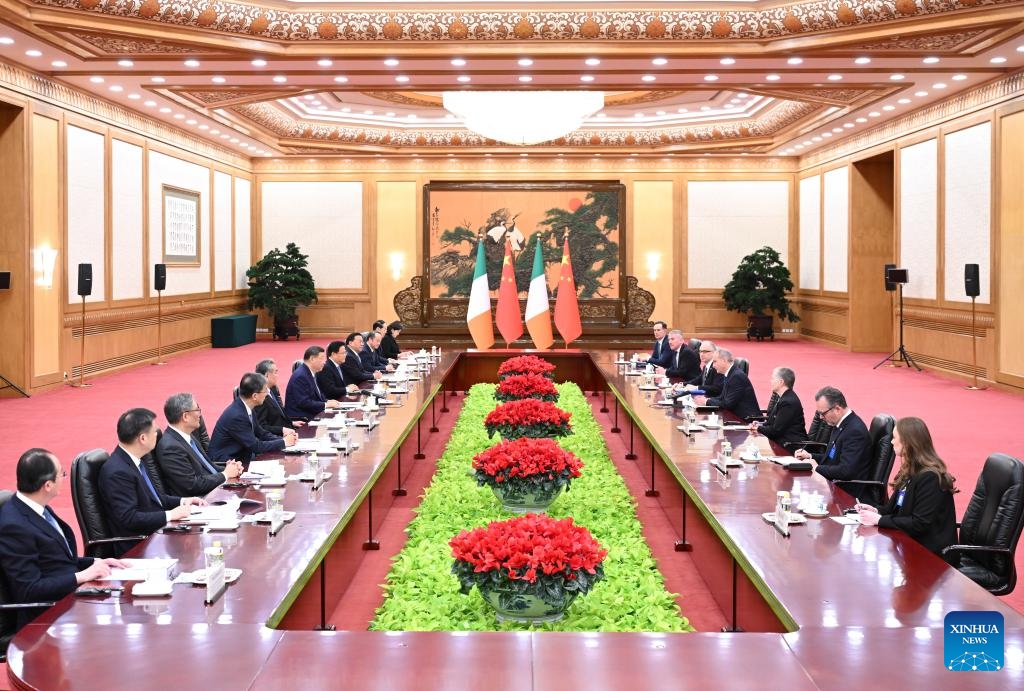
Chinese President Xi Jinping meets with Taoiseach of Ireland Micheal Martin at the Great Hall of the People in Beijing, capital of China, Jan. 5, 2026. (Photo: Xinhua)
All countries should respect the development paths chosen by the peoples of other nations, and abide by international law as well as the purposes and principles of the UN Charter, with major countries taking the lead in doing so, Chinese President Xi Jinping said on Monday, Xinhua News Agency reported.
In a world beset with changes and chaos, unilateral and bullying acts are severely undermining the international order, Xi said when meeting with Taoiseach of Ireland Micheal Martin in Beijing.
Many international media, such as CNN and El Mundo highlighted the remarks of Chinese President as they intensively report the US military operation on Venezuela, seizure of its president Nicolas Maduro, and aftermath of it.
Both China and Ireland support multilateralism and advocate international fairness and justice, Xi added, while urging the two sides to strengthen coordination and cooperation in international affairs, and jointly maintain the authority of the UN and make the global governance system more just and equitable.
According to Xinhua, Martin said that China plays an indispensable and important role in international affairs, making positive contributions to upholding the authority of the UN and promoting world peace. He said Ireland is willing to maintain close communication and coordination with China, uphold international law, adhere to free and open trade, promote global prosperity and stability.
Martin is on his visit to China from January 4 to 8, marking the first visit to China by an Irish Taoiseach in 14 years. Martin is also the first leader from a European country to visit China in 2026. Following the diplomatic itinerary in Beijing, Martin will visit Shanghai.
Strong commitment
China is willing to strengthen strategic communication with Ireland, deepen political mutual trust and expand pragmatic cooperation to benefit the peoples of both countries and add momentum to China-EU relations, Chinese President said during the meeting with Martin, Xinhua reported.
Xi said China is willing to strengthen economic and trade cooperation with Ireland, align development strategies in fields such as artificial intelligence, digital economy, and medicine and healthcare, promote two-way investment, leverage each other's strengths, share opportunities and pursue common development.
The two sides should enhance cooperation in education, culture and tourism to foster greater people-to-people affinity, and China welcomes more Irish youth to come to China for study and exchanges, Xi said.
Noting that Ireland firmly adheres to the one-China policy, Martin said the country is committed to developing the strategic partnership for mutually beneficial cooperation between the two countries, per Xinhua.
Ireland is willing to deepen cooperation with China in trade, investment, science and technology, biomedicine, renewable energy, artificial intelligence, education and other fields, Martin noted.
Martin released several X posts on Monday following his meeting with Chinese leader. In one post, he posted photo of him visiting the China's Palace Museum, writing "it offers a unique window into centuries of Chinese history and culture."
China-Ireland cooperation is characterized by distinct strategic complementarity and an innovation-oriented approach, Wang Hanyi, a research fellow at the Shanghai International Studies University, told the Global Times on Monday.
She added that bilateral cooperation in emerging fields such as low-carbon technology, agricultural technology, and smart cities is expected to expand rapidly. And in the long term, if breakthroughs can be achieved on key issues such as cross-border data flows, AI standards, and mutual recognition of pharmaceutical regulations, China-Ireland cooperation has the potential to become a "pioneering demonstration zone" for China-EU cooperation.
Facing the global geopolitical conflicts and economic fragmentation, China and Ireland jointly emphasize the multilateral system centered on the UN, which constitutes a clear rejection of unilateral bullying, said Wang.
Under the current circumstances, particularly the highly irresponsible actions of certain major powers, it is more urgent for China, Ireland and Europe to enhance consensus on global governance as well as peace and security issues, strengthen coordination, provide practical and feasible solutions, and even undertake joint actions, said Cui Hongjian, a professor at the Academy of Regional and Global Governance at Beijing Foreign Studies University.
China is Ireland's largest trading partner in Asia and its fifth largest globally. Irish exports to China are driven by medical equipment, pharmaceuticals, computer services and agricultural products, according to Dublin's Department of the Taoiseach.
Bridging role
As Dublin prepares to assume the rotating presidency of the EU in July, among the top objectives will be to shore up ties between the EU and China, AFP reported.
The Irish Times also highlighted that Taoiseach Martin is the first of a number of European leaders who are expected to visit Beijing in 2026, following separate state visits to China made by French President Emmanuel Macron and Spanish King Felipe VI in late 2025.
Speaking of China-EU relations, Xi said China and the EU should bear the long-term picture in mind, uphold the positioning of partnership, and view and handle differences objectively and rationally to work for win-win cooperation, according to Xinhua.
As Ireland will hold the rotating EU presidency in the second half of this year, China hopes Ireland will play a constructive role in promoting the healthy and stable development of China-EU relations, the Chinese President said.
Martin said it is crucial to maintain stable development in EU-China relations, and that the Irish side is willing to play a constructive role in promoting the healthy development of EU-China relations, Xinhua reported.
Reuters mentioned that Martin's trip came two weeks after China announced tariffs on EU dairy products, which was seen as countermeasure against the bloc's electric vehicle tariffs on China.
Expert noted that the Irish prime minister's visit to China as his first overseas trip of the new year signals the voice of the "pragmatic dialogue faction" within the EU.
Although bilateral relations may face potential constraints from the EU's "de-risking" push, Ireland's pragmatic diplomatic tradition and its economic needs will enable Dublin to play a unique "bridging role" in mitigating extremist tendencies in Europe and focusing on practical cooperation with China, said Wang.
China-EU relations have recently encountered some challenges, one key reason being that the EU's so-called "decoupling" tendency and it has failed to fully absorb the positive elements from member states' interactions with China, Cui said.
If China and Ireland can achieve substantive cooperative outcomes, it could potentially create a demonstrative effect within the EU, Cui said.
RELATED ARTICLES