China’s tightened export control of dual-use items to Japan targets dangerous signals from Tokyo in security domain, serves regional common interests: expert
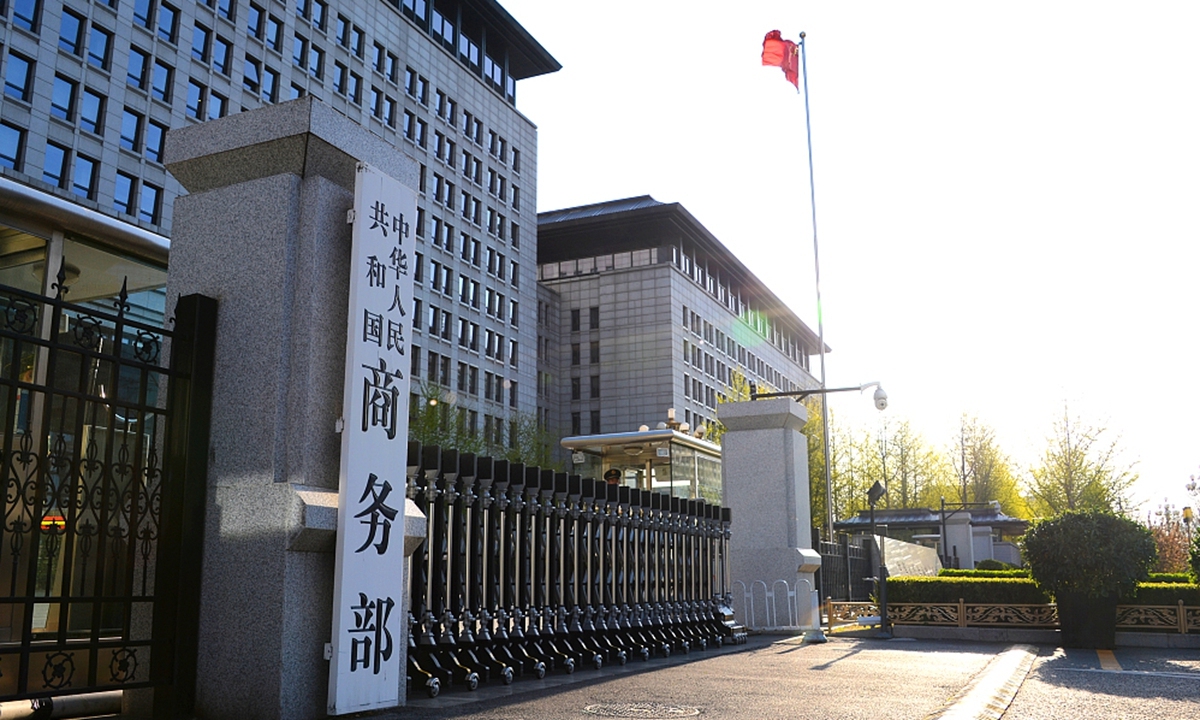
The Ministry of Commerce (MOFCOM) Photo: VCG
China announced on Tuesday the decision to strengthen export controls on dual-use items destined for Japan, in accordance with the relevant provisions of laws and regulations including the Export Control Law of China. The announcement takes immediate effect. The decision was made in order to safeguard national security and interests and fulfill international obligations such as non-proliferation, said China's Ministry of Commerce (MOFCOM) on Tuesday.
China has confined the export controls to military-related end users and uses that could enhance Japan's military capabilities, rather than imposing a blanket ban, reflecting a targeted and restrained approach consistent with international practice, a Chinese analyst said.
According to the MOFCOM, under the decision, all dual-use items are prohibited from being exported to Japan for military end users, military purposes, or any other end users or uses that contribute in any way to enhancing Japan's military capabilities.
Any organization or individual in any country or region that violates the above provisions by transferring or providing relevant dual-use items of Chinese origin to organizations or individuals in Japan will be held legally liable in accordance with the law, said the MOFCOM.
This is an export control measure implemented in accordance with laws and regulations, targeting dangerous signals recently released by Japan in the security domain, whose related moves could have a disruptive impact on regional peace and stability, Xiang Haoyu, a research fellow at the China Institute of International Studies, told the Global Times on Tuesday.
In recent years, multiple high-ranking Japanese politicians have publicly declared Japan's attempt to possess nuclear weapons while planning revisions to the "Three Non-Nuclear Principles," triggering domestic and international attention and concern.
Given this context, Xiang said that any spillover of such risks could have serious consequences, making it necessary for China to take corresponding measures to strengthen risk prevention, in line with the shared concerns of regional countries and the international community over safeguarding strategic stability and security.
As a responsible major country, China is committed to fulfilling international obligations such as non-proliferation. Against the backdrop of statements by relevant countries that could affect regional security and stability, China's decision to tighten export controls helps prevent the diversion of dual-use technologies to military expansion or conflict escalation, serving the common interests of the region and the international community, the analyst said.
On a further note, Xiang said that China has clearly limited the scope of the controls to military end users, military purposes, and other end uses that could enhance Japan's military capabilities, rather than adopting a "blanket ban," reflecting a targeted and restrained approach consistent with international practices. "Normal civilian trade and compliant commercial activities are unaffected, and normal economic and trade cooperation can continue as long as companies comply with export control regulations and due diligence requirements," said Xiang.
RELATED ARTICLES