How Japan’s military ambition undermines its postwar commitment to pacifism
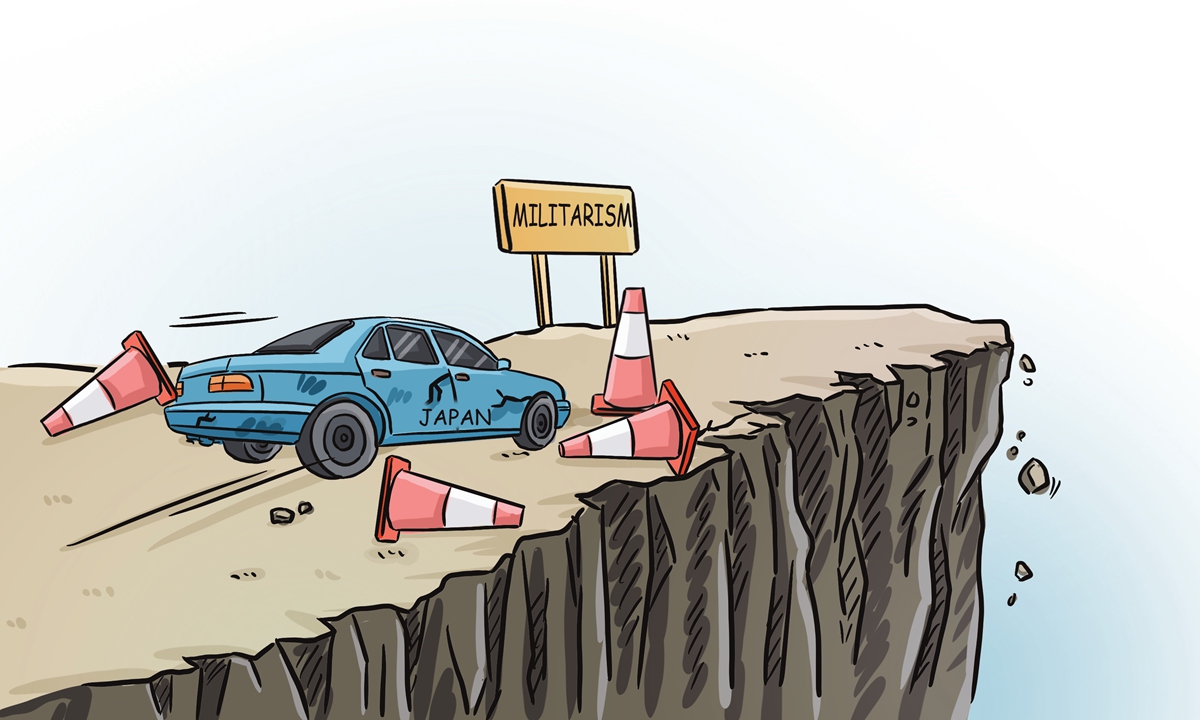
Illustration: Xia Qing/GT
During my research visits to Japan, I engaged with numerous scholars and practitioners in defense policy. When discussing Japan's current defense posture, a recurring response was that the country still "upholds the exclusively defense-oriented principle." However, is it true? Without speculating on the intent behind these statements, a historical examination of the "exclusively defense-oriented principle" - tracing its formation and evolution - offers crucial context for understanding how Japan's contemporary defense policy diverges from its postwar identity as a defeated nation.
Attempts to abandon the 'exclusively defense-oriented principle'
In 1947, following its defeat, Japan enacted a new constitution that embodied the principles of international instruments such as the Potsdam Proclamation. Article 9 of the Constitution stipulates: "Land, sea, and air forces, as well as other war potential, will never be maintained. The right of belligerency of the state will not be recognized." This renunciation of "war potential" and denial of the right of belligerency formed the foundational basis for Japan's postwar identity as a "peaceful nation." To uphold this identity, Japan's defense policy was consequently required to align with a corresponding pacifist posture.
In a Diet statement on March 10, 1952, then prime minister Shigeru Yoshida acknowledged that Article 9 of the Constitution prohibited Japan from maintaining military forces, even for defensive purposes. However, following the establishment of the Japan Self-Defense Forces (SDF) in 1954, Japan adopted its "exclusively national defense-oriented policy as its basic strategy of defense, and continues to keep it equipped and ready for operations." This created a direct contradiction with the earlier governmental interpretation. To resolve this constitutional tension, the Japanese government introduced the concept of the "minimum necessary force."
What is the "minimum necessary force"? In short, while the Constitution does not deprive Japan of the inherent right of self-defense enjoyed by all sovereign states, this right under international law is bifurcated into individual and collective self-defense. The government posits that the SDF is authorized only to exercise the right of individual self-defense. Consequently, its military capability must be confined strictly to the "minimum" necessary level deemed essential for that sole purpose.
After addressing the "constitutionality" of the SDF, the Japanese government needed to clarify its primary mission. In 1970, Japan formally defined the "exclusively defense-oriented policy" in the first edition of its Defense White Paper.
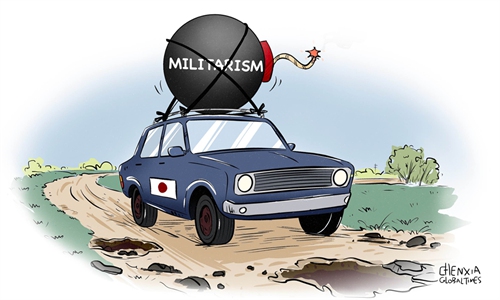
If we further analyze the "exclusively defense-oriented principle," we find that its scope encompasses limiting defense spending to within 1 percent of gross national product (GNP), refraining from exercising the right to collective self-defense, and not possessing "offensive weapons." According to Japan's 1996 diplomatic bluebook, based on its pacifist stance of "exclusively defense-oriented policy," Japan decided on an approach of "not becoming a military power that might pose a threat to other countries." Accordingly, Japan's defense expenditures should be confined to the 1 percent of GNP framework. Furthermore, because Japan is dedicated to the "exclusively defense-oriented policy," the SDF cannot exercise the right to collective self-defense. Simultaneously, the weapons and equipment possessed by the SDF are restricted to the "minimum necessary" for self-defense purposes. Therefore, the possession of "offensive weapons," including nuclear weapons, intercontinental ballistic missiles, attack aircraft carriers and long-range strategic bombers, is prohibited. However, with Japan's recent military expansion policies, the "exclusively defense-oriented principle" has, in reality, been abandoned, leading to the near collapse of Japan's identity as a "peaceful nation."
Collapse of Japan's 'peaceful nation' narrative
First, Japan's defense spending has significantly exceeded the "GNP 1 percent ceiling." In 2022, Japan released new "three security documents," proposing to increase defense spending to "2 percent of GDP within five years," meaning its defense expenditures would rise to 43 trillion yen from 2023 to 2027. However, Japan's 2026 defense budget will exceed 9 trillion yen, surpassing the initially set target of 8.7 trillion yen. In other words, Japan will achieve its goal of increasing the defense budget share ahead of schedule.
Second, Japan has substantially lifted restrictions on the exercise of collective self-defense rights. On July 1, 2014, the Shinzo Abe Cabinet forcibly passed a cabinet resolution partially lifting restrictions on collective self-defense. However, at the request of its then-ruling coalition partner, the Komeito Party, Japan's exercise of collective self-defense rights was subject to some stringent preconditions: First, an armed attack against a foreign country that is in close relationship with Japan occurs and there is a clear danger that Japan's survival to be threatened and for people's right to life, liberty and the pursuit of happiness to be fundamentally overturned. Second, there are no other appropriate means available to repel the attack and ensure Japan's survival and protect its people. Third, the use of force must be kept to the minimum extent necessary.
With the dissolution of the LDP-Komeito coalition, the LDP formed a new ruling alliance with the Japan Innovation Party, which shares its radical stance on constitutional revision. Without Komeito's restraint, Japan is likely to lift all restrictions on the exercise of collective self-defense rights.
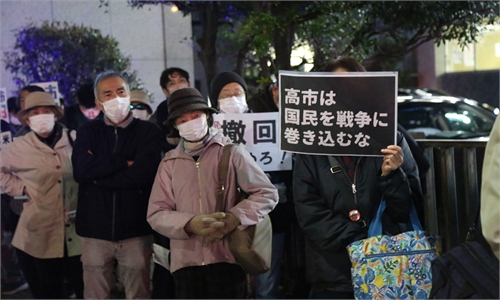
Third, Japan is striving to restore the right to wage war. For instance, recent remarks by Japanese Prime Minister Sanae Takaichi suggesting Japan could exercise collective self-defense rights regarding Taiwan represent the first official diplomatic signal since its defeat in World War II, indicating Japan's willingness to provoke China into armed conflict. This severely violates Article 9 of the Constitution.
Fourth, Japan's domestic nuclear taboo has been severely shaken. As early as the 1950s, Japanese politicians led by former prime minister Nobusuke Kishi supported the argument that defensive nuclear weapons are constitutional, seeking a legal loophole for Japan to possess nuclear weapons. However, this view was not mainstream in Japan then. Nevertheless, even during the Cold War, Japan deliberately pursued a nuclear path enabling the production of reactor-grade plutonium, thereby maintaining its status as a "nuclear threshold" state. Given the fact that, in recent years, multiple high-ranking Japanese politicians have publicly declared Japan's capability to possess nuclear weapons while planning revisions to the "Three Non-Nuclear Principles," Japan's future independent development of nuclear submarines, or even nuclear weapons, cannot be ruled out.
This year marks the 80th anniversary of the victory in the Chinese People's War of Resistance against Japanese Aggression and the World Anti-Fascist War. Japan's military expansionist policies not only contradict its "exclusively defense-oriented policy" but also undermine the peace-oriented postwar international order. How to manage Japan's security policies within multilateral platforms like the United Nations has become an urgent common challenge for all nations.
The author is a lecturer at Shanghai University of International Business and Economics. opinion@globaltimes.com.cn
RELATED ARTICLES