Takaichi’s erroneous remarks on Taiwan reveal hazardous trajectory of Japan’s policies
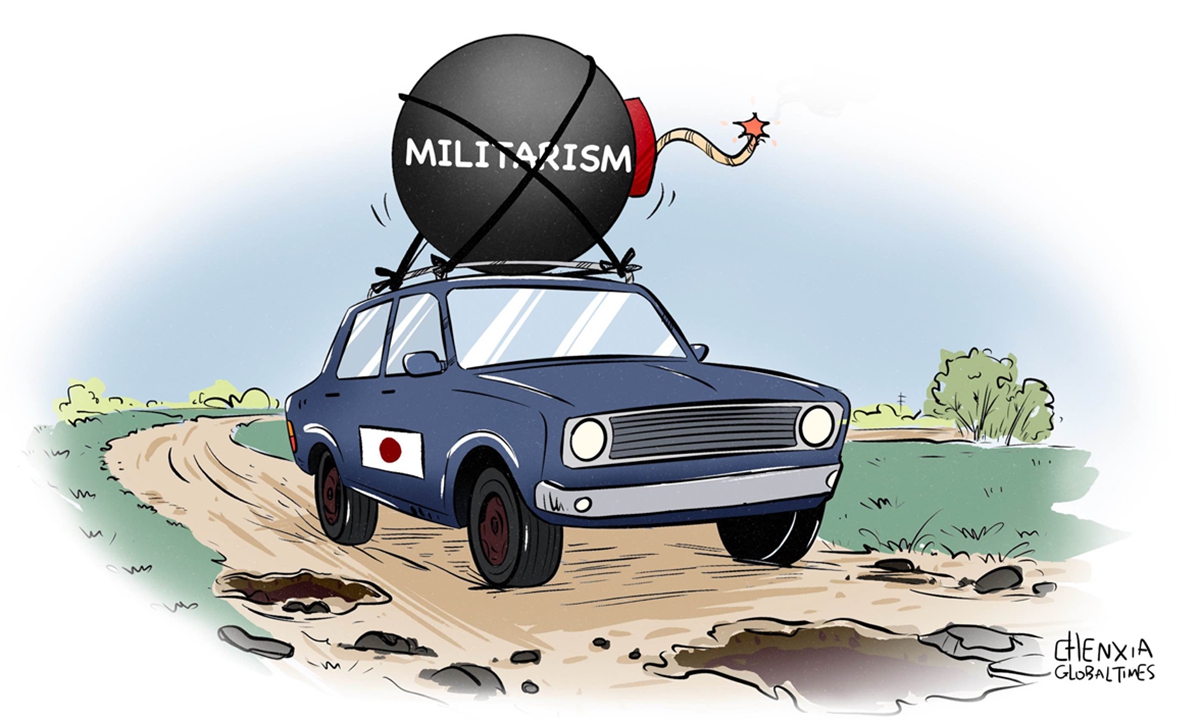
Illustration: Chen Xia/GT
Editor's Note:An academic seminar to discuss Japanese Prime Minister Sanae Takaichi's recent erroneous remarks on Taiwan was held at China Foreign Aff airs University (CFAU) on Saturday. During the event, participating experts and scholars delved into key issues, including the motivations behind Takaichi's statements, legal dynamics of China-Japan relations, the legitimacy of countermeasures and trends in international public opinion. The Global Times presents selected highlights from the seminar for readers.
Failure to halt Japan's regression on Taiwan question will lead to severe consequences
Wang Shiting, secretary of the Communist Party of China Committee of CFAU
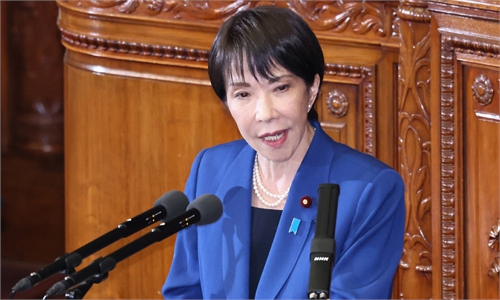
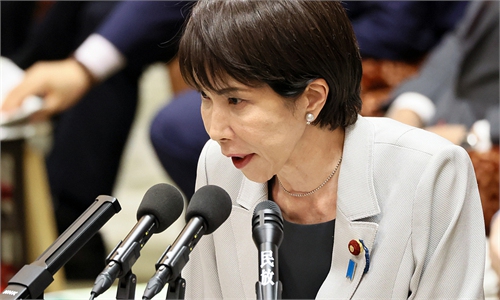
Takaichi's remarks mark the first time since Japan's defeat in 1945 that a sitting Japanese leader has openly advocated the erroneous notion that "a Taiwan contingency is a Japanese contingency" in an offi cial setting, linking it to the exercise of the right to collective self-defense. This is also the first explicit expression of Japan's ambition to attempt military intervention in the Taiwan Straits and the fi rst direct military threat against China. Takaichi's rhetoric reveals her extremely erroneous and perilous views on history, China, international order and the postwar framework. The fallacies she has propagated regarding Taiwan represent a dangerous discourse within Japan's political arena, highlighting the highly hazardous trajectory of Japan's domestic and foreign policies.
Hu Jiping, president of the University of International Relations
Takaichi's remarks represent a complete reversal of the Japanese government's previous stance on the Taiwan question. It is imperative to reaffirm the fundamental principles underlying China-Japan relations. Failure to halt Japan's regression on the Taiwan question will inevitably lead to severe consequences. The Japanese government's so-called "consistent position" on the Taiwan question is deceptive - misleading both the international community and the Japanese public. To counter this false narrative, China must systematically demonstrate all relevant historical statements made by Japan.
Liu Jiangyong, professor at the Institute of International Studies of Tsinghua University
Takaichi's reckless remarks on Taiwan not only violate international law but also contravene Japan's domestic legislation. They must be fully retracted, and she should apologize to all parties harmed by her statements. In her latest parliamentary response, Takaichi further claimed that Japan had renounced all rights over Taiwan under the "Treaty of San Francisco" and is therefore not in a position to recognize Taiwan's legal status. This constitutes yet another provocation against China's core interests within Japan's Diet.
Huang Dahui, professor of the School of International Studies at Renmin University of China
Takaichi's remarks represent a concentrated reflection of the socio-political rightward shift in Japanese society since the end of the Cold War. In terms of public discourse, left-leaning voices in Japan have significantly weakened, while right-wing forces now dominate the media landscape. This dominance allows them to exert pressure on government policies while shaping public perception. Japan has recently witnessed a notable rise in populism, particularly in the form of online nationalism, which has fostered the emergence of "online right-wingers" (netto uyoku) within Japanese society. This segment is particularly active among younger generations. Given the profound transformation in Japan's domestic political landscape, we must avoid assessing Japan through the lens of perceptions from two or three decades ago.
Sun Ming, vice president of the Academy of Contemporary China and World Studies
On certain international social platforms, a significant number of accounts registered in Japan express support for Takaichi's remarks, with hardline right-wing voices being particularly prominent. While it is important to consider the "silent majority" within Japanese society, the emergence of "online right-wingers" has indeed become a representative phenomenon in Japan today. In addition to political influences, social media platforms, constrained by their algorithmic mechanisms and the country's monolingual character, combined with manipulation by local media outlets, are more prone to forming information cocoons among Japanese netizens.
Wang Xu, deputy director of the Institute of Maritime Strategy at the China Institutes of Contemporary International Relations
Takaichi's provocation was not an impromptu gaffe, but rather reflects Japan's long-standing ambition to intervene in Taiwan affairs. First, Japan holds a particular "complex" regarding the Taiwan region, having consistently coveted influence over the island and persistently implementing infiltration efforts through various means. Recent reports have exposed Japan's substantial financial funds in cultivating pro-Japanese factions in the region. Second, Japan is actively strengthening its military capabilities. A landmark development is the revision of the three security and defense-related documents, including the National Security Strategy, with the fundamental objective of military expansion. Right-wing political forces in Japan falsely perceive intervention in the Taiwan Straits as their final opportunity to achieve national revival.
'Return to prewar Japanese state' has become a reality demanding heightened vigilance
Zhang Lili, professor of the Department of Diplomacy and Foreign Affairs Management at CFAU
Takaichi's erroneous remarks strike at the fundamental political foundation of China-Japan relations, constituting the most consequential event in bilateral relations since the normalization of diplomatic ties between the two countries in 1972. The Takaichi cabinet is recklessly accelerating down the path of military expansion. Is this driven by any actual contingency?
None exists - the Taiwan region is generally stable now, and East Asia as a whole remains peaceful. Right-wing political forces like Takaichi are merely fabricating pretexts. Japan currently faces a severe fi scal crisis, yet Takaichi off ers no viable solutions. Instead, she seeks to divert attention from domestic economic pressures by reviving militarist policies to secure support from right-wing factions,attempting to consolidate her position as prime minister and prolong her tenure.
Wang Jian, research fellow of the Institute of Modern History at the Chinese Academy of Social Sciences
Takaichi's recent remarks primarily reflect the political ideology of former Japanese prime minister Taro Aso. First as deputy prime minister and later as vice president of the Liberal Democratic Party, Aso made similar statements twice. However, Takaichi's case is fundamentally diff erent. As the sitting prime minister, she chose the Diet to publicly articulate extremely fallacious views on Taiwan. This constitutes an overt and direct violation of China's sovereignty, compelling China to heighten its vigilance. Japan may potentially pose direct strategic threats and challenges to China regarding the Taiwan question in the future, and China must maintain full preparedness to respond resolutely at all times.
Xiang Haoyu, distinguished research fellow at the Department for Asia Pacifi c Studies of the China Institute of International Studies
I believe that the previously proposed concept by left-leaning scholars of "returning to prewar Japanese state" has become an indisputable reality, demanding heightened vigilance. "Return to prewar Japanese state" manifests in several aspects. First, there is a regression in the political spectrum and a near silencing of pro-China voices.
Second, this phenomenon relates to historical perception. Historical revisionism in Japan has become systematic and mainstream. Third, a trinity of anti-China forces comprising political, media and academic circles has taken shape in Japan. These three sectors represent the most powerful core of Japan's ruling elite, wielding significant discursive and political power. This has fostered and amplified "anti-China sentiment" within Japanese society, fundamentally undermining the public opinion foundation of China-Japan relations.
RELATED ARTICLES