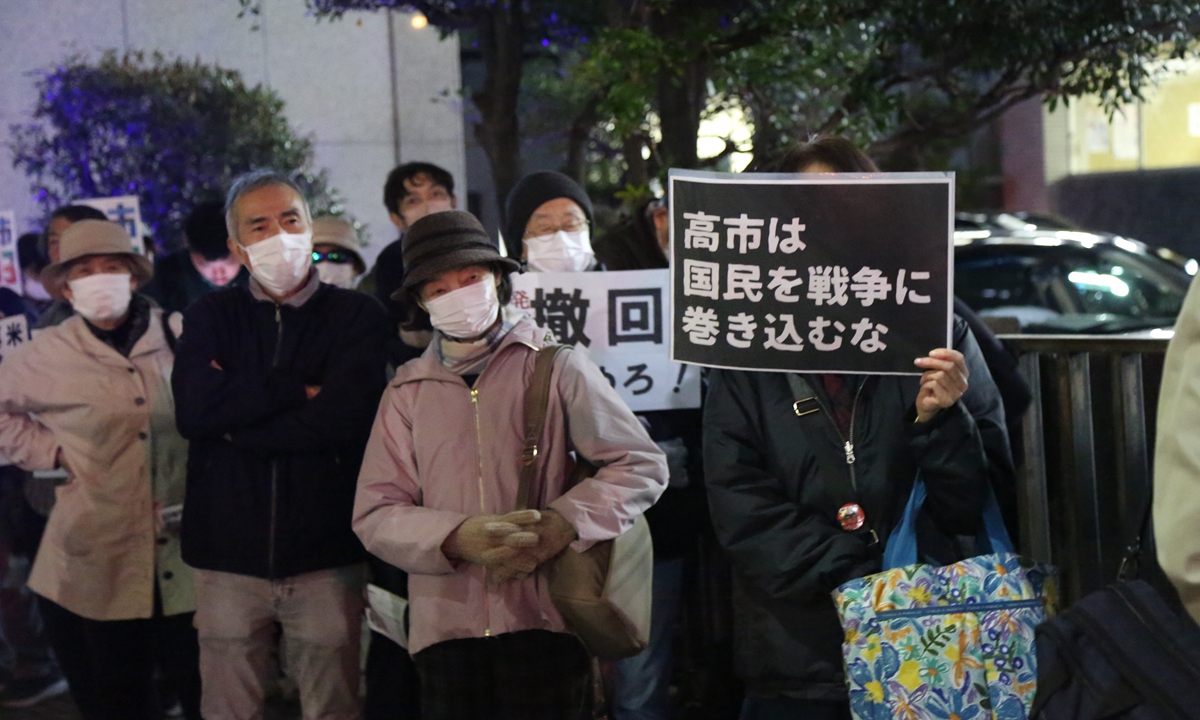
Japanese citizens protest outside the Japanese Prime Minister Sanae Takaichi's official residence over her erroneous remarks on Taiwan on November 25, 2025 Photo: VCG
Editor's Note:
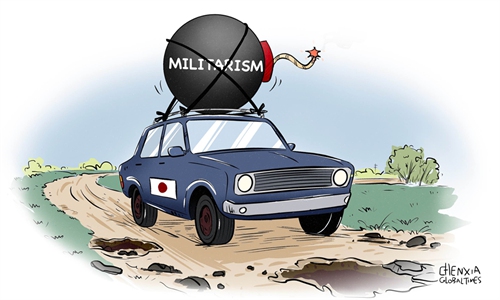
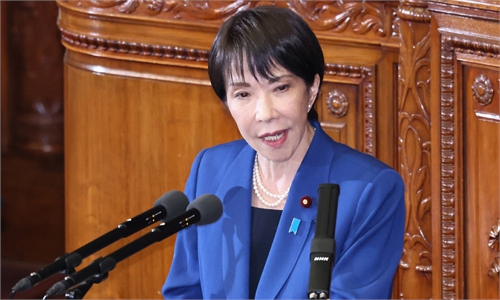
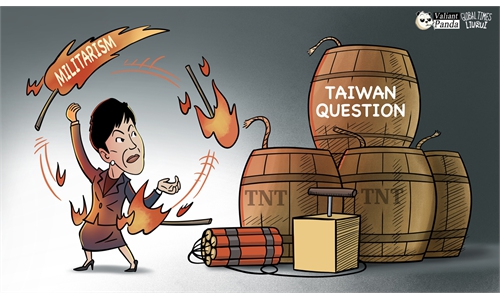
Japanese Prime Minister Sanae Takaichi recently made erroneous remarks on Taiwan, stating that a "Taiwan contingency" could constitute a "survival-threatening situation" for Japan, implying that Japan could exercise the right of "collective self-defense" and making Japan's armed intervention in the Taiwan Straits a possibility. These remarks have not only jeopardized China-Japan relations, but also have fueled anxiety within the international community regarding the revival of Japan's militarism. In her I-Talk show, Global Times (GT) reporter Wang Wenwen talked to Jiro Yamaguchi (Yamaguchi), a professor at Hosei University and former advisor to the cabinet of then prime minister Tomiichi Murayama, about Takaichi's calculations behind her remarks and their implications for Japan's domestic politics.
GT: Takaichi is the first sitting Japanese leader in decades to publicly link so-called Taiwan contingency with the possible deployment of Japanese troops. No previous Japanese government has gone this far. In your view, why has she chosen to take such an aggressive stance on Taiwan, one that is more radical than those of her predecessors?
Yamaguchi: I must say it is very thoughtless of Prime Minister Takaichi to mention the so-called Taiwan contingency. Japanese prime ministers have been refraining from directly talking about the so-called Taiwan contingency and they were cautious enough to avoid needless frictions between Japan and China.
Now the Liberal Democratic Party (LDP) is very weak. The ruling party doesn't have a majority in both houses in the Diet. But interestingly, the weaker the LDP becomes, the more Takaichi seeks to strengthen her conservative supporters. That's why she has deliberately adopted a provocative approach toward China. She wants to present favorable narratives to her own core supporters in the conservative camp. She wants to expand the role of the Self-Defense Forces if any military conflict occurs in the Taiwan Straits.
However, not only many politicians in the opposition but also in the LDP worry that the thoughtless talk about Taiwan would bring about serious conflict or crises in Japan-China relations. I don't deny that Takaichi has a kind of revisionist idea about modern history. She often justifies the aggression of colonial rule before and during World War II (WWII). Former prime minister Shinzo Abe was also revisionist, but he took pragmatic approach toward foreign countries to avoid criticism from international society. It seems to me that Takaichi deliberately tries to isolate Japan by causing unnecessary tension in East Asia. I see very dangerous symptoms among the Japanese political leaders in the current government.
GT: Some have argued that Takaichi, through her remarks on Taiwan, is deliberately amplifying the "China threat" rhetoric and using it as a pretext to justify Japan's military buildup and its departure from an exclusively defense-oriented policy. How do you assess this argument?
Yamaguchi: Conservative or right-wing politicians have long had the agenda of the revision of the constitution, especially Article 9. They really want to expand military forces of Japan.
Before the Takaichi administration, the LDP formed a coalition government with Komeito. Komeito is a rather realistic party and had good relations with China historically. In the coalition government of the LDP and Komeito, Komeito played an important role in putting the brakes on aggressive policies by the LDP, but Komeito has left the coalition because Takaichi refused to implement reforms of the regulation on political fundraising.
Now the governing coalition is tilting toward the right compared with the LDP-Komeito coalition by co-opting Ishin, which is even more conservative than the LDP. It is possible that this coalition government will propose an amendment to the constitution in the near future. There is no one to put a brake on such reckless policies within the coalition government. This is a very serious political problem.
GT: As a Japanese scholar and former advisor to the cabinet of then prime minister Tomiichi Murayama, who in 1995 issued the famous Murayama Statement that explicitly acknowledged Japan's past aggression and colonial rule, what worries you the most?
Yamaguchi: I can't believe that our prime minister mentioned the possibility of going to war with China. No prime minister in Japan has mentioned the possibility of war before her because they shared memory of the war. It is 80 years since the end of WWII, and the national belief in peace has been eroding in the past 30 years. Politicians who know nothing about wars want to demonstrate they can use military powers.
GT: What would be your suggestion to the Japanese government in its approach toward the Taiwan question?
Yamaguchi: China and Japan signed a peace treaty, and we have an agreement regarding the territorial integrity and unity of the state. The Japanese government and Japanese people do not support independence of Taiwan.
The Diet session is continuing and will last until the middle of December, during which Takaichi will have opportunities to revise her answers. She should express some remorse or apology and confirm the continuity of Japan's basic approach toward China.
GT: In an article you wrote before Takaichi took office, you said that "whether Takaichi can achieve political stability depends on her ability to defy her right-wing supporters' expectations and reverse the irresponsible policies and exclusionary attitudes she has previously espoused." Given her actions and rhetoric to date, do you believe she can achieve long-term political stability?
Yamaguchi: No, not at all. She only wants to please her own conservative supporters. She doesn't have a broad view, and is pursuing short-term interests. Compared with previous prime ministers in the LDP, Takaichi is undermining the political stability in Japan. So we will face more serious political turmoil in Japan.
Many Japanese people want peace and stable relations with China, and many want to preserve the memory of the war. In the 1995 Murayama Statement, then prime minister Tomiichi Murayama expressed a deep apology to China and other Asian countries for Japan's path of aggression and colonial rule. This spirit is still shared among a wide range of Japanese people. So please understand that there are counter-activities and arguments against Takaichi's rather insane, aggressive approach.
Liu Xuandi contributed to this story.
RELATED ARTICLES