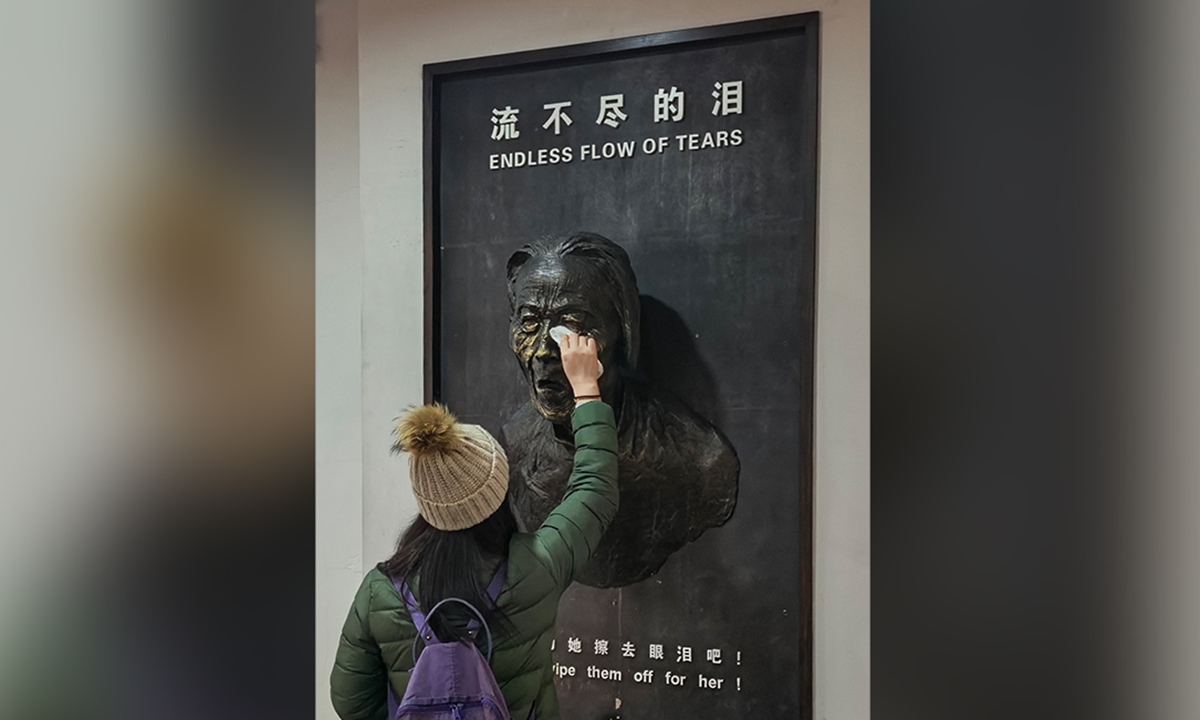
A visitor wipes away the "tears" of a comfort woman sculpture at the former site of the comfort station in Liji Lane, used by the Japanese invading forces in Nanjing, East China's Jiangsu Province, on December 13. Photo: Cui Meng/GT
Editor's Note:
December 13 marked China's 12th National Memorial Day for Nanjing Massacre Victims. On this day in 1937, the invading Japanese army captured Nanjing and the atrocities began. Over the next six weeks, more than 300,000 Chinese civilians and unarmed soldiers were killed by the Japanese invaders. Nonetheless, there have been trends indicating that historical revisionist discourses are regaining a foothold in Japan. What worrying consequences would such trends bring to the region? How urgent is it to clarify the truth in shaping a correct historical perspective for Japan's younger generation? Hisashi Inoue (Inoue), honorary professor at Surugadai University and chairman of the Japan-China Friendship Association, shared his view in an interview with Global Times (GT) reporter Wang Zixuan.
GT: Recently, the Nagasaki Atomic Bomb Museum plans to change the term "Nanjing Massacre" to "Nanjing Incident." Scholars have described this as historical revisionism. What is your view on this change?
Inoue: The issue lies in Japanese right-wing revisionists demanding alterations or deletions from exhibitions at public museums, memorials and similar institutions, claiming they must "defend Japan's honor." Although revisionists are a minority, they are characterized by persistently sending complaints to administrative bodies and aggressively spreading their claims via social media. This case appears to be an instance where Nagasaki City sought to deflect such attacks by adopting a "neutral" name under pressure from these right-wing groups.
GT: As a leading researcher on the Nanjing Massacre, what worries you as historical revisionist discourses regain ground in Japan? How urgent is it to clarify the truth in shaping a correct historical perspective for Japan's youth?
Inoue: The narratives of Japanese revisionists start with entirely unfounded conclusions that the Nanjing Massacre is merely Chinese propaganda, or that it never happened. They will utilize any falsehood to uphold these conclusions. They do not seriously examine historical materials or conduct research. No matter how many historical facts based on primary sources are presented to them, it is unlikely they will alter their dogmatic conclusions. While this handful of die-hard revisionists, who would rather die than repent, are not numerous, they use the internet to disseminate their erroneous conclusions. These are then repurposed and reused, influencing Japanese youth who lack knowledge of historical facts.
Regrettably, within Japan's online sphere, the voices of scholars and ordinary citizens stating historical facts are very few, and revisionists currently dominate. It is crucial that history education in schools is based on historical facts, and teaches young students not to be deceived by right-wing propaganda.
GT: Has your research on the Nanjing Massacre brought you pressure or misunderstandings in Japanese society? What motivates you to promote mutual understanding and peace between China and Japan?
Inoue: As a historical researcher, I believe the most important task is to elucidate the changes of that era based on historical facts. Even if it is disgraceful for Japan, historical truth cannot be altered. Nothing is stronger than facts. Therefore, I pay no heed whatsoever to being labeled an "anti-Japanese element;" indeed, I consider it an honor to be reviled for speaking the truth.
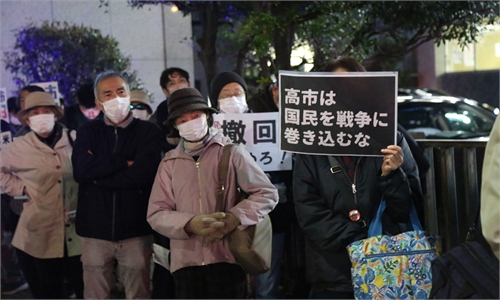
GT: Japanese Prime Minister Sanae Takaichi's recent erroneous remarks on the Taiwan question have severely damaged China-Japan relations. What do you think is the root cause of such provocative statements? Are they linked to Japan's domestic political rightward shift?
Inoue: Takaichi represents the current right-wing faction within the Liberal Democratic Party (LDP). The LDP takes a pro-US right-wing stance, which have been exemplified by figures such as Nobusuke Kishi (Shinzo Abe's grandfather), Taro Aso and Shinzo Abe himself, currently within which Takaichi is positioned. They are distinguished by their advocacy of anti-communism, pro-Americanism stance, historical revisionism and constitutional revision. Organizations such as Nippon Kaigi and the Shinto Association for Spiritual Leadership exist behind them. Against this backdrop, Takaichi's remarks on November 7 emerged.
The rise of an ultra-right figure like Takaichi to prime minister within the LDP reflects the rightward shift in Japanese politics. Abe's prolonged tenure as prime minister allowed this faction to amass considerable influence. Takaichi sees herself as Abe's successor, though her political competence falls short of his.
A significant portion of the Japanese population, dissatisfied with the nation's prolonged recession and economic decline, supports Takaichi. Simultaneously, Takaichi harbors extremely negative sentiments toward China. She has never actively acknowledged China's economic development or social progress. The Japan-China Friendship Association is striving tenaciously to sustain nongovernmental exchanges even with such an anti-China government, but the difficulties are growing.
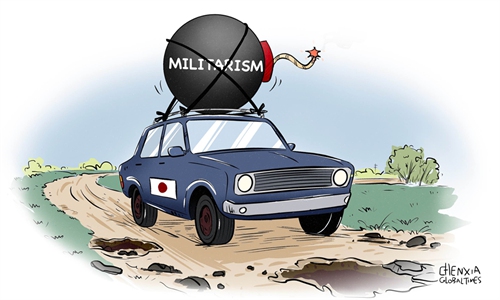
GT: Japan has continuously increased defense spending. According to Japanese media reports, Japan is considering allocating a record high of about 9 trillion yen ($58 billion) for next fiscal year's defense budget. Many in Asian countries worry this signals a revival of Japanese militarism. What is your view on this concern? Are there similarities between these trends and Japan's pre-war path to militarism?
Inoue: During the Abe administration of the 2010s, Japan's defense policy underwent significant changes. The government at the time permitted the exercise of collective self-defense rights in 2015 and has steadily increased defense spending. This shift occurred against the backdrop of changes in US policy toward China and pressure exerted on Japan.
Such moves are naturally viewed with caution not only by China but also by other Asian nations as a resurgence of militarism. However, unlike the militarism of the past, present-day Japan is subordinate to the US. Moreover, China has grown immensely powerful. Therefore, any attempt to rebuild something like the "Greater East Asia Co-Prosperity Sphere" of the 1930s and 1940s is absolutely impossible.
GT: Following the deterioration of China-Japan relations, what specific work should and can Japanese civil groups, like the Japan-China Friendship Association, do to restore trust?
Inoue: Intergovernmental discord and tension are expected to persist into the coming year. While the duration of the Takaichi administration remains uncertain, it is imperative that nongovernmental organizations continue exchanges and rebuild trust. Notably, our Japan-China Friendship Association operates entirely independently, free from control by the Japanese government. It is crucial for such organizations to engage in activities such as informing the Japanese public about facts-based history and contemporary China, as well as dispatching delegations to China.
For the 20 years preceding the 1972 normalization of diplomatic relations, the Japanese government pursued an erroneous policy regarding Taiwan. Throughout that period, the Japan-China Friendship Association criticized the Japanese government's misguided policy while maintaining civilian exchanges. This became the grassroots pressure that compelled the Japanese government to achieve normalization. I believe the current state of tension will eventually be eased by people's power.
RELATED ARTICLES