Significant water activity existed on surface of Mars until approximately 750 million years ago, Zhurong Mars rover discovers
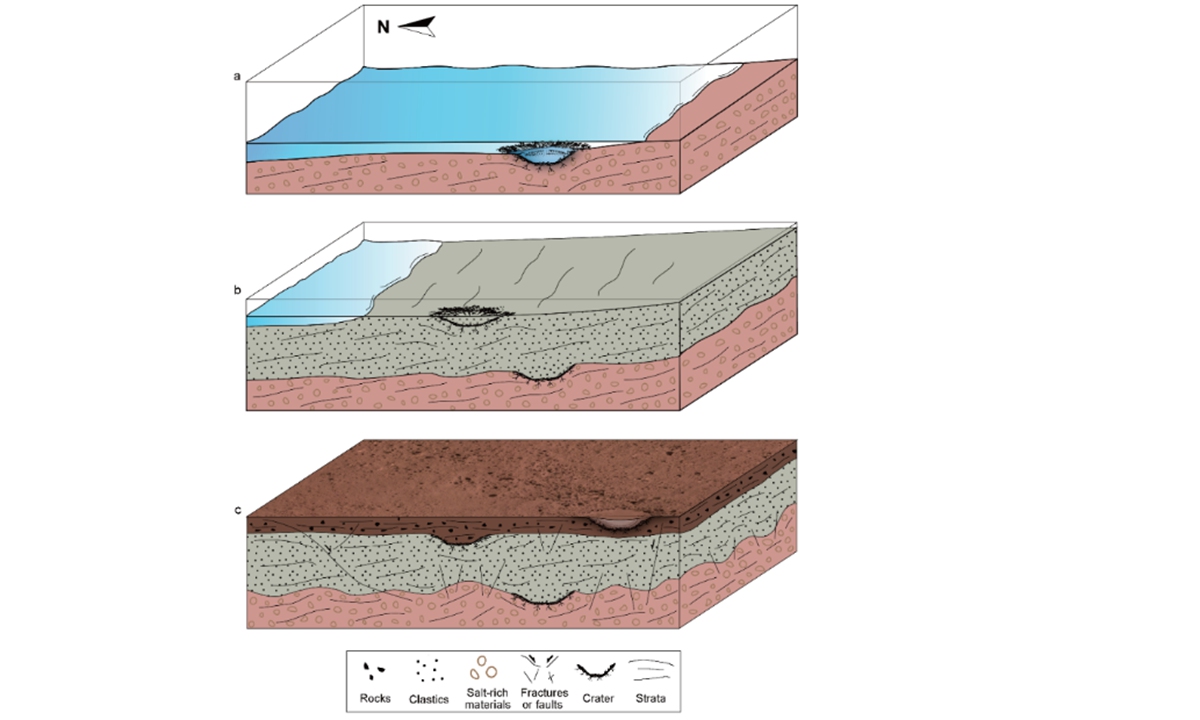
Schematic diagram of the evolution of near-surface sedimentary strata in the landing area of China's Zhurong Mars rover. Photo: Institute of Geology and Geophysics, Chinese Academy of Sciences
Significant water activity existed on the surface of Mars until approximately 750 million years ago - the high-frequency radar data obtained by China's Zhurong Mars rover revealed.
This finding extends Mars' history of harboring water by several hundred million years, providing new evidence for a renewed understanding of the planet's climatic evolution, geological processes, and potential habitability for life, the Science and Technology Daily reported on Tuesday citing the Institute of Geology and Geophysics, Chinese Academy of Sciences.
The related research findings have been published in the journal National Science Review.
Previously, the scientific community believed that Mars had entered an overall arid stage about 3 billion years ago.
After landing on Mars in May 2021, the Zhurong rover has traveled approximately 1.9 kilometers in the southern part of the Utopia Planitia on Mars and conducted shallow subsurface detection using high-frequency quadrupole radar, akin to performing a detailed CT scan of Mars.
Data revealed that the subsurface of the landing area is widely covered by a uniform sedimentary layer about 4 meters thick, beneath which impact craters are buried.
The characteristics of this sedimentary layer, its uniform thickness and continuous nature, rule out the possibility of volcanic eruption or simple wind-blown sand accumulation, Liu Yike, a researcher from the institute, also the first author of this paper, said.
The only plausible explanation is that the area was in an aquatic sedimentary environment at the time, resembling a shallow sea or large lake, Liu added.
The radar also captured centimeter-scale thin sedimentary laminations, whose morphology resembles that of surface-water-formed sedimentary rocks, further supporting the existence of a shallow-water environment in this region, according to Liu.
By combining crater chronology analysis, the researchers determined that the relevant sedimentary layers were formed approximately 750 million years ago, dating to the Middle to Late Amazonian period on Mars.
"A comprehensive analysis indicates that during the Middle to Late Amazonian period, the landing area of the Zhurong rover underwent a significant surface remodeling process, and Mars still experienced persistent water activity during this era," Liu said.
Global Times
RELATED ARTICLES