ARTS / CULTURE & LEISURE
Milestone year lays roadmap for Chinese films to go global
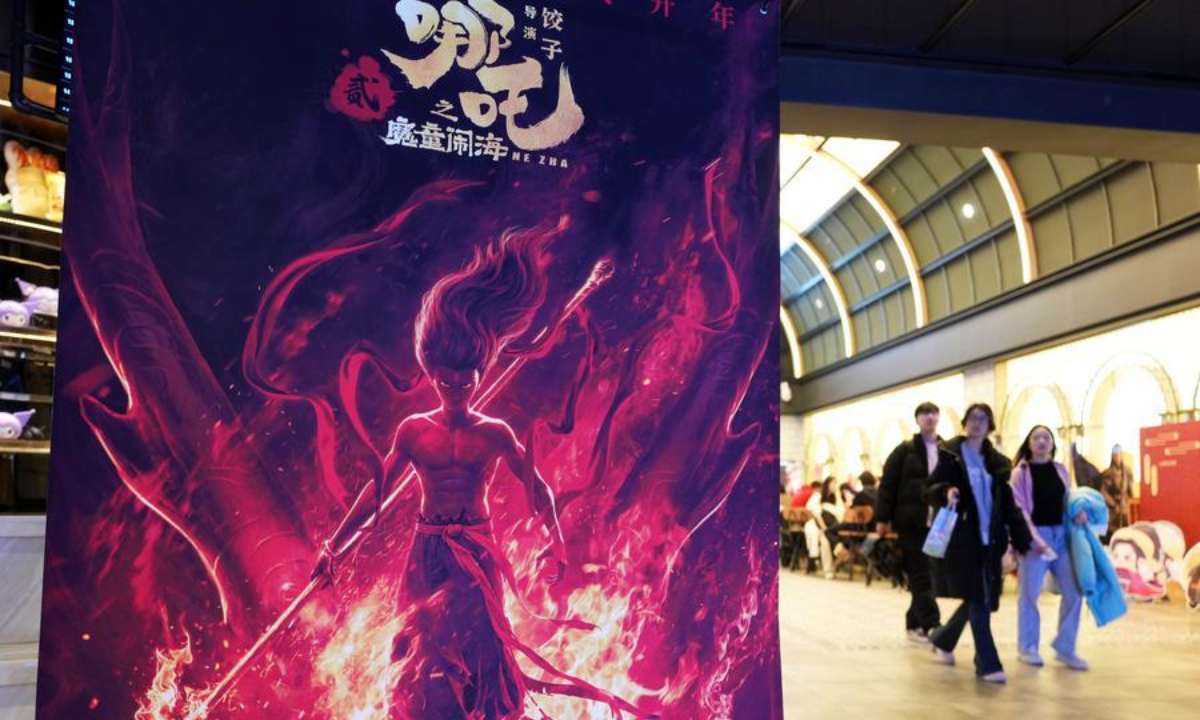
People walk past a poster of the animated feature "Ne Zha 2" at a cinema in Shenyang, northeast China's Liaoning Province, Feb. 6, 2025. (Xinhua/Li Gang)
China's film directors gathered in Beijing on Tuesday for a national conference, highlighting 2025 as the 120th anniversary of Chinese cinema and its strong box-office, while setting 2026 goals to expand global influence and achieve high-quality growth, according to the China Film Administration (CFA).China's film market has staged a powerful comeback in 2025, with the annual box office rising 22 percent to 51.83 billion yuan ($7.42 billion), fueled by an unprecedented animation boom, with the genre contributing nearly half of the total revenue, according to the CFA.
By December 31, 2025, animated films had generated more than 25 billion yuan. Four animated features landed in the year's top 10, with Ne Zha 2, Zootopia 2, Nobody and Boonie Bears: Future Reborn, placing first, second, sixth and ninth.
The year opened with the domestic animated sequel Ne Zha 2, which shattered multiple box-office records and energized the market. A modern reinterpretation of a mythological rebel, it raged its way to a staggering 15.4 billion yuan in the Chinese mainland alone, and to $2.2 billion globally, becoming the world's top-grossing animated feature.
The box office of Ne Zha 2 directly lifted the ceiling for what a single film can achieve in China, Lai Li, an analyst at film data platform Maoyan, told the Global Times. "It set the tone for the entire year."
Midyear, summer hit Nobody, now China's highest-grossing 2D animated film, found its magic in the mundane. The tale of four lowly monsters clumsily impersonating the legendary heroes of Journey to the West mirrors a modern working-class quest for dignity and meaning.
At year's end, Disney's Zootopia 2 delivered a powerful surge, bolstering global industry confidence in the Chinese market at a time when imported blockbusters had generally struggled. On Monday, it surpassed Avengers: Endgame to become the highest-grossing imported film in China.
"Animation's role as merely a supplement to live-action cinema is being fundamentally rewritten," Zuo Heng, director of the Film Culture Research Department at the China Film Archive, told the Global Times.
In the digital era, Chinese animated films are demonstrating growing artistic influence and box-office appeal, while new cinematic forms are reshaping aesthetics and the broader industry ecosystem, he noted.
Beyond animation, other genres also found success. Domestic films grossed 41.29 billion yuan at the box office, accounting for 79.67 percent of total ticket sales. War films such as Dead to Rights and Evil Unbound earned more than 3 billion yuan and 1.94 billion yuan respectively. The market also showed notable diversity, with documentaries, arthouse films from international festivals and niche European imports attracting dedicated audiences.
Data from Maoyan shows China accounted for nearly 24 percent of the global box office in 2025, second only to North America at 29 percent, ahead of all other markets.
Taking Zootopia 2 as an example, the film grossed $602 million from Chinese theaters. The total for "Zootopia 2" from Chinese theaters represents about 36 percent of its global total, based on Maoyan data, far surpassing its North American earnings and firmly establishing China as the sequel's defining market.
Lai noted that the market maintained steady progress amid structural adjustments in 2025, with several key holiday periods exceeding expectations thanks to breakout hits.
Looking ahead, 2026, the opening year of China's 15th Five-Year Plan (2026-30), will focus on boosting creative innovation, producing higher-quality films, strengthening industry and market systems, and further cultivating the film economy. Expanding the international reach of Chinese cinema will also be a priority.
In 2025, Chinese films earned more than 1 billion yuan overseas and were released in 46 countries and regions. Increasingly, Chinese films are appearing in cinemas around the world, serving as a window through which international audiences can better understand China, according to CCTV News.
Meanwhile, efforts to help Chinese films "go global" face challenges that include cultural differences, distribution channels and brand building, Zhang Peng, a cultural researcher and associate professor at Nanjing Normal University, told the Global Times.
In his view, by strengthening cultural exchanges, expanding global distribution networks and developing internationally recognizable brands, the industry is well positioned to enhance its competitiveness and bring more high-quality works to audiences worldwide.
"In 2026, I believe film creation will place a stronger emphasis on quality and genre innovation to better meet audience demand," said Zhang. "Technological advances will drive upgrades across the industry, expanding the space for cinematic expression, while deeper industry integration will strengthen synergies between film and sectors such as tourism and gaming."
RELATED ARTICLES