IN-DEPTH / IN-DEPTH
Don-roe Doctrine? A close look at a 200‑year scourge across Latin America under US' shadow
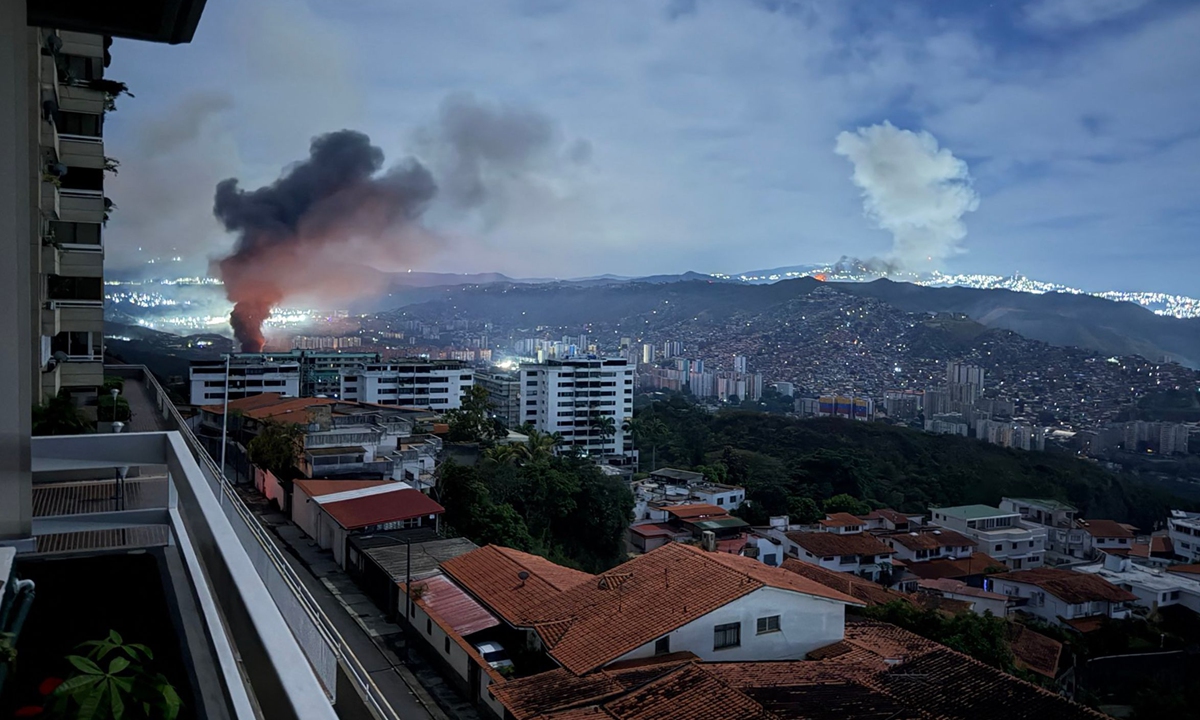
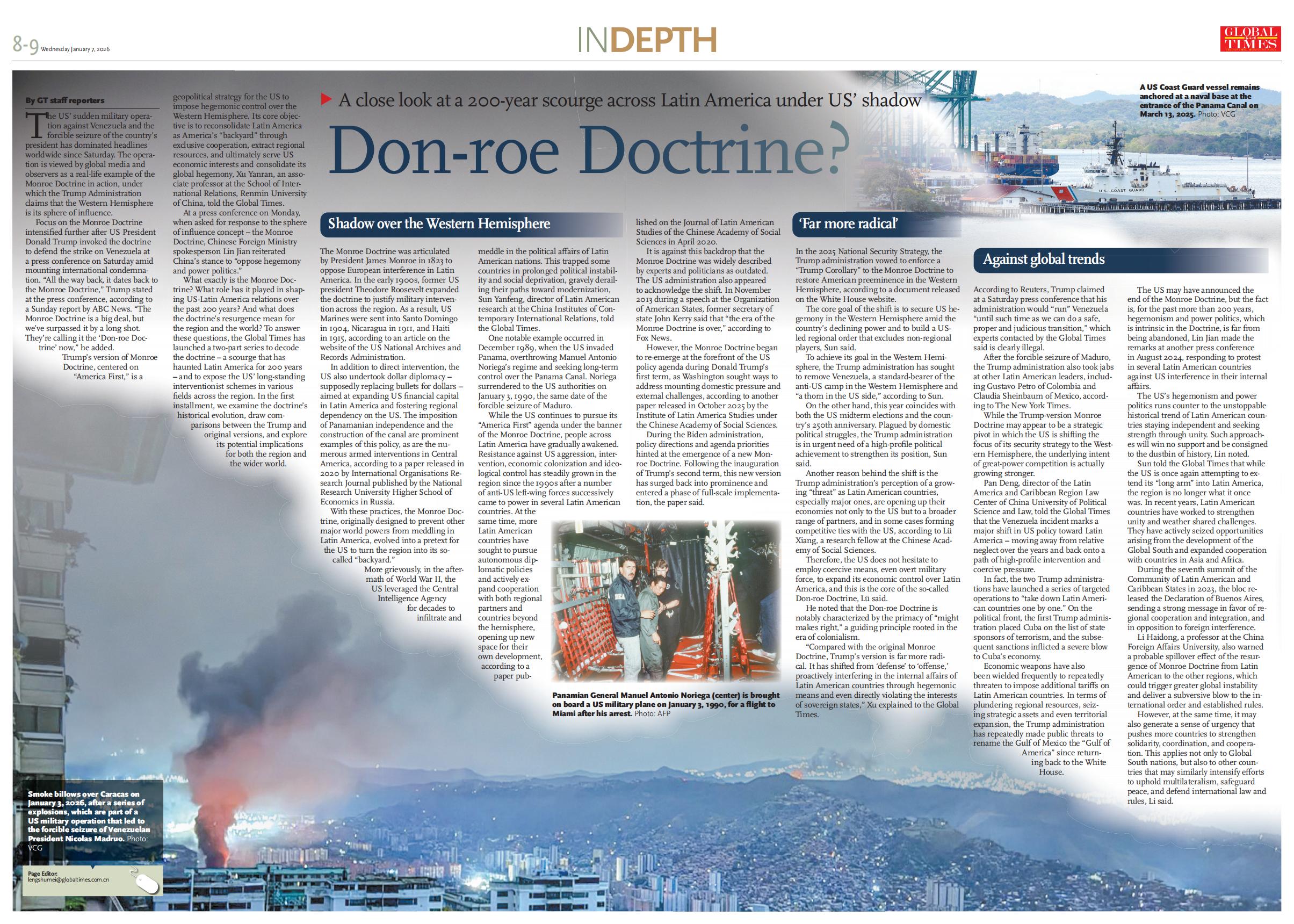
Smoke billows over Caracas on January 3, 2026, after a series of explosions, which are part of a US military operation that led to the forcible seizure of Venezuelan President Nicolas Madruo. Photo: VCG
The US' sudden military operation against Venezuela and the forcible seizure of the country's president has dominated headlines worldwide since Saturday. The operation is viewed by global media and observers as a real-life example of the Monroe Doctrine in action, under which the Trump Administration claims that the Western Hemisphere is its sphere of influence.
Focus on the Monroe Doctrine intensified further after US President Donald Trump invoked the doctrine to defend the strike on Venezuela at a press conference on Saturday amid mounting international condemnation. "All the way back, it dates back to the Monroe Doctrine," Trump stated at the press conference, according to a Sunday report by ABC News. "The Monroe Doctrine is a big deal, but we've surpassed it by a long shot. They're calling it the 'Don-roe Doctrine' now," he added.
Trump's version of Monroe Doctrine, centered on "America First," is a geopolitical strategy for the US to impose hegemonic control over the Western Hemisphere. Its core objective is to reconsolidate Latin America as America's "backyard" through exclusive cooperation, extract regional resources, and ultimately serve US economic interests and consolidate its global hegemony, Xu Yanran, an associate professor at the School of International Relations, Renmin University of China, told the Global Times.
At a press conference on Monday, when asked for response to the sphere of influence concept - the Monroe Doctrine, Chinese Foreign Ministry spokesperson Lin Jian reiterated China's stance to "oppose hegemony and power politics."
What exactly is the Monroe Doctrine? What role has it played in shaping US-Latin America relations over the past 200 years? And what does the doctrine's resurgence mean for the region and the world? To answer these questions, the Global Times has launched a two-part series to decode the doctrine - a scourge that has haunted Latin America for 200 years - and to expose the US' long-standing interventionist schemes in various fields across the region. In the first installment, we examine the doctrine's historical evolution, draw comparisons between the Trump and original versions, and explore its potential implications for both the region and the wider world.
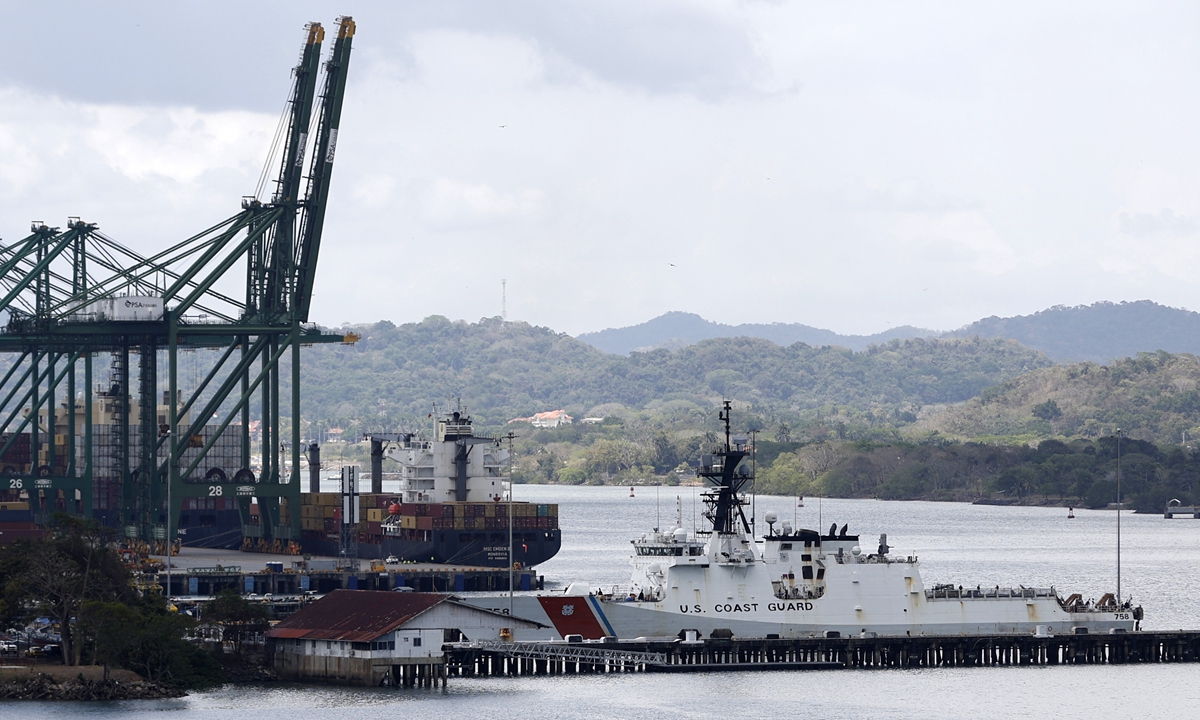
A US Coast Guard vessel remains anchored at a naval base at the entrance of the Panama Canal on March 13, 2025. Photo: VCG
Shadow over the Western Hemisphere
The Monroe Doctrine was articulated by President James Monroe in 1823 to oppose European interference in Latin America. In the early 1900s, former US president Theodore Roosevelt expanded the doctrine to justify military intervention across the region. As a result, US Marines were sent into Santo Domingo in 1904, Nicaragua in 1911, and Haiti in 1915, according to an article on the website of the US National Archives and Records Administration.
In addition to direct intervention, the US also undertook dollar diplomacy - supposedly replacing bullets for dollars - aimed at expanding US financial capital in Latin America and fostering regional dependency on the US. The imposition of Panamanian independence and the construction of the canal are prominent examples of this policy, as are the numerous armed interventions in Central America, according to a paper released in 2020 by International Organisations Research Journal published by the National Research University Higher School of Economics in Russia.
With these practices, the Monroe Doctrine, originally designed to prevent other major world powers from meddling in Latin America, evolved into a pretext for the US to turn the region into its so-called "backyard."
More grievously, in the aftermath of World War II, the US leveraged the Central Intelligence Agency for decades to infiltrate and meddle in the political affairs of Latin American nations. This trapped some countries in prolonged political instability and social deprivation, gravely derailing their paths toward modernization, Sun Yanfeng, director of Latin American research at the China Institutes of Contemporary International Relations, told the Global Times.
One notable example occurred in December 1989, when the US invaded Panama, overthrowing Manuel Antonio Noriega's regime and seeking long-term control over the Panama Canal. Noriega surrendered to the US authorities on January 3, 1990, the same date of the forcible seizure of Maduro.
While the US continues to pursue its "America First" agenda under the banner of the Monroe Doctrine, people across Latin America have gradually awakened. Resistance against US aggression, intervention, economic colonization and ideological control has steadily grown in the region since the 1990s after a number of anti-US left-wing forces successively came to power in several Latin American countries. At the same time, more Latin American countries have sought to pursue autonomous diplomatic policies and actively expand cooperation with both regional partners and countries beyond the hemisphere, opening up new space for their own development, according to a paper published on the Journal of Latin American Studies of the Chinese Academy of Social Sciences in April 2020.
It is against this backdrop that the Monroe Doctrine was widely described by experts and politicians as outdated. The US administration also appeared to acknowledge the shift. In November 2013 during a speech at the Organization of American States, former secretary of state John Kerry said that "the era of the Monroe Doctrine is over," according to Fox News.
However, the Monroe Doctrine began to re-emerge at the forefront of the US policy agenda during Donald Trump's first term, as Washington sought ways to address mounting domestic pressure and external challenges, according to another paper released in October 2025 by the Institute of Latin America Studies under the Chinese Academy of Social Sciences.
During the Biden administration, policy directions and agenda priorities hinted at the emergence of a new Monroe Doctrine. Following the inauguration of Trump's second term, this new version has surged back into prominence and entered a phase of full-scale implementation, the paper said.
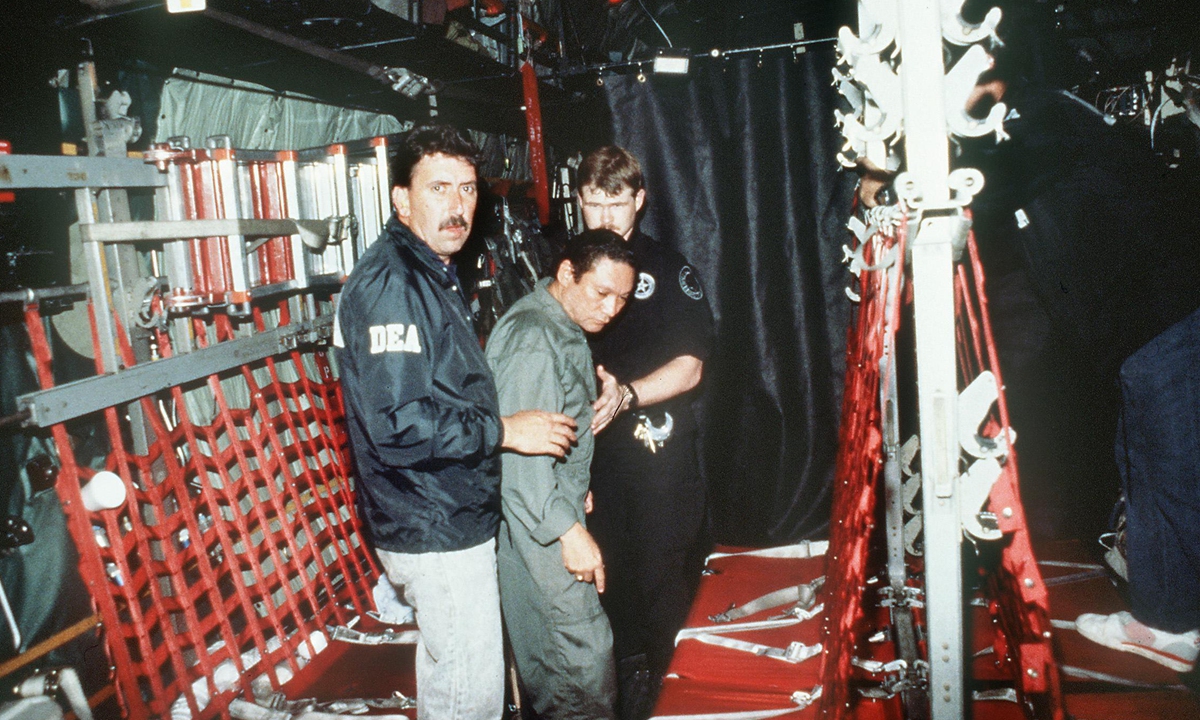
Panamian General Manuel Antonio Noriega (center) is brought on board a US military plane on January 3, 1990, for a flight to Miami after his arrest. Photo: AFP
'Far more radical'
In the 2025 National Security Strategy, the Trump administration vowed to enforce a "Trump Corollary" to the Monroe Doctrine to restore American preeminence in the Western Hemisphere, according to a document released on the White House website.
The core goal of the shift is to secure US hegemony in the Western Hemisphere amid the country's declining power and to build a US-led regional order that excludes non-regional players, Sun said.
To achieve its goal in the Western Hemisphere, the Trump administration has sought to remove Venezuela, a standard-bearer of the anti-US camp in the Western Hemisphere and "a thorn in the US side," according to Sun.
On the other hand, this year coincides with both the US midterm elections and the country's 250th anniversary. Plagued by domestic political struggles, the Trump administration is in urgent need of a high-profile political achievement to strengthen its position, Sun said.
Another reason behind the shift is the Trump administration's perception of a growing "threat" as Latin American countries, especially major ones, are opening up their economies not only to the US but to a broader range of partners, and in some cases forming competitive ties with the US, according to Lü Xiang, a research fellow at the Chinese Academy of Social Sciences.
Therefore, the US does not hesitate to employ coercive means, even overt military force, to expand its economic control over Latin America, and this is the core of the so-called Don-roe Doctrine, Lü said.
He noted that the Don-roe Doctrine is notably characterized by the primacy of "might makes right," a guiding principle rooted in the era of colonialism.
"Compared with the original Monroe Doctrine, Trump's version is far more radical. It has shifted from 'defense' to 'offense,' proactively interfering in the internal affairs of Latin American countries through hegemonic means and even directly violating the interests of sovereign states," Xu explained to the Global Times.
Against global trends
According to Reuters, Trump claimed at a Saturday press conference that his administration would "run" Venezuela "until such time as we can do a safe, proper and judicious transition," which experts contacted by the Global Times said is clearly illegal.
After the forcible seizure of Maduro, the Trump administration also took jabs at other Latin American leaders, including Gustavo Petro of Colombia and Claudia Sheinbaum of Mexico, according to The New York Times.
While the Trump-version Monroe Doctrine may appear to be a strategic pivot in which the US is shifting the focus of its security strategy to the Western Hemisphere, the underlying intent of great-power competition is actually growing stronger.
Pan Deng, director of the Latin America and Caribbean Region Law Center of China University of Political Science and Law, told the Global Times that the Venezuela incident marks a major shift in US policy toward Latin America - moving away from relative neglect over the years and back onto a path of high-profile intervention and coercive pressure.
In fact, the two Trump administrations have launched a series of targeted operations to "take down Latin American countries one by one." On the political front, the first Trump administration placed Cuba on the list of state sponsors of terrorism, and the subsequent sanctions inflicted a severe blow to Cuba's economy.
Economic weapons have also been wielded frequently to repeatedly threaten to impose additional tariffs on Latin American countries. In terms of plundering regional resources, seizing strategic assets and even territorial expansion, the Trump administration has repeatedly made public threats to rename the Gulf of Mexico the "Gulf of America" since returning back to the White House.
The US may have announced the end of the Monroe Doctrine, but the fact is, for the past more than 200 years, hegemonism and power politics, which is intrinsic in the Doctrine, is far from being abandoned, Lin Jian made the remarks at another press conference in August 2024, responding to protest in several Latin American countries against US interference in their internal affairs.
The US's hegemonism and power politics runs counter to the unstoppable historical trend of Latin American countries staying independent and seeking strength through unity. Such approaches will win no support and be consigned to the dustbin of history, Lin noted.
Sun told the Global Times that while the US is once again attempting to extend its "long arm" into Latin America, the region is no longer what it once was. In recent years, Latin American countries have worked to strengthen unity and weather shared challenges. They have actively seized opportunities arising from the development of the Global South and expanded cooperation with countries in Asia and Africa.
During the seventh summit of the Community of Latin American and Caribbean States in 2023, the bloc released the Declaration of Buenos Aires, sending a strong message in favor of regional cooperation and integration, and in opposition to foreign interference.
Li Haidong, a professor at the China Foreign Affairs University, also warned a probable spillover effect of the resurgence of Monroe Doctrine from Latin American to the other regions, which could trigger greater global instability and deliver a subversive blow to the international order and established rules.
However, at the same time, it may also generate a sense of urgency that pushes more countries to strengthen solidarity, coordination, and cooperation. This applies not only to Global South nations, but also to other countries that may similarly intensify efforts to uphold multilateralism, safeguard peace, and defend international law and rules, Li said.
Don-roe Doctrine?
RELATED ARTICLES