Chinese tech firms draw crowds at CES as global AI rivalry heats up
Competition, cooperation between China, US unfold simultaneously: experts
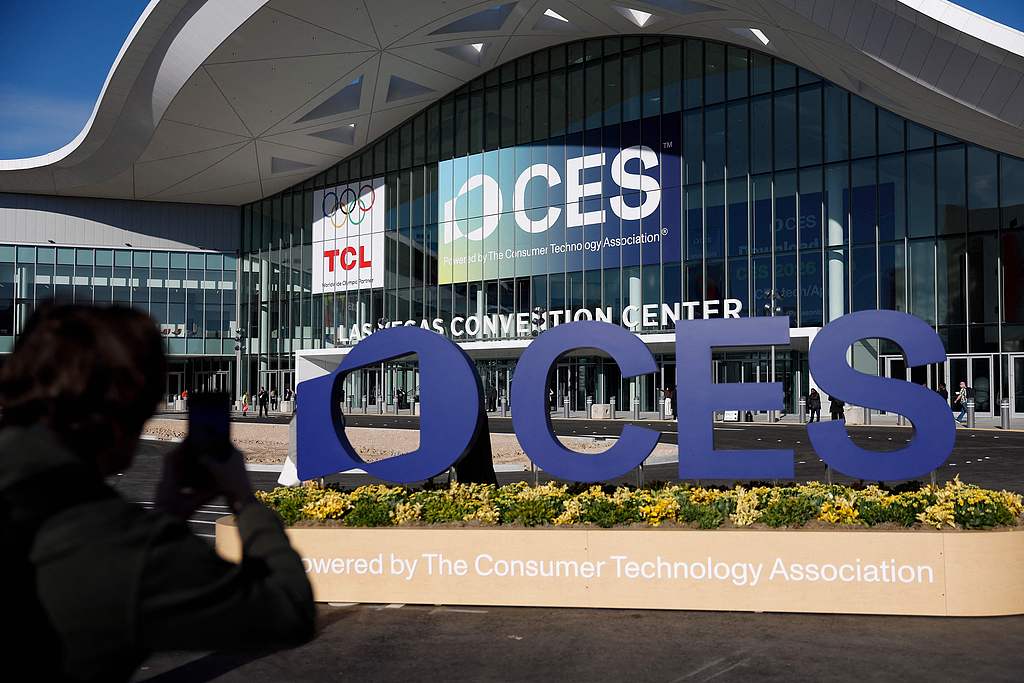
2026 Consumer Electronics Show (CES), dubbed the "Super Bowl of tech," opens in Las Vegas on January 6, 2026. Photo: VCG
Chinese tech companies stepped up their global competition as the 2026 Consumer Electronics Show (CES), often dubbed the "Super Bowl of tech," opened in Las Vegas. The event runs from Tuesday to Friday, with domestic humanoid robots edging closer to real-world deployment, autonomous driving technologies advancing rapidly, and lightweight artificial intelligence (AI) and augmented reality (AR) glasses breaking into the mainstream.
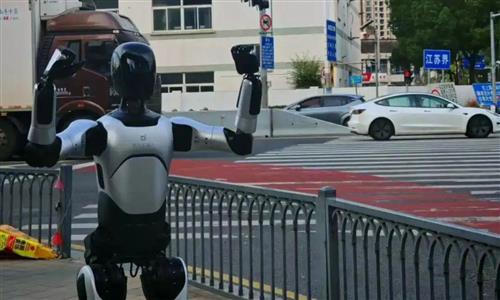
At CES 2026, the humanoid robotics spotlight turned into a three-way contest among companies from China, the US and South Korea, reports said. Chinese players such as Unitree and Agibot drew attention with humanoid and quadruped robots that underscore tangible progress in mass production and real-world deployment.
Unitree Robotics told the Global Times that it showcased its full range of robots at the CES, including newly released humanoid models H2, R1 and G1, alongside quadruped robots A2 and Go2.
The boxing version of the G1 humanoid drew particular attention for its performance in live demonstrations. Equipped with self-developed high-response dynamic balance algorithms and joint-drive technology, the robot demonstrated stable movement during fast, close-range action. Unitree's staff said that the robot's agility and control drew repeated applause from visitors, who dubbed it the "Bruce Lee of robots."
Agibot told the Global Times that it showcased one of the industry's most comprehensive embodied robotics portfolios, backed by cumulative shipments of 5,000 robots, highlighting its transition from advanced research and development to scaled manufacturing and real-world deployment at a time when much of the humanoid robotics sector remains in the prototype or pilot stages.
The lineup featured Agibot's A2 full-sized humanoids, G2 industrial robots and D1 quadruped robots, targeting applications ranging from public interaction to industrial deployment and operations in complex environments.
On the US side, Boston Dynamics unveiled the production version of its fully electric Atlas robot, designed for autonomous operation across industrial environments ranging from -20 C to 40 C. The company estimates it will produce 30,000 robots annually starting in 2028, according to Verge.
On the South Korean side, the emphasis was on ecosystem-led collaboration, according to media reports. The country highlighted the "K-Humanoid" alliance, led by Rainbow Robotics with backing from Samsung, featuring the HMND-01 Alpha—a wheeled industrial humanoid standing 2.2 meters tall with a 15-kilogram payload—underscoring South Korea's push to integrate its robotics supply chain from core components to complete systems, according to media reports.
In the smart device segment, Chinese companies are stepping up their presence with a focus on lightweight, consumer-ready AI hardware.
Rokid staff told the Global Times that an AI glasses installation roughly the height of a person became a crowd draw at CES, allowing visitors to see both the design and real-time display content, and offering an intuitive sense of how the product works in daily use.
They said that the company's flagship exhibit was its 49-gram AI glasses, which resemble ordinary eyewear and use diffractive waveguide technology for all-day comfort, underscoring Rokid's progress in lightweight mass production. At the booth, Rokid demonstrated translation and payment in a mock cafe, underscoring that the product is already in use, with sales in 115 countries and more than 100,000 active users.
Another Chinese AR AI glasses company, inmo, told the Global Times that this marked its second appearance at the CES, with the newly launched INMO GO3 making its overseas debut at the show. The company said that the exhibition was both a technology showcase and a step toward expanding overseas markets, adding that it plans to launch international crowdfunding for GO3 and speed up the rollout of its full product lineup through global online and physical channels.
Autonomous driving and foundational AI have emerged as key battlegrounds between Chinese and US firms.
Autonomous driving and foundational AI remain central to competition between Chinese and US companies. Nvidia told the Global Times that its Alpamayo open-source models, simulation tools and datasets are designed to address the most challenging long-tail scenarios in autonomous driving. By incorporating reasoning models with chain-of-thought capabilities, vehicles can move beyond perception to make causal judgments in unfamiliar situations, improving safety and transparency.
Chinese automakers are also moving quickly to catch up in the technological sector.
Great Wall Motor brought its full lineup to the CES, highlighting new-energy technologies such as the Hi4-Z platform, semi-solid-state batteries and hydrogen fuel cells, alongside AI developments including its ASL 2.0 agent and VLA (Vision-Language-Action) -based large-language model.
Geely announced a shift to "All-Domain AI 2.0," unveiling its World Action Model, which combines VLA with a world model. The move reflects a broader push toward large-language models, end-to-end systems and human-like reasoning in autonomous driving.
Wang Peng, an associate researcher at the Beijing Academy of Social Sciences, said that the CES floor highlighted clear differences in strengths between Chinese and US tech firms. Chinese companies benefit from integrated supply chains and cost efficiency, enabling rapid mass production and scenario-driven innovation in areas such as home services and smart devices, while US firms maintain an edge in core technologies such as chips and displays, as well as in global platforms and premium industrial markets.
He added that for Chinese tech companies going global, success hinges on agile deployment and open ecosystems, shifting from technology-following to demand-driven development, strengthening core capabilities, upgrading brands and engaging in international standard-setting to move beyond price competition toward value and rule-making.
Tian Feng, president of the Fast Think Institute and former dean of Chinese AI software giant SenseTime's Intelligence Industry Research Institute, told the Global Times that the CES has become a platform where competition and cooperation between China and the US unfold simultaneously.
Tian noted that while the US still leads in high-end AI intelligence chips, Chinese firms are accelerating breakthroughs via RISC-V and computing-in-memory approaches. Chinese companies show stronger momentum in bringing applications to market in areas such as smart homes, e-mobility and consumer robotics, while complementary strengths in models, chips and manufacturing are creating new room for cross-border collaboration.
RELATED ARTICLES