China Space Station conducts in-orbit experiment on lithium-ion batteries, aiming to enhance performance of spacecraft energy system: report
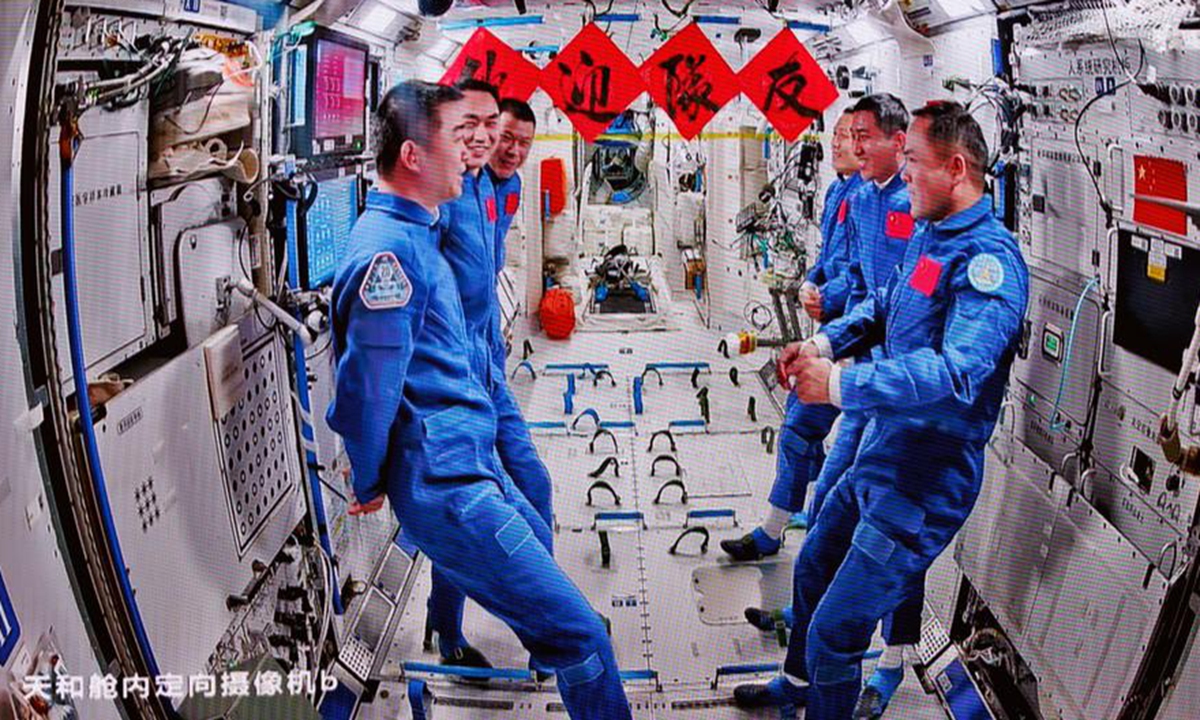
This image captured at Beijing Aerospace Control Center on Nov. 1, 2025 shows the crew of Shenzhou-20 and Shenzhou-21 spaceships talking with each other. (Xinhua/Jin Liwang)
The Chinese Academy of Sciences (CAS) revealed that the project titled "In-situ electrochemical optical research on lithium-ion batteries for space applications" has been carried out on the China Space Station, with an ultimate goal to enhance the performance of spacecraft energy system.The Shenzhou-21 crew jointly conducted in-orbit operations for the experiment, with crew-member Zhang Hongzhang from CAS serving as the payload expert and leveraging his professional expertise, Xinhua News Agency reported on Wednesday.
The experimental program aims to directly observe and analyze the mechanisms by which the microgravity environment affects key internal processes in batteries, thereby providing strong scientific evidence to enhance the performance of spacecraft energy systems, according to the report.
It is reported that the advancement of this experiment is expected to break through the cognitive bottleneck in understanding the coupled effects of gravitational and electric fields, promote the further development of fundamental electrochemical theories, and provide a basis for optimizing current in-orbit battery systems and designing the next generation of high-specific-energy, high-safety space batteries.
Lithium-ion batteries, with their high energy density, long cycle life, and high safety and reliability, serve as the "energy heart" of modern space missions. Currently, research on lithium-ion battery performance has delved into microscopic mechanisms, in which the distribution state of chemical substances within the electrolyte is one of the core factors determining battery power and lifespan, the report said.
However, in ground-based experiments, the gravitational field is always intertwined with the electric field, making it difficult to isolate and clarify the impact of gravity on internal battery processes. The unique microgravity environment in space provides an ideal experimental platform to break through this scientific bottleneck, the report explained.
Global Times
RELATED ARTICLES