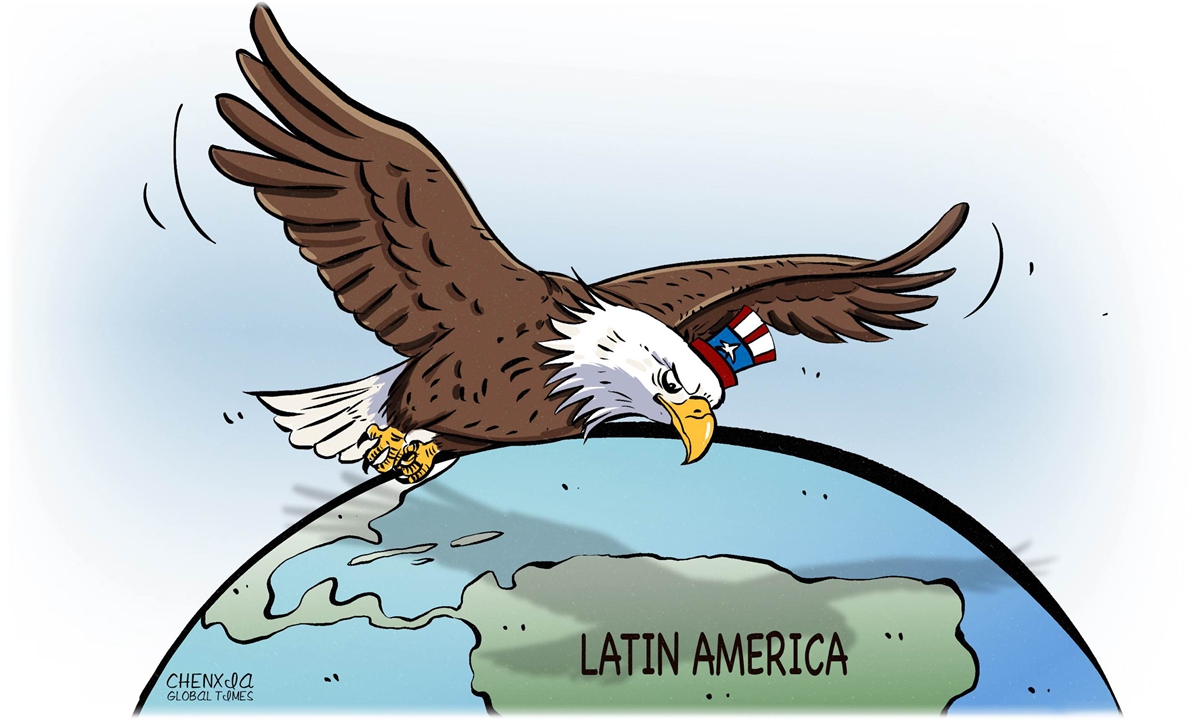
Illustration: Chen Xia/GT
Reports on Tuesday local time showed that the US president warned Venezuela to cooperate or risk a new US military attack. This came after Venezuelan President Nicolás Maduro and his wife were forcibly seized by the US from Caracas and flown to New York. With the US operation against Venezuela, the US is back in the business of abandoning the internationally held concept of the sovereign state.
The US is once again committing itself to installing regimes in Latin America or the Caribbean which will be palatable to Washington, leaving a strong indication that it might continue its reckless ambitions closer to home.
Make no mistake: The US has undertaken what could turn out to be the beginning of the 21st century version of colonialism in Latin America and the Caribbean. The Monroe Doctrine, the idea that the US and the US alone will control the region, is, unfortunately, alive and well.
Meanwhile, the global community gets another chance to understand what the US called as "the Donroe Doctrine." Whatever it is, it was on display in Venezuela.
Early Saturday morning, the White House gave the green light to an operation that involved military and law enforcement personnel. In Venezuela, they seized the country's president, Maduro, and his wife. Barely 48 hours after US forces took Maduro and his wife, the Venezuelan leader stood in a New York court and pleaded not guilty to conspiracy charges brought by the US government. Prosecutors in their charging document alleged Maduro, his wife and son and their accomplices engaged in a cocaine-trafficking conspiracy and partnered with cartels designated as terrorist groups, according to media reports.
In court on Monday, Maduro's lawyer suggested he should be immune from prosecution as the leader of a sovereign country and that the US taking him by force is illegal. As he left court, Maduro said in Spanish that he is a "kidnapped president" and a "prisoner of war."
Washington wants the world to accept its portray of Maduro as a "bad evil man" who is no longer capable of "terrorizing his people at home and profiting from illegal drug sales abroad," while at the same time encourages audiences to remember that Maduro and his wife is allowed the opportunity to defend themselves against the charges against them.
However, what Washington cannot whitewash in any framing of what is going on is its history of aggression throughout Latin America and the Caribbean. Whether in large countries like Argentina, or smaller ones like Grenada, the US has eagerly sent military personnel or advisers to the region to advance Washington's aims. The defense of these actions is always some version of national security: If the US did not act, then the safety of the entire country might be in danger. The many essential questions associated with such "logic," including how nations with populations much smaller than that of the US and no viable international military capability could threaten the large and militarily potent US, often go unanswered.
Controlling Venezuela allows Washington to "fix" Venezuela's oil industry so that "large amounts" of oil can be sold on the international market, as the US administration claimed. As one carefully reads them again, the implication is clear: The Venezuelan oil industry will operate just like the US wants it to. Doesn't this all sound quite colonialist?
Moreover, US Secretary of State Marco Rubio suggested that Venezuela might not be the only regional country in Washington's cross-hairs. He said on Saturday, "If I lived in Havana and I was in the government, I'd be concerned at least a little bit."
The current US administration had better hope that its attempt at forced nation-building, leadership-installation and colonialism proves more successful than the disastrous efforts in Iraq and Afghanistan at the beginning of this century. However, even if these goals are achieved, the lasting legacy of the current US administration as the bully and the global cop will remain.
In short, what unfolds in Venezuela will be seen by significant segments of the global community as yet another commitment to brute force.
The author is an associate professor at the Department of Communication and Organizational Leadership at Robert Morris University. The opinions expressed in this article are solely those of the author and do not necessarily reflect the views of Robert Morris University. opinion@globaltimes.com.cn
RELATED ARTICLES