IN-DEPTH / IN-DEPTH
People in the Message: Xi’s livelihood concerns in New Year address fuel hopes for 15th Five-Year Plan period

Hosts promote embroidery products during live broadcasts at a live-streaming studio for intangible cultural heritage e-commerce in Qiandongnan Miao and Dong Autonomous Prefecture, Southwest China's Guizhou Province, on December 9, 2025. Photo: VCG
Editor's Note:On New Year's Eve, Chinese President Xi Jinping delivered his 2026 New Year message, reviewing the remarkable achievements of the concluding 14th Five-Year Plan period (2021-25) while outlining the blueprint for the opening year of the 15th Five-Year Plan (2026-30). On the path toward modernization, what has changed is the stage of China's economic and social development, but what remains unchanged is the original aspiration of the Communist Party of China (CPC) to be with the people, the tribute to the strivers, and the pursuit of a better life.
In this special series, the Global Times goes behind the encouraging moments highlighted in President Xi's New Year message. We seek out the individuals whose efforts make these stories real, listening as they share their gains during the 14th Five-Year Plan period and their aspirations as the 15th Five-Year Plan commences.
"When the happy hum of daily life fills every home, the big family of our nation will go from strength to strength." This remark from President Xi's 2026 New Year message has warmed and inspired countless Chinese families.
President Xi pointed out, "The prosperity and strength of the country and the rejuvenation of the nation must be ultimately reflected in the happiness of myriads of families and the continuous improvement of the lives of hundreds of millions of people." Looking back at his new year message over the years, the people's happy life has always been his utmost concern.
Prioritizing the people's everyday concerns as its top priority has been the consistent value orientation of the CPC. From the Recommendations of the Central Committee of the Communist Party of China for Formulating the 15th Five-Year Plan for National Economic and Social Development to the eight major tasks for 2026 economic work deployed at the Central Economic Work Conference, improving people's lives has been the country's core consideration. Key areas that matter most to ordinary people - employment, elderly care, education, healthcare, and housing - receive prominent attention in policy planning.
Meeting urgent demands
At the beginning of the year, a small family in Central China's Hunan Province had just marked the first birthday of their second child, little Yangyang. His mother, who prefers to be identified simply as "Yangyang's mom," still remembers the day the childcare subsidy landed in her account. On November 21, 2025, while she was busy with work, her phone let out a soft ding. She glanced down and saw that the country had transferred 3,600 yuan. A smile crept onto her face.
Beginning in 2025, China rolled out a nationwide childcare subsidy program, offering families 3,600 yuan ($515.7) per year for each child under the age of three. The country's improving childcare-friendly policies - including direct financial support - are further warming the hearts of households raising new life.
What does 3,600 yuan mean for a toddler? It could be turned into a dozen tins of formula, or dozens of seasonal outfits, or a branded stroller and a car seat, or a year of children's commercial insurance... When adding up the options, Yangyang's mom smiled and said she planned to use the money to buy clothes and picture books. "I'm really grateful for the government's increasingly supportive childcare policies. It's very heartwarming," she told the Global Times. "It's not a huge sum, but it's very practical for spending on the child."
"Facilities have been upgraded to bring more convenience to the elderly, and each family with childcare needs has received a subsidy of 300 yuan per month."In the 2026 New Year message, Xi's words of care for both the elderly and children struck a warm chord with the public.
Thousands of kilometers away in Beijing, 57-year-old retiree Liu Min told the Global Times that he often strolls across the street from his home to dine at a community canteen, ever since it opened in September 2025. He enjoys a 12 percent senior discount, with each meal costing just over 30 yuan - excellent value by local standards.
In recent years, around 86,000 senior meal assistance sites have been established nationwide. Under the government's coordination, localities have explored tailored models suited to their own conditions, steadily improving the quality of meal services for the elderly, the Xinhua News Agency reported.
According to data from the Ministry of Human Resources and Social Security (MOHRSS), by the end of March 2025, the number of people covered by China's basic pension insurance had reached 1.071 billion.
The recommendations for the 15th Five-Year Plan continue to place strong emphasis on both the elderly and children, with the goal of further improving service levels. For example, it states that "we should provide medical services integrated with infant care and elderly care," and that "better health services should be ensured for women and children."
Looking ahead, Liu is confident in the future of the country's community-based elderly care system. "As long as there is such strong demand, national policies will not stall, and these efforts will certainly continue,'' he said.
Yangyang's mom also feels optimistic and hopeful. She said that the benefits she now enjoys, are all better than when her first child was born nine years ago. "As the country pays more attention and provides greater support to child-rearing, things will keep getting better for us," she said.
Striving for better life
With the New Year holidays ending, morning light enters the livestreaming studio of Jingning county's odd-jobs markets in Northwest China's Gansu Province at 8 am. Gao Bin, the host, adjusts the fill lights, flips through thick notebooks of job listings, and begins his daily work.
"Good morning, friends! Today, 8 companies have entrusted us to recruit for 27 positions, including parcel sorting, housekeeping services, construction workers..." Gao's voice, tinged with a Gansu accent, rings clearly through his livestream on Kuaishou.
President Xi's words in his 2026 New Year message - "Over the past year, the rights and interests of the workforce in new forms of employment have been better protected" - deeply resonated with Gao. As an employment counselor at the local odd-jobs markets, Gao told the Global Times that he has personally witnessed the nation's growing care for this workforce.
In 2024, the MOHRSS issued a circular featuring new measures aimed at bolstering flexible and informal employment. The ministry instructed odd-jobs markets, which are important platforms for those seeking flexible and informal employment, to expand services to cover more urban and rural areas, diversify services to meet the special needs of flexible and informal employees.
These policies have been met with an active response at the grass-roots level. Jingning county invested 160,000 yuan to set up a odd-jobs markets livestreaming studio, through a digital employment platform jointly developed with the county human resources department, the traditional hustle and bustle of the odd-jobs markets has been transformed into precise connections reaching tens of thousands daily via several live-streaming platforms.
Looking ahead, Gao hopes to set up micro-courses on vocational skills in the odd-jobs market he works.
"I want to invite skilled professionals like electricians and nursing attendants to give livestreamed lessons, so that fellow workers can not only secure jobs but also realize that they can earn more money through their skills," said Gao. He believes that as the country further improves social security policies for flexible employment workers, the future of casual laborers will become more stable and bright.
Data from the MOHRSS show that by November 2025, 12.1 million new urban jobs had been created across the country. At the end of 2024, the total number of employed people in China reached 734.39 million, including 473.45 million in urban areas - an increase of 10.74 million since the end of 2020.
Zhu Wei, a professor at the China University of Political Science and Law, told the Global Times that during the 15th Five-Year Plan period, people's wellbeing faces multiple challenges that also present opportunities - such as balancing digital risk management with equitable access to information and digital dividends across urban-rural areas and different educational groups.
"Achieving common prosperity and social equity are key concerns for grass-roots communities. Against this backdrop, a series of China's current policies aim to further create platforms for people to strive for better lives," he said.
'No issue of the people is too small'
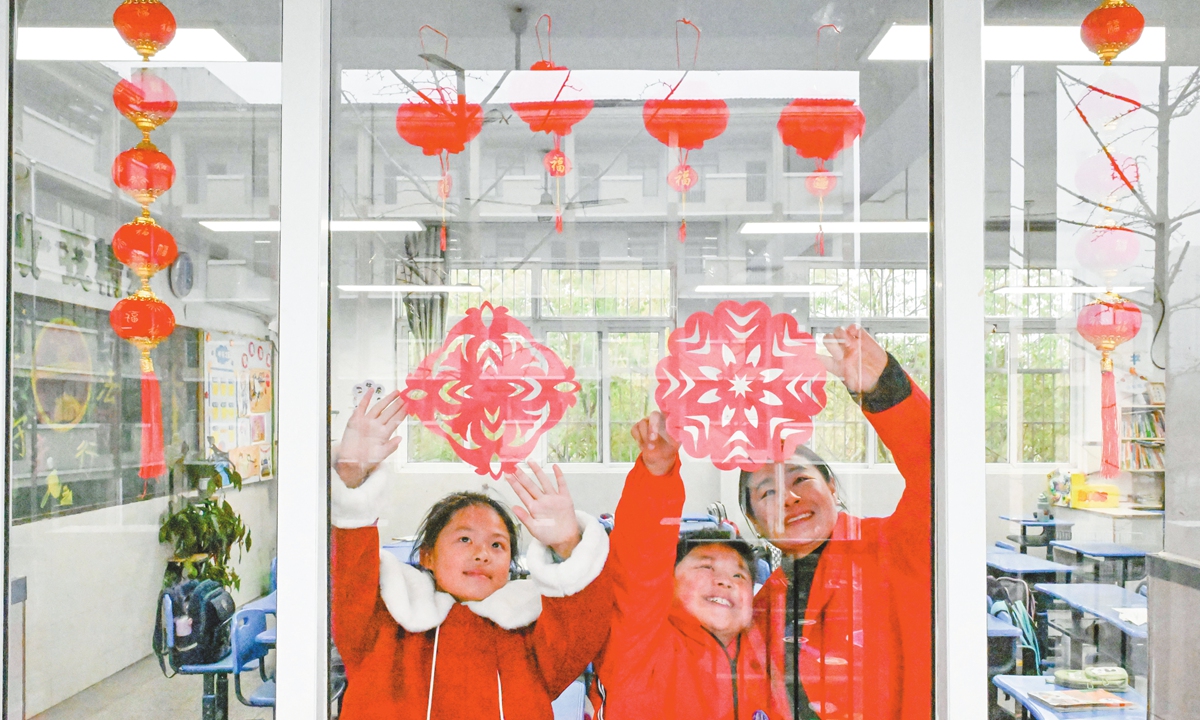
Students and teachers of a local primary school, East China's Anhui Province, put up window paper-cuts together on January 4, 2026. Photo: VCG
At the foot of Mount Qomolangma, rows of newly built Tibetan-style houses stand in orderly fashion. This is the new home for residents of Cuo'ang Village in Dingri county, Xigaze in Southwest China's Xizang Autonomous Region. Inside one of the homes, warmth fills the air as Awang Quzong and her family gather in front of the television to watch President Xi deliver his New Year massage.On January 7, 2025, a magnitude-6.8 earthquake struck Tingri county. By the third day after the quake, Xizang had launched early-stage efforts such as designing housing layouts and clearing debris. Construction began in early March, and by late October, the homes were completed and delivered, allowing tens of thousands of affected residents to spend the winter in warmth, according to the publicity department of Xigaze.
"For our little family," Awang Quzong told the Global Times, "2025 was a very special year. There was the sorrow of experiencing the earthquake, the determination and drive during the rebuilding phase, and finally the joy of moving into our new home."
To stabilize employment and boost income, the local authorities have integrated post-disaster reconstruction with industrial support. By promoting agricultural science and technology parks, cultivating distinctive seed industries and providing skills training for farmers and herders, more residents are being included in long-term development plans.
For Awang Quzong's homeland, 2025 marked the 60th founding anniversary of China's Xizang Autonomous Region, a milestone celebrated with historic significance. In his New Year address, Xi recalled on this moment: "I attended celebrations in Xizang and Xinjiang... With white khatas and passionate singing and dancing, they expressed their love of the motherland and the happiness they enjoy."
Since the 18th CPC National Congress, Xi has visited across the country. Awang Quzong told the Global Times she often sees President Xi on TV asking detailed questions during his local inspections like "What is your family's main source of income?" "Do many villagers work outside the village?" These concrete, heartfelt care has deeply touched her.
From "national priorities" to villagers' "critical daily concerns," each of China's solid step in people's livelihoods translates into tangible gains, Zhu said. "The CPC's vision positions people not just as beneficiaries but as co-architects of development," he explains.
In the interview with the Global Times, Zhu particularly mentioned a set of data. During the formulation of the 14th Five-Year plan in 2020, relevant central authorities, for the first time, solicited public opinions online and received more than 1.018 million suggestions from netizens. In the preparation of the 15th Five-Year plan, over 3.113 million suggestions were submitted within a month, according to the People's Daily.
"This reflects the high level of participation and broad coverage of the online solicitation activity for the formulation of the 15th Five-Year plan, which has fully absorbed grass roots insights and aspirations," Zhu said.
As the 15th Five-Year Plan period unfolds, Zhu believes that the ardent hopes of ordinary people will continue to expand China's "toolkit" of support policies, making people's well-being initiatives more equitable, balanced, inclusive, and accessible.
RELATED ARTICLES