Opening a window to high-quality, sustainable development of the Yangtze River Economic Belt
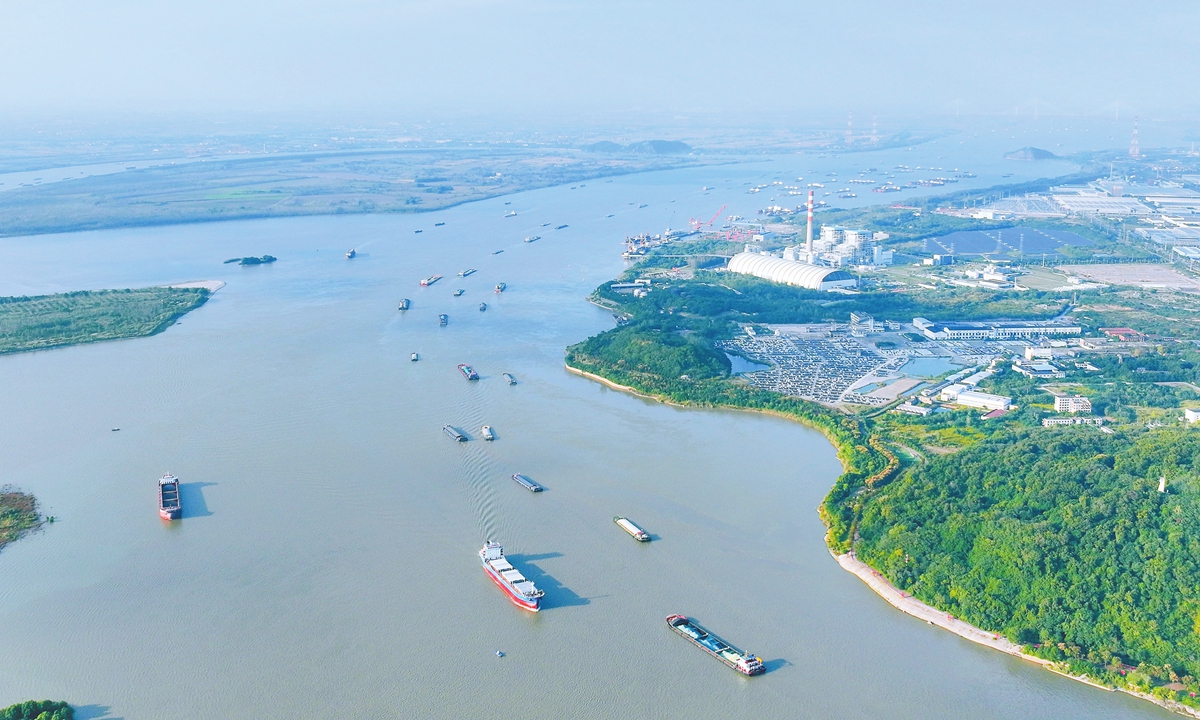
Ships shuttle back and forth in the Siheshan waters of the Yangtze River in Wuhu, East China's Anhui Province on October 24, 2025. Photo: VCG
How is China advancing toward a path of high-quality and sustainable development in the new era? The development of the Yangtze River Economic Belt serves as a window and provides the answers. Almost all the challenges of Chinese modernization can find their testing grounds in the region.
Thought is the lighthouse guiding the path forward. The Yangtze River is the mother river of the Chinese nation and an important pillar of its development, concerning the continuous development of the Chinese nation and the happiness and well-being of its people. Chinese President Xi Jinping has personally planned, deployed, and promoted the major national strategy of developing the Yangtze River Economic Belt.
Clarifying the direction. In January 2016, Xi, also general secretary of the Communist Party of China Central Committee and chairman of the Central Military Commission, stressed that "the Yangtze River boasts a unique ecological system. To restore its ecological environment will be an overwhelming task and no large-scale development will be allowed along the river at present and for a rather long period to come." The status and role of the river and the economic belt mean the development along the river must prioritize ecology and "green development" to respect natural, economic and social rules, he said.
Focusing on the methods. In April 2018, it was pointed out that in developing the economic belt, the key lies in properly dealing with the relationship between pressing ahead on the whole and making breakthroughs in key areas, between ecological environment protection and economic development, between making an overall plan and making unremitting efforts, between getting rid of old growth engines and cultivating new engines, and between developing individually and developing in a coordinated way.
Drawing the blueprint. In November 2020, it was stressed that efforts are aimed at turning the Yangtze River Economic Belt into the country's main focus for green development, the major artery for a smooth "dual circulation" of domestic and international markets, and the main force spearheading high-quality economic development.
Underlining the key points. In October 2023, it was pointed that the region's development should be led by scientific and technological innovation while environmental protection and economic and social development should be advanced in a coordinated manner. It is imperative to strengthen coordination in policies and work to make long-term plans.
From Southwest China's Chongqing Municipality and Wuhan, Central China's Hubei Province to Nanjing, East China's Jiangsu Province and Nanchang, East China's Jiangxi Province, the development of the Yangtze River Economic Belt has progressed from "promotion" and "in-depth advancement" to "comprehensive" and "further" progress. Over the course of 10 years, four symposia have been held regarding the development of the economic belt and multiple inspection tours were made to the upper, middle and lower reaches of the Yangtze River. The General Secretary's overall strategic vision and arrangements encapsulate the CPC's epistemological, methodological, and practical approaches to governance of China.
This is the right path, and we must continue on it. This is a path of high-quality and sustainable development.
Along this path, over the past decade, the proportion of good-quality water in the Yangtze River Economic Belt has risen from 67 percent to 96.5 percent, the region's share of national GDP has increased from 42.2 percent to 47.3 percent, and per capita disposable income of residents has risen from 23,000 yuan ($3,289) to 44,000 yuan, representing a growth of 91 percent.
Starting from these three pairs of relationships - between development and protection, between establishing the new and phasing out the old, and between the whole country and one region, we can more profoundly comprehend how to integrate and apply Xi Jinping Thought on Economy and Xi Jinping Thought on Ecological Civilization in practice, and gain a deeper understanding of the internal logic behind China's economy moving toward high-quality and sustainable development.
Green development
No matter how the Yangtze River Economic Belt develops in the future, or to what stage it reaches, the Chinese nation can never be separated from the nurturing of the Yangtze River.
In January 2016, the first symposium on improving the development of the Yangtze River Economic Belt was held in Chongqing. General Secretary Xi said that the Yangtze River boasts a unique ecological system, and to restore its ecological environment will be an overwhelming task and no large-scale development will be allowed along the river at present and for a rather long period to come.
Chemical enterprises along the river were once a chronic problem.
In the Shishou section of the Yangtze River in Hubei Province, the riverside chemical company Chuyuan Group was once a major local taxpayer but also a major polluter. The local environmental protection authorities took tough action and conducted rigorous investigations over the company, issuing a fine of over 27 million yuan - the largest environmental penalty in the history of the Yangtze River Basin, which then forced the enterprise to undergo transformation and upgrading.
As a result, the company cleared production areas within one kilometer of the shoreline, invested hundreds of millions of yuan in environmental upgrades, and entered the circular economy - Chuyuan has been reborn.
The key to addressing the problem of chemical enterprises along the river lies in the path that puts ecology first while pursuing green development.
The General Secretary said that efforts should be made to properly deal with the relationship between ecological environment protection and economic development, and explore a new path which puts ecology first while pursuing green development.
Today, green electricity accounts for nearly 40 percent of the total electricity consumption in society; more than 6,000 national-level green factories are leading the construction of a green industrial system.
The 2025 Global Survey on Impression and Understanding of China showed that "lucid waters and lush mountains are invaluable assets" received approval from nearly 80 percent of international respondents.
Innovative development
The Yangtze River shoreline has long accumulated a large volume of traditional, outdated production capacity, marked by scale, high risks, and weakening growth momentum. How this challenge should be addressed?
General Secretary Xi said that efforts should be made to properly deal with the relationship between getting rid of old growth engines and cultivating new engines, and facilitate the establishment of a modern economic system for the Yangtze River economic belt.
Once known as "neither an Eastern region or a Western one," East China's Anhui Province has tailored its economic efforts to local conditions, achieving a regional GDP exceeding 5 trillion yuan in 2024 and successively crossing four trillion-yuan thresholds over the past decade. The capital of Hefei, in particular, has risen dramatically to become a city of scientific and technological innovation, achieving a GDP of over 1 trillion yuan alongside a population exceeding10 million.
How it overcame its disadvantages? The Science Island on the western suburbs of Hefei is home to two national major science facilities and seven research units, which attracted more than 3,000 scientific researchers. Some have remarked: The city has reserved the most beautiful scenery for scientific and technological innovation.
Across China, localities have been transforming and upgrading traditional industries through new technologies, actively promoting intelligence, greening, and integration, thereby unleashing tremendous potential for high-quality development.
During the 14th Five-Year Plan (2021-25) period, China's innovation index ranked among the global top ten for the first time.
Coordinated development
Development momentum is also shaped by better grasping the relationship between the whole country and a single region, accurately identifying the strategic positioning within the national overall situation, forging a path of high-quality development suited to local realities, and promoting coordinated regional development.
This is vividly reflected in the practice of the eco-green integrated development demonstration zone in the Yangtze River Delta. The Qingpu district in Shanghai, Wujiang in East China's Jiangsu Province and Jiashan in East China's Zhejiang Province started exploration eco-friendly green integrated development in November 2019. Now, the three places have integrated in six fronts - management, planning, market, project, supervision and people's livelihood. In December 2025, it was designated a practice innovation base for "lucid waters and lush mountains are invaluable assets."
In today's China, from river basin governance to urban-rural integration, from regional coordination to the market's "five unifications and one opening-up," production factors flow reasonably, regions collaborate efficiently, and a vibrant panorama unfolds of harmonious coexistence and win-win cooperation.
The recommendations for the 15th Five-Year Plan stated that China will improve mechanisms for implementing regional coordinated development strategies, fostering an integrated and complementary regional economic layout and a well-ordered system for territorial spatial development.
Planning for long-term momentum, implementing long-term strategies, and establishing a foundation for lasting stability.
The mighty Yangtze surges onward, as does a striving China. Along this path of high-quality and sustainable development, a thousand sails vie in spirited competition.
This was compiled from an article originally published on the front page of the People's Daily on January 7, 2026.
RELATED ARTICLES