China-Africa ‘36-year new year tradition’ sets example for Global South cooperation
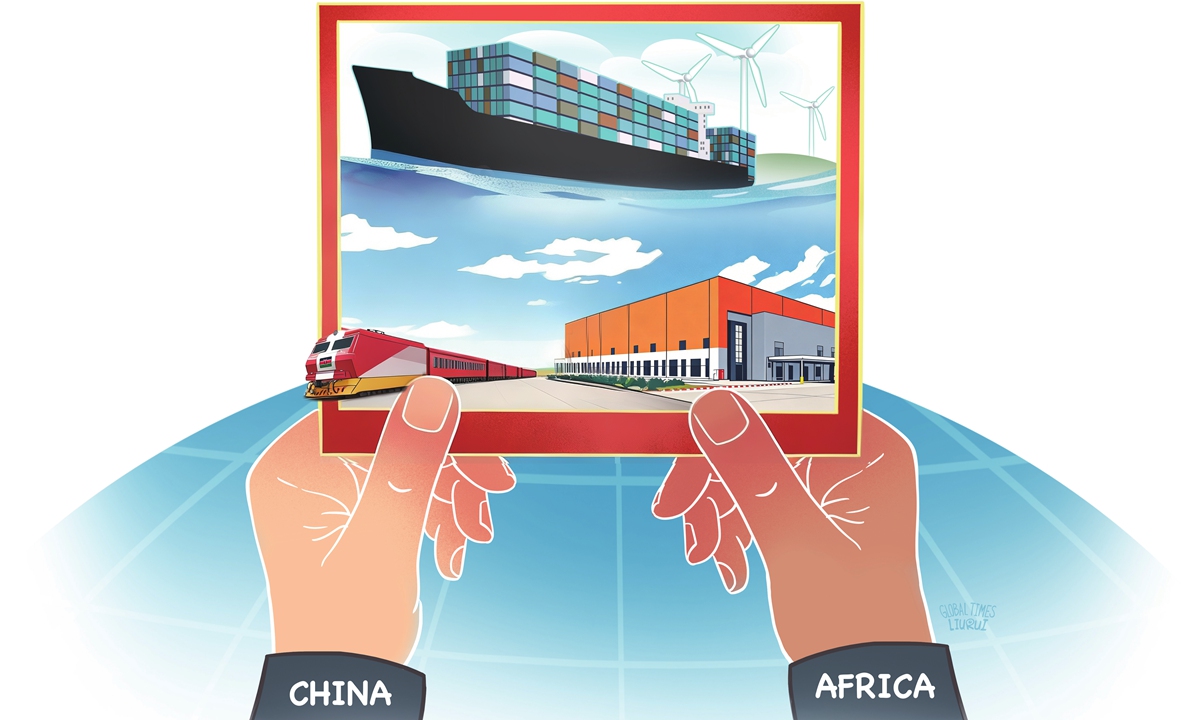
Illustration:Liu Rui/GT
As the new year begins, a 36-year diplomatic tradition remains unbroken, bridging the vast distance between China and the African continent. On Wednesday, it was announced that Wang Yi, a member of the Political Bureau of the CPC Central Committee and Minister of Foreign Affairs, will visit Ethiopia, Somalia, Tanzania and Lesotho upon invitation from January 7 to 12.
This will mark the 36th consecutive year for Africa to be the destination of the Chinese foreign minister's first overseas trip of the year - a gesture that underscores both China's steadfast commitment to the continent and the profound friendship defining China-Africa relations in a new era.
Looking back at the year that just passed, the cooperation between China and Africa has hit new milestones. 2025 marked the 25th anniversary of the Forum on China-Africa Cooperation (FOCAC). It was also a year of accelerated implementation and early harvests following the 2024 FOCAC Summit in Beijing. Despite a complex and volatile international landscape, bilateral cooperation has not only remained resilient but has achieved several pragmatic breakthroughs.
This progress is particularly evident in trade: From January to November 2025, trade volume between China and Africa exceeded $314.4 billion - a year-on-year increase of 17.8 percent, surpassing the total for the entire 2024. Furthermore, China's decision to drop tariffs on imports from all 53 African countries with which it maintains diplomatic relations has allowed African products to enter the Chinese market at an unprecedented pace.
In terms of investment, in the first nine months of 2025, after the 2024 Beijing Summit, China invested over 13.3 billion yuan ($1.85 billion) in Africa, driving high-quality cooperation in infrastructure, green industries and technology. Key projects like the revitalization of the TAZARA Railway are expanding into a broader TAZARA Railway Prosperity Belt. By seizing the cooperative opportunities presented by our times, China and Africa are forging a new paradigm for South-South cooperation.
Besides, China and Africa have also shown their capability to work together to navigate shared challenges. In particular, as two pivotal forces of the Global South, they advocate for a more just and equitable world order. This is exemplified by another defining moment of 2025 regarding China-Africa relations, which was the release of the Changsha Declaration on Upholding Solidarity and Cooperation of the Global South. The document took a firm stand against unilateralism and protectionism while calling for an international order based on international law and the WTO-centered multilateral trading system.
More recently, the urgency for the Global South to enhance cooperation to promote reforms in global governance has been underscored after the US forcibly controlled Venezuelan President Nicolás Maduro, a flagrant disregard for international law by hegemonic powers that has shocked the world. The African Union and numerous African countries have voiced condemnation against Washington's military intervention and its violation of Venezuela's sovereignty.
Against this backdrop, the cooperation between China and Africa has been entrusted with the mission to serve as a vital bulwark for the Global South to safeguard the UN Charter and reject foreign interference.
Ma Hanzhi, an assistant research fellow at the Department for Developing Countries Studies under the China Institute of International Studies, told the Global Times on Wednesday that China and Africa play a critical role in the rise of the Global South across three dimensions: first, defending independence, which is the political hallmark of the Global South; second, focusing on development and revitalization through the exchange of technology and talent; and third, promoting equity and justice to ensure the Global South, particularly Africa, has a stronger voice in international affairs.
Notably, during this year's trip, Foreign Minister Wang Yi will attend the launching ceremony of the China-Africa Year of People-to-People Exchanges at the African Union headquarters. Ma noted that this initiative will deepen mutual understanding and identity. "Whether it is political solidarity or pragmatic cooperation, the ultimate goal is to connect the hearts of the people. This emotional resonance will set a new example for Global South cooperation," he said.
In every possible aspect, the 36-year new year tradition between China and Africa conveys a crucial sense of certainty in bilateral relations, and now - more than ever - a constant joint call for a more just, inclusive and trustworthy global order. Hopefully this timely trip to Africa will sound the first powerful note for Global South solidarity and cooperation in 2026.
RELATED ARTICLES