China to roll out facial recognition, mobile payment and more to cut hospital billing queues
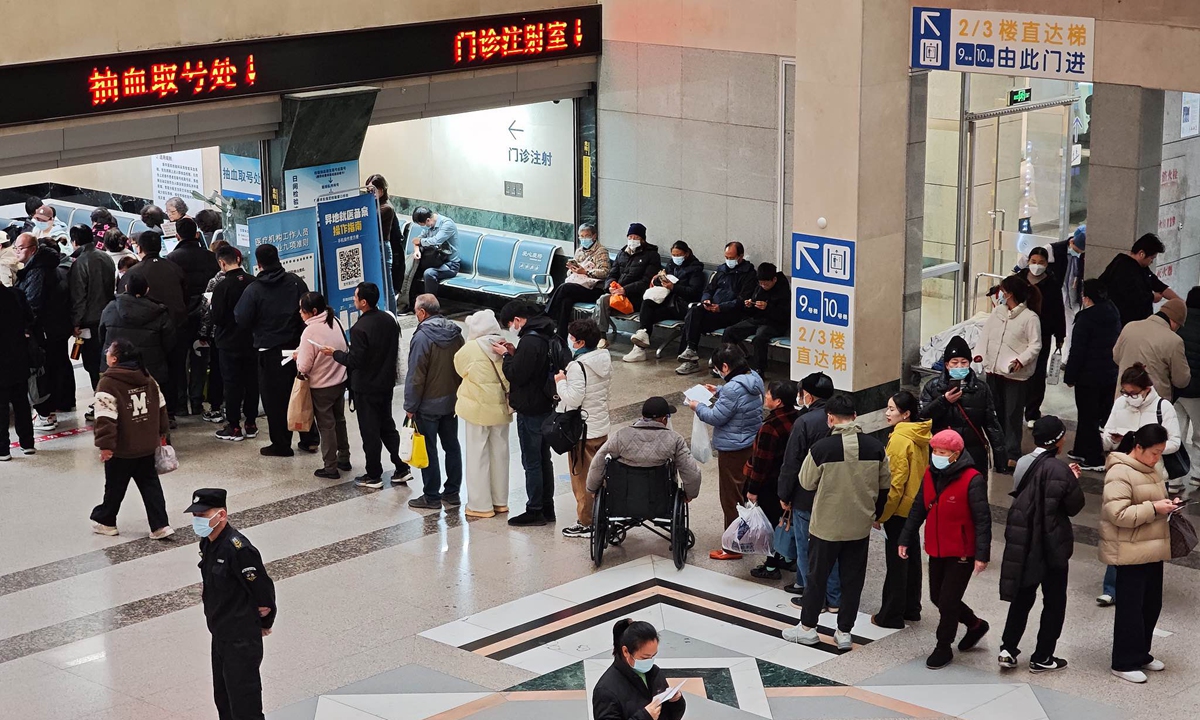
Patients are queuing up in an orderly manner for registration, payment and blood tests in the outpatient hall of a top-tier hospital in Yangpu district, Shanghai, on December 22, 2025. Photo: VCG
Long queues and repeated waits to settle medical bills—a long-standing public concern—are set to ease, as China's National Healthcare Security Administration (NHSA) on Thursday released a document outlining plans to expand facial-recognition, one-code, mobile, and credit-based payment methods. The initiative aims to establish a unified, convenient payment system covering both outpatient and inpatient services within about three years.These four different payment methods are designed to address the problems of different groups. Facial recognition payment, which completes identity verification and payment through facial scanning, eliminates the need to carry physical cards or mobile phones. This method is particularly suitable for elderly individuals who may forget their cards or struggle with smartphone operations, according to NHSA.
One-code payment allows patients to complete medical insurance reimbursement, personal account payments, and out-of-pocket expenses with a single scan, eliminating the need to move between different windows and making the payment process more integrated and streamlined.
Mobile payment enables patients to complete the entire process of registration, payment, and medical insurance reimbursement through mobile apps or mini programs without queuing at self-service machines or payment windows. This method is especially beneficial for pregnant women, people with disabilities, and others who face mobility challenges.
Credit payment, based on the contractual relationship between insured individuals and banks, allows the bank to cover the out-of-pocket portion of medical expenses within an approved credit limit. This enables patients to see a doctor first and pay later. For example, elderly individuals who find it inconvenient to pay at the hospital can receive treatment first and have their family members settle the payment afterward.
According to the NHSA document, each province will initially implement these payment methods in at least two cities. Provinces are required to ensure effective implementation in the first batch of pilot cities and designated medical institutions by 2026. By 2027, coverage is expected to extend to all coordinated regions within provinces, and by 2028, all eligible designated medical institutions in provinces will fully adopt these payment methods.
In recent years, healthcare security services have been continuously upgraded to enhance convenience. Efforts include enabling direct settlements for cross-provincial medical treatments, promoting medical imaging cloud data sharing to eliminate the need for physical films, and striving to build a convenient healthcare payment system. Each of these initiatives addresses the public's concerns about medical services, according to a Xinhua News Agency report.
The NHSA stated that building a convenient healthcare payment system will empower medical institutions in management, improve patient flow, and optimize the allocation of high-quality medical resources. Additionally, it will extend credit scenarios from financial consumption to public services, providing high-quality, authentic, and closed-loop behavioral data for the social credit system.
Global Times
RELATED ARTICLES