Eight-point decision fosters ‘disciplined, innovative and responsible party governance’
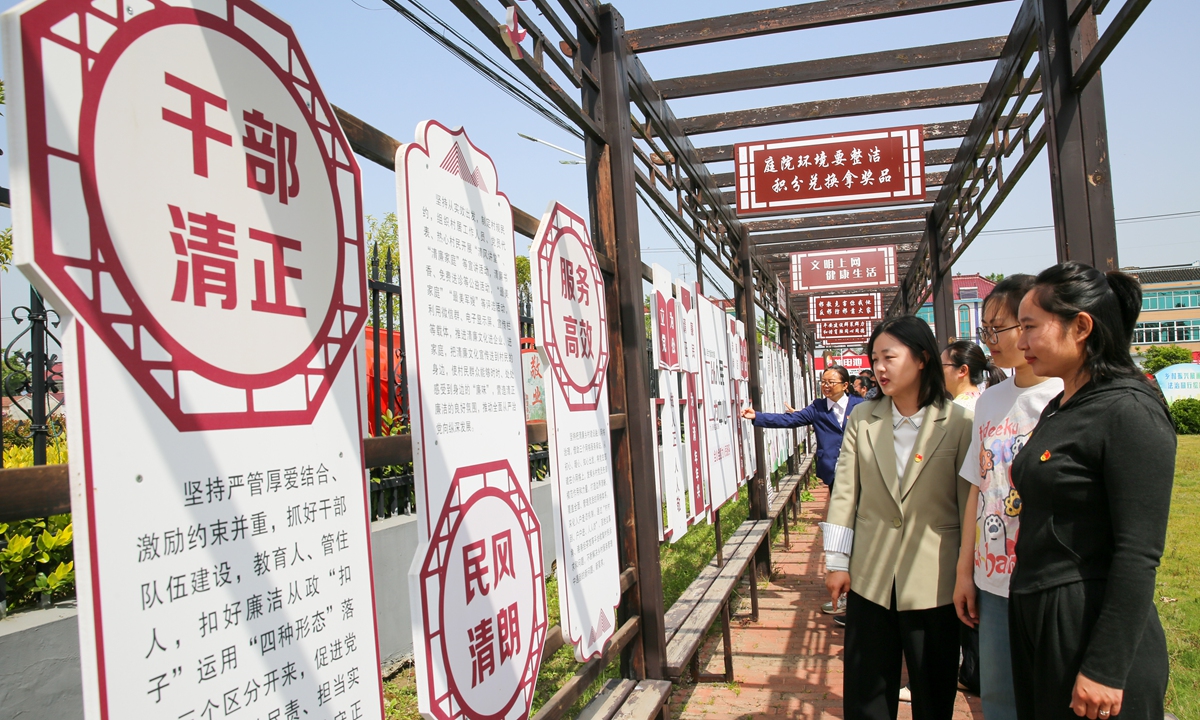
Young members of the Communist Party of China visit an integrity education corridor in a village in Nantong, Jiangsu Province, on May 7, 2025. Photo: VCG
Editor's Note:
Since its introduction in 2012, the eight-point decision has not only become a "golden hallmark" of the efforts of the Communist Party of China (CPC) to improve Party conduct in the new era, but it has also served as a mobilization order for Party members to uphold credibility with concrete actions, stay clean and dedicated in their work, and create new achievements. The Global Times invites experts and scholars from around the world to discuss the efficacy, global significance of the eight-point decision and the examples it sets for ruling parties in other countries, especially those in the Global South. In the fifth article of the series, Global Times (GT) reporter Liu Xuandi interviewed Keshab Prasad Joshi (Joshi), principal of Arunima College in Nepal.
GT: The CPC has focused on sustained efforts for over a decade to implement the eight-point decision. In your view, what motivates the CPC, a major party that has successfully steered China's modernization, to devote such large-scale and long-term efforts to the improvement of its work conduct?
Joshi: Every nation advances on the path of progress and social solidarity with insightful missions and visions. Governing a country with the world's second-largest population requires visionary leadership grounded in collective interests and public welfare. Nations falter when leadership lacks determination and responsibility toward the people. Party conduct therefore plays a vital role in promoting national integrity and prosperity, as corruption and extravagance undermine public trust.
By curbing such practices, the CPC's eight-point decision has strengthened public support and accountability, offering a roadmap for fostering disciplined, innovative and responsible governance.
GT: Chinese President Xi Jinping pointed out that fine conduct of maintaining close ties with the people should be further promoted among Party members. How do you think this embodies the CPC's approach to governance?
Joshi: The CPC's approach to people-centered governance is reflected in the effective integration of both bottom-up and top-down mechanisms, creating a coherent and responsive governing system. Strong accountability among officials is essential to maintaining close ties with the people and ensuring that governance remains rooted in integrity and public welfare.
GT: You have observed grassroots governance in Sichuan Province. During your visit, did you meet any CPC officials? What are your impressions and feelings regarding their performances and work conduct?
Joshi: During my visit to Sichuan, I had several opportunities to meet with CPC officials at the grassroots level. I was struck by how clearly they understood both local needs and national goals, and how guidance from the top translated into concrete action on the ground. Local officials discussed community issues openly, worked toward consensus-based decisions, and demonstrated a strong sense of accountability and collaboration. They were accessible, amicable, virtuous and focused on balanced local development.
GT: The CPC has grown from just over 50 members a century ago to more than 100 million members today, becoming the largest political party in the world. From the perspective of the eight-point decision, what do you consider the fundamental sources of the CPC's continued cohesion and resilience?
Joshi: A political party earns public trust and confidence through the formulation and implementation of people-centered policies. Since its inception, the CPC has emphasized humanistic and environmentally conscious development. Its commitment to good governance - an essential and deliberate political choice - has played a crucial role in China's transformation into a prosperous and modern country.
What do people ultimately seek? Good governance, social inclusion, equal opportunities, quality education, healthcare, ethical leadership and a strong work ethic. The CPC's sustained focus on corruption-free governance is central to its cohesion and resilience. Social inequality, a persistent global challenge, often stems from corruption, nepotism and unequal resource distribution. Through long-term vision and policy innovation, the CPC has played a decisive role in addressing such structural challenges and promoting social stability and development.
GT: Amid global crises of political trust and governance efficiency, the CPC's extensive experience in improving work conduct and strengthening intra-party supervision is worthy of attention. In your view, can the CPC's experience in conduct governance offer valuable insights for other countries' political party reforms, especially those in the developing world?
Joshi: Political trust and good party governance are essential in building public support and optimism. The work ethic of the Chinese officials that dedicates to serve the people is widely exemplary. Intra-party supervision plays a crucial role in upholding integrity by ensuring transparency in conduct and decision-making. A clear chain of command has proven to be a powerful mechanism for guiding collective action in the right direction.
While governance models cannot be mechanically transplanted from one context to another, the CPC's eight-point decision offers valuable lessons. The eight-point decision can serve as an eye opener for countries struggling with weak party governance.
RELATED ARTICLES