‘LAC faces turbulent path of overcoming the neocolonizing strategy of the neighborhood bully’
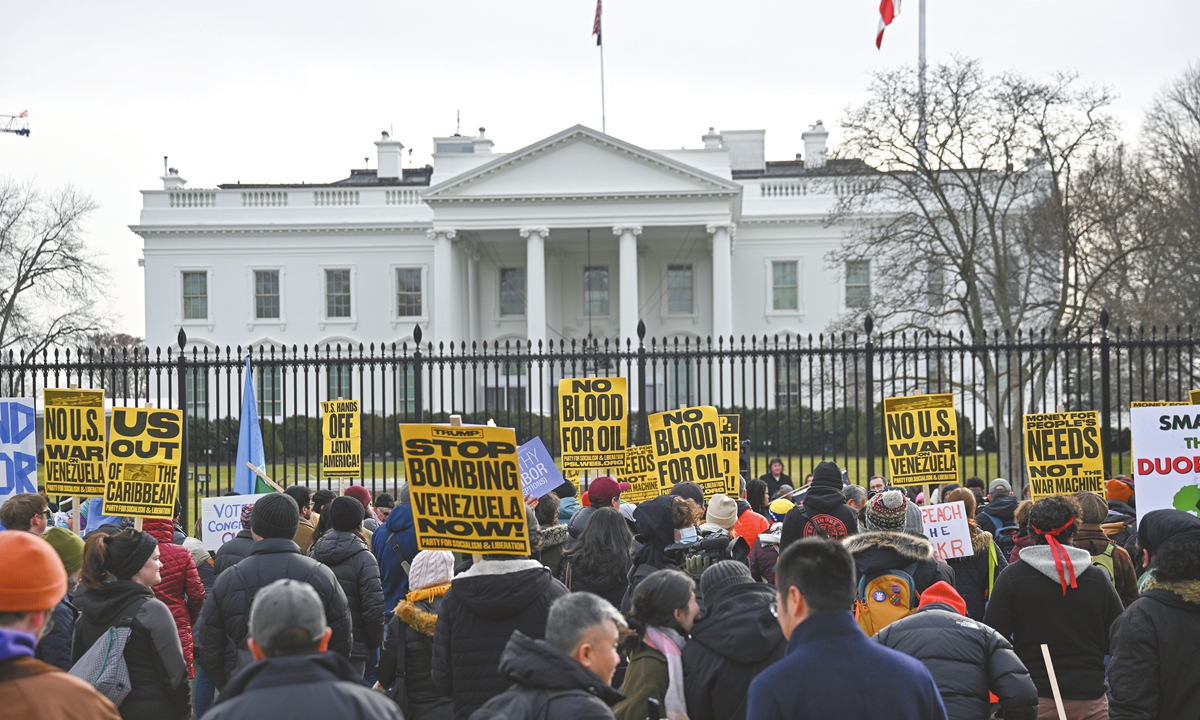
People carrying banners gather to protest the US attacks on Venezuela, in Washington, US, on January 3, 2026. Photo: VCG
Editor's Note:
The US attack on Venezuela and the seizure of President Nicolás Maduro reflect a persistent pattern of US intervention in Latin America that has fueled resentment in the region. As this aggressive move has sent shockwaves through the international community, Latin America has expressly condemned US military actions. Protests have erupted across the region as people took to the streets to denounce US actions and the ongoing legacy of colonialism. In light of these developments, the Global Times, in our commentary column "Global Times Opinion Arena," invites a panel of Latin American scholars to analyze the immediate impact of US military actions on Venezuela and the region, along with its wider implications for inter-American relations.
Javier Vadell, a professor of international relations and chair of the Contemporary China Center at the Pontifical Catholic University of Minas Gerais in Brazil
The recent military intervention and forcible seizure of Venezuelan President Nicolás Maduro is not an isolated incident. Rather, it serves as a stark catalyst - pouring accelerant on a long-smoldering fire of anti-American sentiment across Latin America and awakening a renewed and profound consciousness of independence. This episode connects directly to a deeper historical pattern, revitalizing regional resolve to resist hemispheric hegemony.
At its core, this emerging wave is driven by a blatant violation of international law by the US. The principles of national sovereignty and non-intervention are sacrosanct in the Latin American and Caribbean (LAC) region, which retains a long and painful memory of US-backed coups and military invasions. The brazen plot against Maduro, following years of severe unilateral sanctions that have crippled Venezuela's economy and inflicted widespread humanitarian suffering, is widely perceived as the latest manifestation of 21st-century "gunboat diplomacy." It signals a willingness to circumvent multilateral institutions and legal norms in pursuit of political objectives - an approach that resonates deeply with the region's history of external interference.
The explicit adoption of US military options in Venezuela, the marginalization of Latin American leadership and the indiscriminate application of coercive economic measures have stripped away any pretense of partnership. This approach has alienated even traditionally US-aligned governments, many of which quietly fear the precedent of regime change through force or economic strangulation.
As a result, the potential for a sustained and deepening wave of anti-Americanism is substantial. Yet this wave differs markedly from past expressions. It is less emotional and ideological, and more institutional and strategic in nature. It is rooted in a collective defense of sovereignty. Regional organizations - despite internal divisions - are increasingly reluctant to endorse US-led initiatives perceived as interventionist. What is emerging is a consciousness of strategic autonomy: a deliberate effort to diversify economic partnerships, strengthen Latin American-led institutions, and shield the region from the destabilizing effects of abrupt shifts in US policy.
In essence, the plot against Maduro functions as a powerful mnemonic for the region. It reminds the LAC that, without vigilance and unity, the patterns of 20th-century domination could reemerge. The resulting anti-Americanism, therefore, is not merely an expression of resentment, but a conscious political awakening - a firm assertion that the era of unilateral imposition has passed, and that the region's destiny must be shaped by its own people.
Ricardo Guerrero, director of Mexico-based law firm Legal & Quality Control
Recent actions taken by the US against Venezuela have once again brought issues such as state sovereignty, the limits of international law, and the illegitimacy of external intervention to the forefront of Latin American discourse.
From a legal perspective, sovereignty remains a cornerstone of the international order. The Charter of the United Nations and customary international law rest on a clear premise: States should not unilaterally intervene in the internal affairs of others. This principle does not seek to shield governments, but to prevent force or political imposition from replacing the shared rules that sustain global stability.
Aymara Gerdel, director at the Venezuelan Center of Studies on China
Venezuela has fallen victim to a military attack by the US government. The US actions constitute a flagrant violation of Venezuela's national sovereignty, international law and our people's right to life and peace. They took the form of a foreign military incursion into our national territory, involving bombings in Caracas and other cities across the country. Such events are unprecedented in our country's republican history, and their potential impact on the stability and peace of Latin America and the Caribbean should shock and alert countries around the world.
US threats to seize natural resources and control territories by force are not an isolated case. Cuba, Mexico and Colombia have already been targets of this intimidating rhetoric, and even Denmark's sovereignty is at stake, with Greenland in the US sights.
This escalation follows an imperialist logic: In order to perpetuate itself, the US requires Venezuelan oil and other strategic resources. Military interventions and acts of aggression are not geographical accidents, but calculated operations designed to control resources. The result is threefold: It endangers world peace, undermines the foundations of international law and sets a dangerous precedent whereby no country is safe.
I call on the Venezuelan academic community, academic networks and scientific research institutions to unite in defense of our country and the framework of international law, in anticipation of possible future events that could endanger the integrity of our territory and population.
Isaura Diez Millan, chief correspondent of the China bureau of the Latin American news agency Prensa Latina
The attack on Caracas has significantly and negatively affected ties between Washington and the LAC, while in the long term, it opens a new chapter of aversion among civil society toward the northern neighbor.
After the attack, the true objectives of the Republican administration became clearly evident: to seize the resources of the Venezuelan oil industry, eliminate Caracas as a significant regional actor and establish a government there that is fully aligned with the interests of the White House in the long term.
What Washington has designed for the South American country and for the LAC is a situation of neocolonialism. The feeling in the region is that no government is safe; in fact, direct threats to Colombia, Mexico and Cuba have already been noted.
This is occurring amid deep fragmentation in the region, with a notable rise of the right wing and clear US interference in the internal affairs of several nations.
Now the LAC faces the turbulent path of overcoming the neocolonizing strategy of the "neighborhood bully" and strengthening diversified ties with other countries of the world that prioritize tangible, pragmatic and mutually beneficial cooperation, without geopolitical calculations or interference.
RELATED ARTICLES