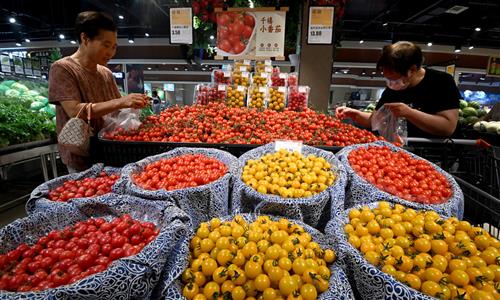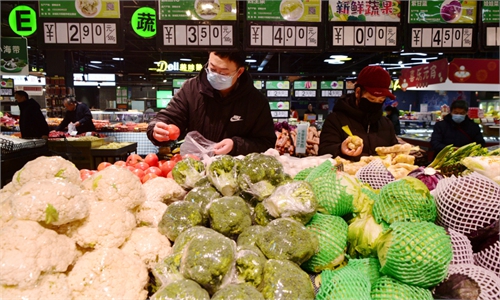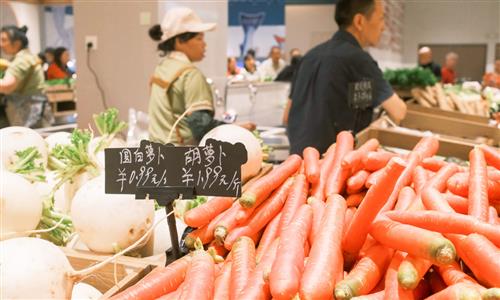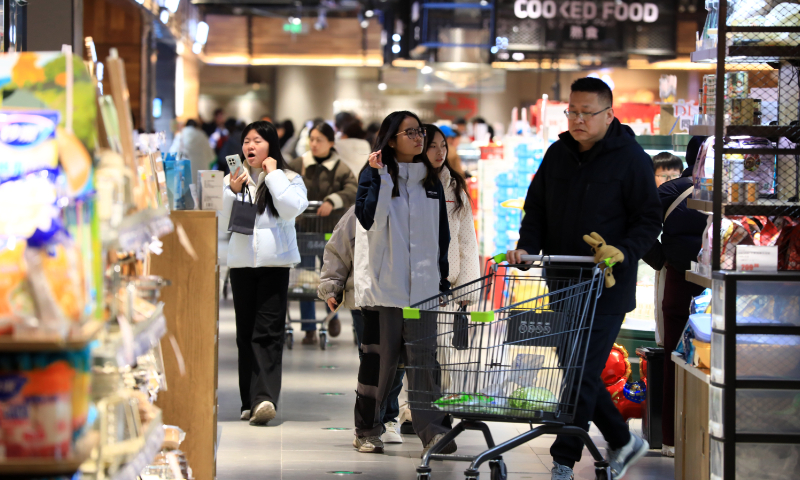
Consumers shop at the food section of a supermarket in Huaian, East China’s Jiangsu Province, on December 31, 2025. Photo: VCG
China's consumer price index (CPI) rose 0.8 percent year-on-year in December 2025, up 0.1 percentage point from November, marking the highest level since March 2023. Core CPI (excluding food and energy) climbed 1.2 percent year-on-year - remaining above 1 percent for four straight months, according to the latest data from the National Bureau of Statistics (NBS).
Urban areas saw a 0.9 percent increase on a yearly basis, while rural areas increased by 0.6 percent. Food prices rose 1.1 percent year-on-year, while consumer goods prices increased 1.0 percent, and services prices up by 0.6 percent, according to NBS data released on Friday.
NBS chief statistician Dong Lijuan said that policies to boost domestic demand and consumption continued to take effect. Combined with the New Year's Day, consumer demand rose, driving the CPI up 0.2 percent month-on-month and 0.8 percent year-on-year.
The wider CPI increase was mainly driven by faster food price growth. Food prices rose 1.1 percent year-on-year, expanding the gain by 0.9 percentage points from November and contributing about 0.17 percentage points more to December CPI than the previous month, said Dong.
Among food items, fresh vegetables and fruits surged 18.2 percent and 4.4 percent respectively; beef, lamb, and aquatic products rose 6.9 percent, 4.4 percent, and 1.6 percent, all with wider gains. Energy prices dropped 3.8 percent, with gasoline alone down 8.4 percent.
Core CPI rose 1.2 percent year-on-year, staying above 1 percent for four consecutive months. Services prices increased 0.6 percent, contributing about 0.25 percentage points to CPI's year-on-year growth, with household services up 1.2 percent, though rents went down by 0.3 percent.
On the month-on-month side, CPI shifted from a 0.1 percent decline in November to a 0.2 percent rise, primarily due to higher non-energy industrial consumer goods prices, said Dong.
"Ongoing consumption-boosting policies, plus pre-New Year demand, lifted prices for communication devices, baby products, entertainment durables, and household appliances up 1.4-3.0 percent. Rising international gold prices drove domestic gold jewelry up by 5.6 percent," said Dong.
According to NBS, the producer price index (PPI) declined 1.9 percent year-on-year in December, narrowing 0.3 percentage points from November. PPI showed a 0.2 percent month-on-month rise. This was also the third consecutive month witnessing a month-on-month rise in PPI.
Macro policies continued to show results, with positive price changes in some sectors. Narrowing declines were seen in coal mining, lithium batteries, and photovoltaic equipment due to unified national market reforms, said Dong.
"Cultivation of new quality productive forces drove PPI's year-on-year gains, with external storage devices/parts up 15.3 percent, biomass liquid fuels up 9.0 percent, graphite/carbon products up 5.5 percent, integrated circuits up 2.4 percent, waste resource utilization up 0.9 percent, and service robots up 0.4 percent," said Dong.
Unleashed consumption potential lifted related prices, including arts/crafts and ceremonial goods, which rose 23.3 percent year-on-year, sports balls up 4.0 percent, Chinese musical instruments up 2.0 percent, and nutritional foods up 1.5 percent.
Dong pointed out that a key month-on-month PPI feature was imported factors causing divergence: falling international crude oil pulled domestic petroleum extraction and refined products down 2.3 percent and 0.9 percent, respectively.
Global Times
RELATED ARTICLES