Macron strongly criticizes US, mentions China and Russia; speech reflects Europe's frustration over eroding influence: expert
By Published: Jan 09, 2026 01:30 PM

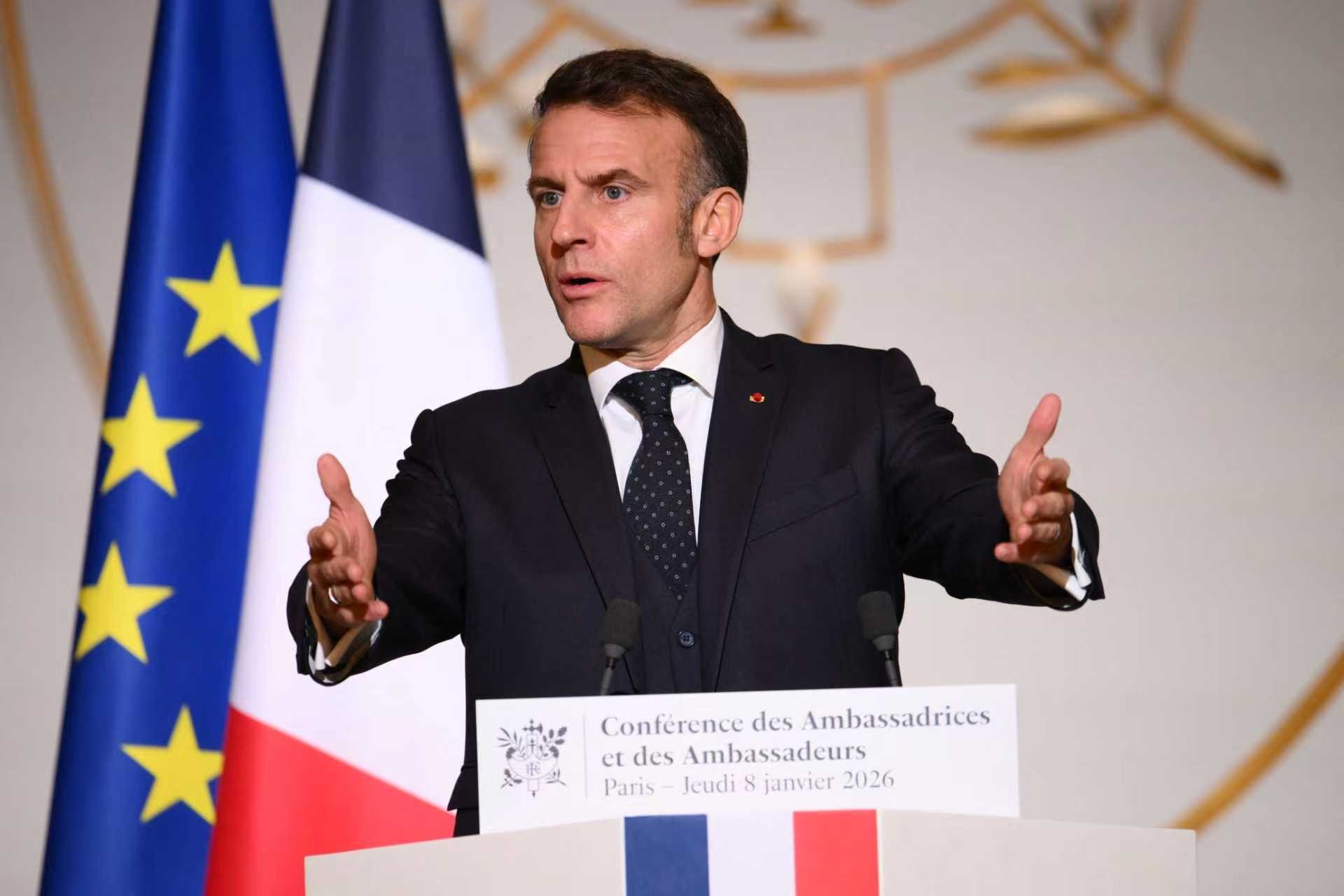
French President Emmanuel Macron during the 2026 Ambassadors' Conference at the Elysee Palace in Paris on January 8, 2026. Photo: VCG
In his annual address to French ambassadors at the Élysée Palace in Paris on Thursday, French President Emmanuel Macron outlined France's foreign policy priorities, sharply criticizing the US for "gradually turning away" from some of its allies and "breaking free from international rules," while leveling criticisms and claims against China and Russia, according to a press release issued by the Élysée Palace.
A Chinese expert noted that Macron's criticism appears to be mostly aimed at the US following a series of Washington's actions, although he also criticized Russia and made claims against China. Despite the broad targets, the speech reflects Europe's broader frustration and constraints, highlighting the strategic dilemmas facing both France and the EU as their ability to shape global affairs continues to erode, the expert said.
According to the Élysée Palace, Macron on Thursday met French ambassadors at the Élysée Palace during the Conference of Ambassadors and chaired three thematic working sessions that will help shape France's 2026 diplomatic agenda. These focused on European sovereignty, France's G7 presidency, and Africa, ahead of the Africa-France Summit to be held in Nairobi.
In his address, Macron repeatedly referred to the US both directly and indirectly, noting that "the United States is an established power, but one that is gradually turning away from some of its allies and breaking free from international rules that it was still promoting until recently," according to the release.
"We are living in a world of great powers with a real temptation to divide up the world," Macron said, rejecting what he described as a "new colonialism and new imperialism." Macron did acknowledge that "multilateral institutions are functioning less and less effectively."
But the French leader insisted that "global governance" was key at a time when "everyday people wonder whether Greenland is going to be invaded" and whether "Canada will face the threat of becoming the 51st state." He also said it was the right moment to "reinvest fully in the United Nations, as we note its largest shareholder no longer believes in it."
An AFP report noted that Macron's remarks on Thursday is "some of his strongest criticism yet of Washington's policies under Donald Trump" and it came as European powers were "scrambling to come up with a coordinated response" to Washington's forcible seizure of Venezuela's leader Nicolas Maduro and the US president's designs on Greenland.
A report by Politico EU noted that "Macron used the speech to paint a picture of predatory global powers seeking to divide the world into spheres of influence, with the US dominating the Western Hemisphere under the so-called Monroe Doctrine."
The report noted that the French president did not specifically mention Venezuela, but the situations in Caracas and Greenland are both top concerns for Paris, which is helping to craft a European response to Trump's threats against the self-governing Danish territory.
France's annual envoy meetings have become a key stage for Macron to articulate his worldview and set the direction of French diplomacy. Macron's recent criticism of the US - framed as opposition to a "new imperialism" - reflects lessons drawn from a series of shocks, from Venezuela to Greenland, Cui Hongjian, a professor at the Academy of Regional and Global Governance at Beijing Foreign Studies University, told the Global Times on Friday.
Cui noted that Macron's earlier remarks on Venezuela triggered domestic backlash and may now be quietly corrected. Recent US rhetoric on Greenland, he said, have shattered Europe's lingering belief that Washington would treat its allies differently. For France and Europe, US policy is increasingly embracing a hierarchical, US-centric order that contradicts the principle of sovereign equality, Cui added.
Previously, although France's political class has largely condemned the forcibly seizure of Venezuelan leader Maduro by US armed forces, but Macron has denounced neither the method nor the intervention itself, saying the Venezuelan people should "rejoice" in a post on X on January 4. France's leftwing parties have slammed his comments as a "disgrace," according to a report from the RFI.
In his Thursday speech, the French president also criticized Russia as a "destabilizing power," with regard to Ukraine and other regions, as well as information interference and other activities. Macron also complained about China on trade.
In his speech, Macron also noted that while managing the global imbalances addressed by the G7, it is essential to do everything possible to avoid the fragmentation of the world—namely, not turning the G7 into an anti-China club, a club of global division, or an anti-BRICS club, and not allowing the BRICS to become an anti-G7 club.
While his tone on China differed from that during his visit to Beijing, Macron's claims largely echoed the EU's familiar economic rhetoric, reflecting Europe's own frustrations and structural constraints, Cui noted.
The expert further pointed out that Macron's speech underscored Europe's strategic dilemma as it is caught between major powers. Burdened by internal divisions and institutional constraints, and with limited leverage abroad and declining influence on global affairs, the EU struggles to keep pace with China or the US. Unable either to compete effectively or to step back, Europe faces a growing sense of strategic insecurity, he said.
As the US, Russia and China accelerate competition in areas of their respective strengths, Europe's warnings about a new era of great-power rivalry reflect this vulnerability, Cui said.
RELATED ARTICLES