White House trade adviser’s claims that US to ‘wipe away’ China’s ‘dominance’ in rare-earth market inflammatory, nonsensical: expert
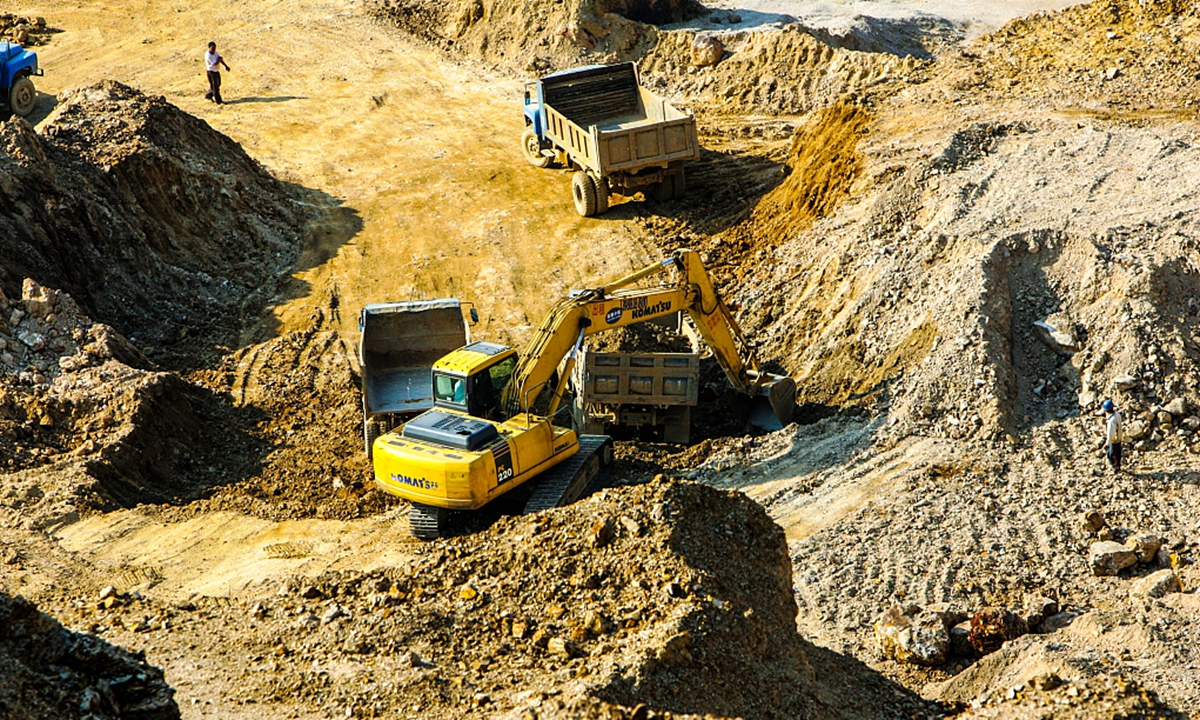
Rare earth Photo:VCG
According to Bloomberg's Friday report, the White House trade adviser Peter Navarro claimed in an interview with The Mishal Husain Show that American industrial breakthroughs would boost domestic production and "end China's market dominance in the rare earths market." He also distorted China's lawful resource management, asserting that US innovation would "quickly wipe away" what he alleged as "China's weaponization."
Chinese experts dismissed the remarks as "highly unprofessional and nonsensical," saying that labeling objectively existing natural resources such as rare earths as a "monopoly" is fundamentally flawed. They stressed that China's export management of rare earths is based on law not targeted at any specific country, nor does it constitute so-called "economic coercion."
During the interview, Navarro even misrepresented China as threatening to "take away" critical minerals from Europe, India and the United States if its actions were challenged.
"For decades, China's exports and supply of rare earths have not been a source of international controversy. The real issue lies not with the resources themselves, but with certain countries injecting Cold War-era thinking and geopolitical calculations into global supply chains, politicizing and fragmenting what had been a highly integrated rare-earth supply system and thereby fueling tensions," He Weiwen, a senior fellow at the Center for China and Globalization, told the Global Times on Friday.
Rare earths are naturally occurring resources rather than man-made products, He Weiwen noted, adding that their development and utilization involve capital-intensive, high-barrier processes such as mining, smelting and refining, and they are, in essence, industrial resources shared by humanity as a whole.
Labeling China's rare-earth supply chain as a "monopoly" is fundamentally misguided and unprofessional, He Weiwen said. "China does not monopolize rare-earth resources, but has developed a pronounced comparative advantage in smelting and refining. Depending on the category and processing stage, China accounts for close to 90 percent of global rare-earth refining capacity—a position built on decades of technological accumulation, integrated industrial support and cost efficiencies, reflecting competitiveness rather than monopolistic behavior," according to He Weiwen.
At a press briefing in October last year, China's Ministry of Commerce (MOFCOM) responded to recent rare-earth export control measures, stressing that the nation's actions are lawful steps taken in accordance with relevant laws and regulations to improve its export control system.
The measures are aimed at preventing rare earths from being illegally diverted to improper uses such as weapons of mass destruction, and at better safeguarding China's national security and global common security, according to the ministry.
The nation has made clear that its export controls do not amount to an export ban, and that compliant applications for civilian use will be approved.
On October 30, MOFCOM said it would suspend for one year the implementation of certain export control measures announced on October 9, while studying more detailed arrangements, according to the ministry's official website.
Meanwhile, China stands ready to strengthen communication and cooperation with all parties, continuously optimize licensing procedures, and actively apply facilitation measures such as general licenses to promote compliant trade in export-controlled items, MOFCOM spokesperson He Yadong said at a press conference held on November 6 last year.
Notably in the same interview with the Bloomberg, Navarro even urged the EU to impose higher tariffs on China, Bloomberg noted this as a request that could raise fresh tensions in the transatlantic trade relationship.
Navarro also urged Europe to "adopt exactly the same level of tariffs that we adopt," claiming that higher US tariffs were aimed to "defend" the US from China.
Equating China's price competitiveness with dumping distorts basic economic facts and fuels protectionist sentiment, aimed at pushing Europe to impose restrictions on China to curb its exports and industrial development, said Jian Junbo, director of the Center for China-Europe Relations at Fudan University's Institute of International Studies. Such actions would not only harm China's interests but also undermine multilateral trade relations, ultimately backfiring on those who impose them and weakening their long-term economic interests, he told the Global Times.
Trade diversion is inherently a two-way phenomenon in global commerce, Jian highlighted, noting that by the same logic, restrictions on Europe's exports to the United States could just as easily lead to increased European exports to China, offsetting part of the impact. "On that basis, attributing changes in China-EU trade patterns to so-called Chinese 'dumping' simply does not hold up," he said.
More fundamentally, China's competitiveness and trade surpluses with global markets, including Europe, are "not the result of deliberate design or manipulation, but the outcome of decades of evolving international division of labor and market competition," Jian noted. Over time, China has built a comprehensive manufacturing system spanning low-, mid- and high-end segments, becoming one of the world's leading manufacturing hubs through the combined forces of global capital, technology, labor and market choice.
China's manufacturing strengths have also delivered tangible benefits to Europe, he stressed, helping ease inflationary pressures, lower consumer costs and supply high-value intermediate goods that enhance European industrial competitiveness. "This level of interdependence reflects a fundamentally mutually beneficial trade relationship," Jian added.
RELATED ARTICLES