Washington sets dangerous precedent of power politics, risks pushing intl community back to jungle law, expert warns after US leader’s reported claims of not needing intl law
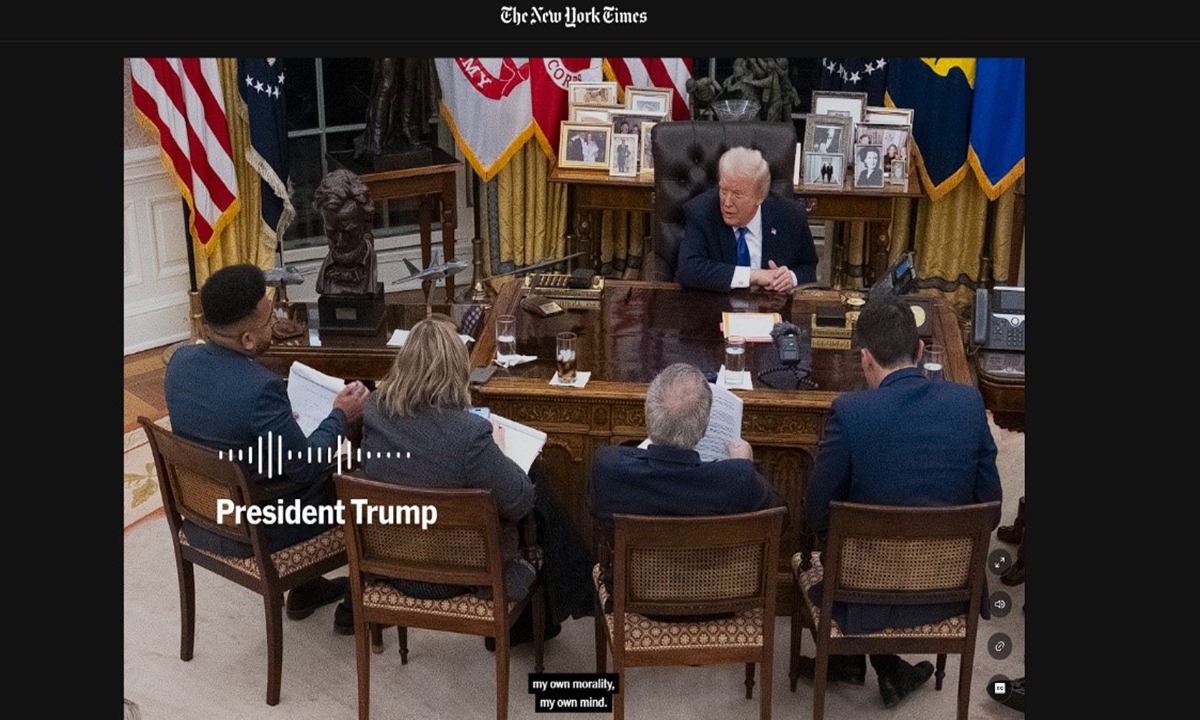
Photo: Screenshot from a video released by The New York Times accompanying its report on an interview with US President Donald Trump
US President Donald Trump claimed that he doesn't need international law, in a wide-ranging interview with The New York Times, adding that his power as commander in chief is constrained only by his "own morality."
A Chinese expert said the remarks, in addition to Washington's recent military actions against Venezuela and seizure of its leader as well as its threatening to take over Greenland, reflect the US' long-standing hegemonic tradition and power-politics mindset, warning that such thinking could steer the world toward a disorderly and even brutal state.
According to The New York Times report published Thursday, when asked whether there were any limits on his global powers, Trump responded: "Yeah, there is one thing. My own morality. My own mind. It's the only thing that can stop me."
"I don't need international law," Trump claimed. When pressed further about whether his administration needed to abide by international law, Trump said, "I do." But he made clear he would be the arbiter when such constraints applied to the US, the newspaper reported.
The New York Times interview also touched on broader geopolitical issues. When asked which was the higher priority — acquiring Greenland or preserving NATO — Trump declined to answer directly, but acknowledged "it may be a choice." He made clear that the trans-Atlantic alliance was essentially useless without the US at its core, according to The New York Times.
The newspaper further noted that "the president's insistence that Greenland must become part of the United States was a prime example of his worldview."
The US leader's latest remarks came after the administration's earlier statements about acquiring Greenland and US military actions that forcibly seized Venezuelan President Nicolas Maduro, have triggered opposition from European countries.
Previously, US Vice President JD Vance reportedly again hyped that Greenland is "critical" for the defense of the US and the world against possible Russian or Chinese missile attacks. BBC reported on Thursday that Vance claimed in an interview on Wednesday that the US' missile defense infrastructure is partially dependent on Greenland.
French President Emmanuel Macron on Thursday sharply criticized the US for "gradually turning away" from some of its allies and "breaking free from international rules," according to a press release issued by the Élysée Palace.
"We are living in a world of great powers with a real temptation to divide up the world," Macron said, rejecting what he described as a "new colonialism and new imperialism." Macron did acknowledge that "multilateral institutions are functioning less and less effectively."
German President Frank-Walter Steinmeier has strongly criticized US foreign policy under President Trump and urged the world not to let the world order disintegrate into a "den of robbers" where the unscrupulous take what they want, Reuters reported on Thursday.
In unusually strong remarks, which appeared to refer to actions such as the ousting of Venezuela's President Nicolas Maduro at the weekend, the former foreign minister said global democracy was being attacked as never before, according to Reuters.
International law has long been treated by the US as an auxiliary tool — emphasized and invoked when it serves US global hegemony, but readily discarded when it conflicts with American interests, Jiang Feng, a researcher at Shanghai International Studies University and president of the Shanghai Regional Studies Association, told the Global Times on Friday.
The Trump administration's approach, Jiang said, has openly laid bare a long-standing US tradition of "self-centered supremacy" in defining its global role and handling relations with other countries. The result is a substantive overturning of the existing liberal international order, which is still largely Western-dominated.
The US-EU alliances which once framed around shared values are being downgraded or even transformed into blatant transactions driven by interests and money. At a broader level, the post-World War II international system built around order and values is now being dismantled and undermined by the US, Jiang said.
The world has spent centuries gradually establishing an international order to prevent war and pursue lasting peace and common development, which is the result of collective global efforts. However, against the backdrop of the US openly declaring itself unconstrained by international law, the system is facing unprecedented damage. Such behavior sets a dangerous precedent of power politics — where "might makes right" — and risks pushing the international community back toward a jungle law, Jiang warned.
Jiang also cautioned that many European countries remain immersed in a moral identity shaped by post-Cold War narratives and are struggling to adapt to this fundamental rupture. Current trans-Atlantic relations, he said, reflect a structural breakdown of value-based alignment.
"For Trump, the key question is no longer values, but what services and tangible benefits Europe can provide to the US. Europe is clearly unprepared for this shift, which explains the intense criticism and condemnation directed at Washington," Jiang said.
These remarks also prompted discussions from Chinese netizens, many of whom said they reflected Washington's long-standing contempt for international law. One Sina Weibo user commented that the remarks "have exposed [US] hegemony and bullying." Another wrote that such rhetoric suggested that "the US has lost basic credibility and reputation." while others described the stance as that of a "blatant bully."
RELATED ARTICLES