Chinese vice premier meets Disney CEO; mutual cooperation with China creates bigger pie: expert
By Liu Yang and Published: Jan 09, 2026 10:17 PM

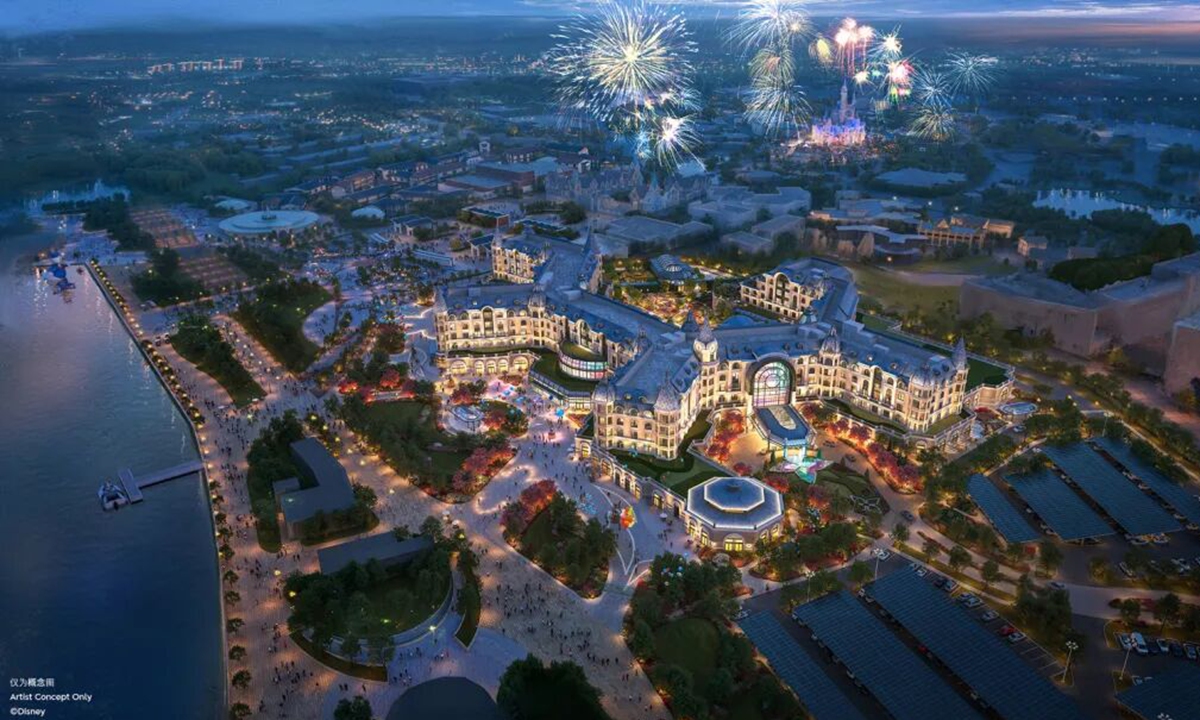
The concept photo of Shanghai Disney Resort fourth hotel Photo: Screenshot of Shanghai Disney Resort's official WeChat account
Chinese Vice Premier Ding Xuexiang met with Bob Iger, CEO of The Walt Disney Company, in Beijing on Friday, noting that China welcomes enterprises from all countries, including Disney, to continue investing in China and deepening their presence, and share China's opportunities to achieve greater development, Xinhua News Agency reported.
Noting that China's economy is deeply integrated into the world economy, Ding, also a member of the Standing Committee of the Political Bureau of the Communist Party of China (CPC) Central Committee, said the better China develops, the more benefits all parties will gain, according to Xinhua.
Ding said that the fourth plenary session of the 20th CPC Central Committee has outlined the blueprint for China's development over the next five years. "We will steadfastly promote high-quality development, expand high-standard opening up, and continuously optimize the business environment," said Ding.
Iger said Disney is confident in China's development, and will continue to expand its investment in China and better promote exchanges and cooperation between the US and China, Xinhua reported.
The meeting came as Zootopia 2, produced by Walt Disney Animation Studios, became China's highest animated opening of all time for a non-local title and the highest-grossing non-local animated film of all time, which was achieved in only five days, according to Disney.
"The Chinese market has consistently served as a vital source of business growth for multinational companies, including those from the US. As long as these companies can offer competitive products and services while emphasizing innovation, they will find broad opportunities for development in this vast, highly dynamic, and uniquely distinctive market," Li Yong, an executive council member at the China Society for WTO Studies, told the Global Times on Friday.
The Shanghai Disney Resort announced in November plans to build its fourth themed hotel. The resort now operates two themed hotels in Shanghai, with a third one already under construction. The fourth one will be located near the main entrance of the resort, and the expansion will also include new shopping and dining facilities.
Meanwhile, as Spring Festival approaches, some US companies have launched Year-of-the-Horse-themed products tailored for the Chinese market. For instance, Universal Beijing Resort stores will introduce new Kung Fu Panda-themed merchandise, including firecracker themed Bubble Machine and the adorable Horse Novelty Hat, the resort told the Global Times on Friday.
In addition, Starbucks introduced its Zodiac Year of the Horse cup collection, embodying wishes for good luck to gain momentum and for everything to progress smoothly in the new year, according to a press release the company sent to the Global Times.
"From the strong popularity of their products in China to their proactive embrace of Chinese culture, the performance of American companies in the Chinese market clearly shows the profound integration between the two economies - China has become an irreplaceable and essential market for US businesses," Li noted.
However, compared with China's opening-up, the US has recently rolled out some restrictive measures targeting Chinese enterprises, including the addition of China's DJI and all foreign-made drones and components to a list of companies "determined to pose unacceptable risks to US national security" and will bar approvals of new types of drones for import or sale in the US.
In response, Lin Jian, a spokesperson for China's Foreign Ministry, told a press conference on December 23 that China firmly opposes the US overstretching of the concept of national security and making discriminatory lists to go after Chinese companies.
"The US should stop its wrong practice and create a fair, just and non-discriminatory environment for Chinese companies," the spokesperson noted.
Li said that Chinese firms still want to invest in the US, but recent US restrictive policies toward China have increasingly politicized routine commercial activities, seriously impeding the legitimate business operations and growth of Chinese companies in the American market.
"China has always offered a stable and fair operating environment for foreign enterprises - including American ones - and the US should recognize that mutual cooperation benefits both parties and creates 'a bigger pie,' significantly outperforming the results of one-sided pressure and restrictions," Li noted.
RELATED ARTICLES