In a turbulent world, China revisits an 80-year-old question
By Published: Jan 09, 2026 10:48 PM
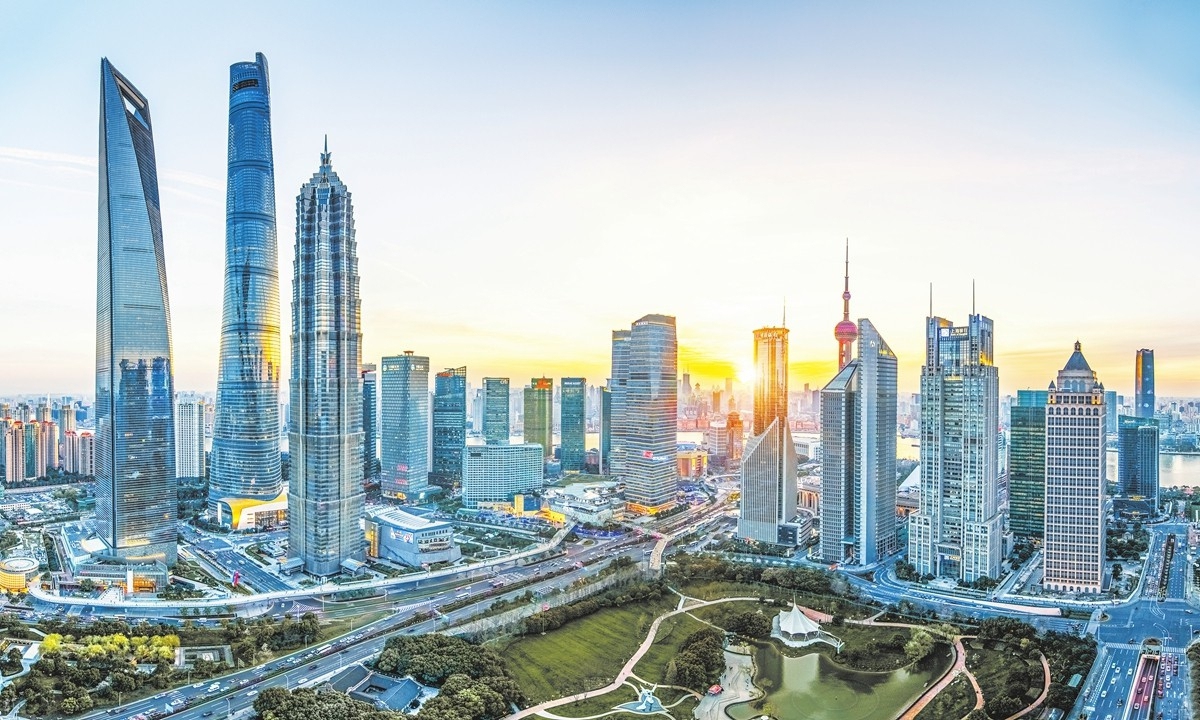
A view of Lujiazui, Shanghai Photo: VCG
In his 2026 New Year's message, President Xi Jinping said that we should continue to give a good answer to the question on how to maintain long-term governance put forth in a cave dwelling in Yan'an and prove ourselves worthy of the people's expectation in the new era.
In 1945, Huang Yanpei, a democratic personage, asked late Chairman Mao Zedong how to maintain the long-lasting success of political power. Mao gave an answer: supervision by the people and the due diligence of people working in public positions.
Decades later, the Communist Party of China (CPC) added a second answer: "self-revolution" - the party's continuously growing capacity to reform and discipline itself.
The question raised in a cave dwelling asks something deceptively simple yet profoundly challenging: how does any ruling power avoid corruption and decay over time? It is closely related to China's peaceful development in a turbulent era.
Hearing this question raised again in 2026 struck me not as nostalgic rhetoric, but as surprisingly relevant to what I've been observing across the globe.
As a journalist who has spent years tracking international affairs, I've watched democracies stumble, hegemonic regimes calcify, and in particular, the US is exporting the political divisions caused by its own governance disorder to the world.
The question raised in a cave dwelling, it turns out, isn't uniquely Chinese - it's a question every political system faces, especially in an era of escalating global turbulence. There is no superiority of the West.
In the US, the tools of democratic self-correction - elections, checks and balances, free press - are still formally in place. Yet they're increasingly paralyzed. Steven Levitsky and Daniel Ziblatt, in their book How Democracies Die, identify the diagnosis: "American politicians now treat their rivals as enemies, intimidate the free press, and threaten to reject the results of elections."
In America today, oversight is weaponized, and policy swings wildly with each administration; the whole society is divided into opposing camps, and domestic politics further exacerbates this division, making sustained reform nearly impossible. The system isn't broken; it's locked in endless combat with itself.
Europe faces different but related challenges: populist revolts against established parties, institutional sclerosis in Brussels, and declining trust in governance. Across the so-called democratic world, there's a growing sense that systems designed for self-correction are instead producing stalemate and decline.
This change has led to the extreme tendency of transferring domestic political issues to international issues, which has triggered stronger protectionism and the corresponding tendency of sovereign intervention in international affairs.
Revisiting the question emphasizes the importance of resilience, inspiring confidence in a regime's capacity for continuous self-renewal amid global challenges.
In an era when external shocks - supply chain disruptions and geopolitical conflicts - come faster and hit harder, internal resilience becomes decisive.
Countries don't collapse primarily from external pressure; they collapse when internal decay is suddenly exposed by crisis.
China's answer - combining public oversight with institutionalized self-discipline - may not yet offer a universal template.
But it does suggest something important: that system competition in the 21st century won't be won by whoever has the best ideology on paper, but by whoever can actually reform themselves in practice. It's not about perfection; it's about possessing the institutional courage to confront your own shortcomings before they become fatal.
When China keeps asking itself the "cave dwelling question," it demonstrates a commitment to self-responsibility, reinforcing legitimacy and trust in governance during turbulent times.
For the world, a China that genuinely pursues this question - that fights corruption, improves governance, and stays accountable to its people - represents something stabilizing in turbulent times: proof that a significant power can navigate uncertainty.
China is the world's largest developing country, and its modernization is both the most difficult and the most remarkable.
2026 is the starting year of the 15th Five-Year Plan and a crucial period for China to build a modern socialist country in all respects. This will further consolidate China's commitment to peaceful development in an era of hegemonic exporting turbulence.
This is why the "cave dwelling question" carries weight beyond China's borders. China's focus on self-reform underscores the vital role of self-correction in effective governance, fostering a sense of purpose in confronting global changes, and providing consistent, predictable support for global development.
The author is a senior editor with the People's Daily and currently a senior fellow with the Chongyang Institute for Financial Studies at Renmin University of China. dinggang@globaltimes.com.cn. Follow him on X @dinggangchina
RELATED ARTICLES