Public expectations ‘warm up’ Canadian PM’s visit to China: Global Times editorial
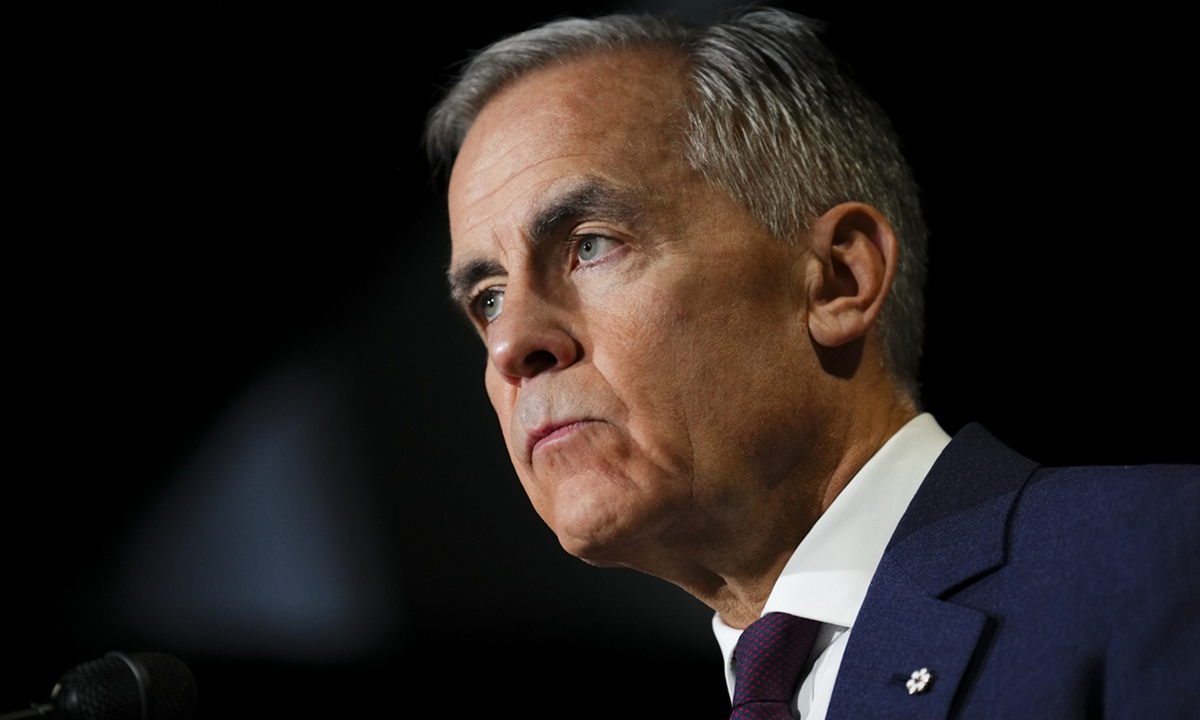
Canadian Prime Minister Mark Carney holds a press conference during the G20 Summit in Johannesburg, South Africa, on November 23, 2025. Photo: IC
The Office of the Canadian Prime Minister has announced that Prime Minister Mark Carney will visit China from January 13 to 17 to discuss trade, energy, and international security with the Chinese side. If the trip goes ahead, it will be the first visit to China by a Canadian prime minister since 2017. Canadian media generally hold a certain degree of anticipation for Carney's visit to China, describing the trip as a "reset" or "guarded reset" of China-Canada relations. These key phrases reflect Canada's objective understanding of the current state of bilateral ties. Canada's Global News described the anticipation vividly: "For Saskatchewan farmers, the trip could not come soon enough." This captures strong public expectation in Canada for a warming of China-Canada relations.
A warm wave of public opinion is quietly taking shape between China and Canada. According to a Canadian poll, the proportion of Canadians holding a positive view of China has risen from 16 percent in early 2025 to 27 percent. This upward trend indicates that a "warming" current is flowing through the public, symbolizing the "thawing" of relations. Two other poll results showed that more than 60 percent of Canadians support the "complete removal" of tariffs on Chinese electric vehicles in exchange for China lifting its corresponding countermeasures. Additionally, 31 percent of Canadian respondents last year thought Canada should expand trade relations with China, a significant increase compared to just 7 percent in 2023. This "rebalancing" of public opinion provides a valuable social and psychological buffer for improving China-Canada relations.
In recent years, bilateral ties between China and Canada have fallen to a low point, with Canadian farmers among the first to feel the impact. After Canada followed the US in imposing unilateral and discriminatory tariffs on Chinese electric vehicles, and steel and aluminum products, China implemented countermeasures by levying tariffs on Canadian canola, aquatic, pork, and other products. Last year, provincial premiers across Canada issued a joint statement urging Carney to remove the tariffs on China. The premier of Saskatchewan, the country's main grain-producing province, personally led a delegation to China to seek solutions to the canola export issue. This long-standing anticipation among Canadian farmers has, to a large extent, propelled Carney's visit. For them, the trip is not merely diplomatic - it carries the hope of renewed "certainty" and "orders." Such down-to-earth public sentiment forms a powerful foundation of popular support for improved bilateral relations.
Perhaps it was the heavy price paid for blindly following the US in imposing high tariffs on China that awakened Ottawa's sense of strategic autonomy. Washington's disregard for the United States-Mexico-Canada Agreement (USMCA) in levying additional tariffs on many Canadian exports to the US, along with its recent moves to tighten control over the Western Hemisphere, has also further strengthened Ottawa's resolve to diversify its trade and "reduce its reliance on the US."
China has long been Canada's second-largest trading partner. Last year, despite political pressure, BC Ferries in the Canadian province of British Columbia awarded contracts for the construction of four new ferries to a Chinese shipbuilder. At the end of last year, China's resumption of outbound group tours to Canada also generated a positive response there. From a people-to-people perspective, whether it is Canadian farmers' demand for markets, the ferry company's trust in the capabilities of Chinese enterprises, or the Chinese public's expectation for cultural and people-to-people exchanges, all point to a shared appeal: pragmatism and rationality are the foundation for steady and enduring engagement between nations.
Over the past six months or more, the Canadian side has continuously sent signals of engagement with China, forming a clear timeline. After Carney held his first "constructive call" with Premier Li Qiang in June last year, he met Premier Li again in September on the sidelines of the United Nations General Assembly in New York, hoping to push for the growth of the Canada-China strategic partnership and "lift it to a higher level." In October, Canadian Minister of Foreign Affairs Anita Anand visited China and proposed efforts to "recalibrate" Canada-China relations. On October 31, President Xi Jinping met with Carney on the sidelines of the APEC Economic Leaders' Meeting in Gyeongju, South Korea, where Carney stated that the Canadian government wishes to revive the original aspiration of establishing diplomatic relations and make up for lost time, Xinhua reported. Guided by leader-level diplomacy, the resumption of engagement mechanisms at various levels between China and Canada has sent a clear signal of a return to rational and pragmatic cooperation.
There are high expectations that Prime Minister Carney's visit to China will serve as a new starting point for the two countries, amid a complex international landscape, to reassess their positioning and rebuild a framework for pragmatic cooperation. Carney has publicly praised China as "one of the most influential actors" in the global system. Welcome Prime Minister Carney to visit China and it is also hoped that the Canadian side will translate a correct understanding of China into concrete actions, including lifting unreasonable tariff restrictions and advancing more pragmatic cooperation. A warming of China-Canada relations will not only bring tangible benefits to the peoples of both countries, but also inject greater certainty into the world.
RELATED ARTICLES