Viral Chinese app 'Sileme' responds to rising public attention, possible rebranding
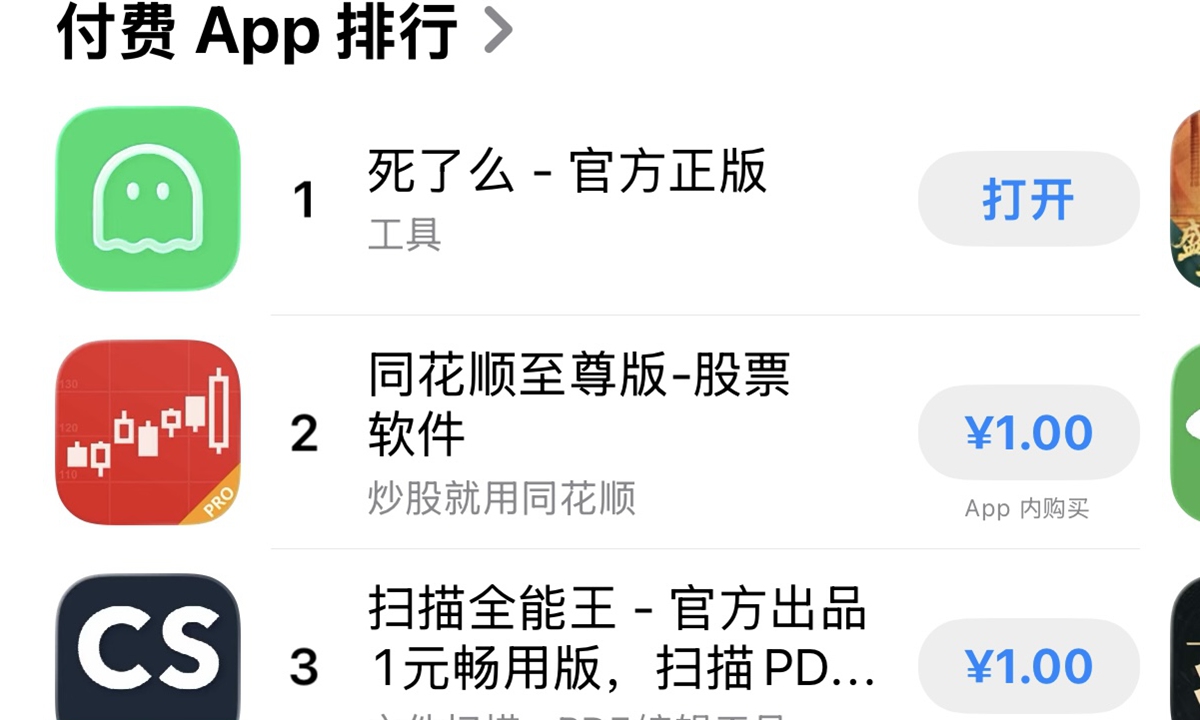
Screenshot shows safety monitoring app "Are You Dead?" topping Apple's paid App Store ranking on Saturday.
A Chinese app called "Are You Dead" known in Chinese as "Sileme," has sparked a wave of public attention and debate online. On Sunday, the safety monitoring app's team responded, addressing the recent surge in user interest and outlining next steps for the project after the app's price, name, and the social phenomenon it reflects have all become very contentious topics online.
Sileme noted in its statement that the team expressed appreciation to the users and the media, and the company introduced themselves as a small, independent startup of three co‑founders born after 1995. "We feel honored and deeply grateful to receive such widespread attention," the team said in the statement.
The team described the app as "a lightweight safety tool for solo dwellers." On Sileme, a user can simply check in daily with one click, and Sileme silently monitors the user's status. If the user fails to check in within the app's timeframe, the app can automatically notify the user's emergency contact, the company said.
The app topped Apple's paid App Store ranking on Saturday. The app is designed as a safety tool for people living alone. Users set emergency contacts and check in daily. If they fail to check in for consecutive days, the system automatically sends an email to their emergency contacts the following day.
The Global Times reporter found on Saturday that the app is priced at eight yuan ($1.15). The interface appeared simple: a central "Check In" button with a reminder stating, "If you do not check in for two days, the system will notify your emergency contact by email the following day in your name."
Its viral growth, the team said, began only in recent days and led to a download spike of more than 100 times now, bringing increased server load and operational costs, the National Business Daily reported.
The app's website reports 12,408 users as of press time, according to its official website.
As of Saturday, the app had attracted widespread attention on Chinese social media, with many short videos discussing it. After the app became popular, netizens suggested optimizations such as switching to SMS notifications to emergency contacts and improving the check‑in mechanism. Many users, however, felt the name "Are You Dead" sounded unpleasant or offensive, and suggested the company rename it to "Huozheme," (Are You Alive?)."
Regarding its name, many users felt it conflicted with Chinese cultural preferences for auspicious or positive meanings. A user surnamed Zhao from Southwest China's Sichuan Province commented, "Death has both a literal and sociological meaning. If it were changed to 'Are You Alive,' I would pay to download it."
Another netizen from Northwest China's Shaanxi Province suggested that the name should reflect care and positive emotions.
Also, some users hold positive views of the app, saying it is useful not only for the elderly people living alone but also for many young adults who live by themselves and face certain risks.
Suggestions for improvement included adding heart-rate monitoring and automatic alert detection. Regarding its name, many users felt it conflicted with Chinese cultural preferences for auspicious or positive meanings.
In response, the team said that "next, we will focus our main efforts on refining the product -- for example, enriching SMS notification features, considering adding a messaging function, and exploring more elder-friendly products. We also appreciate everyone's suggestions for a new name and will study and consider them carefully."
Business registration records showed the operator is a micro company named Yuejing (Zhengzhou) Technical Services Co, established in Central China's Henan Province in March last year, with registered capital of 100,000 yuan.
To cover rising costs for SMS, email delivery and servers, the team announced an 8-yuan paid plan (the app's initial price was 1 yuan). They said the price change aims to make the service sustainable and that SMS notification support will be rolled out within the month. The team also invited investors and said they will choose partners who can best help the project grow.
The "Sileme" team appealed for public to heed the needs of people who live alone, urging society to offer them more care, respect and protection, according to the statement.
The different opinions are mainly about the app's name rather than its social function. Internet expert Liu Dingding told the Global Times on Saturday that the app addresses a genuine social demand in the age of social networks - the health and safety of China's one-person household population, an issue that requires more attention and protection.
In recent years, experts have noted that the growth of China's one-person household population is a broader social trend. Real estate research institutions predict that by 2030, China may have up to 200 million one-person households, with a solo-living rate exceeding 30 percent.
China's one-person household population continues to grow, including both elderly people and younger adults. Liu said the greatest hidden risk for this group is that sudden illness or accidents may go unnoticed. The app meets this urgent need, and its "straightforward" name directly highlights the safety monitoring needs of those living alone.
The heated online discussion of this product has brought greater societal focus, and similar products may follow with improved features. This is likely to spur further development of comparable products, with iterative functional improvements. Future versions are expected to include richer features, such as monitoring physical health indicators, Liu said.
Global Times
RELATED ARTICLES