Airborne wind power system generates 385 kWh at 2,000 meters in maiden flight: developer
By Published: Jan 11, 2026 08:23 PM

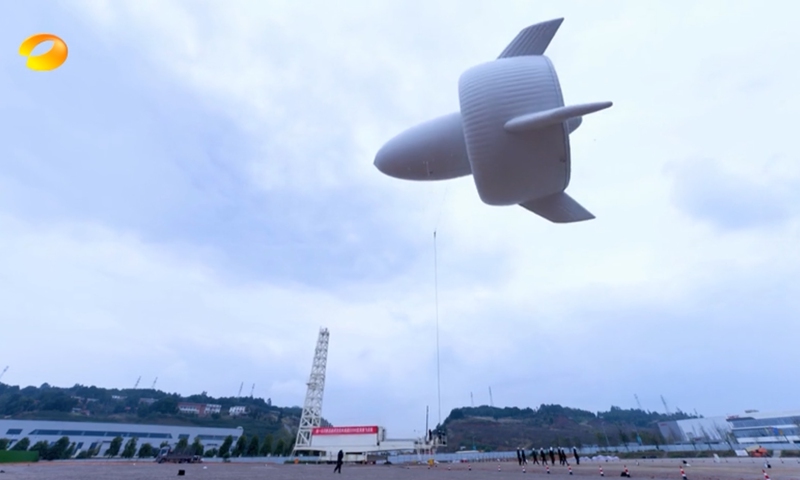
S2000 floating wind power system under test Photo: screen of Hunan TV
A megawatt-class airborne wind power system, resembling a fantasy airship and developed by a Beijing-based company, successfully completed its maiden flight and power generation test in Southwest China's Sichuan Province, the Global Times learned on Sunday. During the test, the system ascended to an altitude of 2,000 meters, generating and feeding 385 kWh of electricity into the grid.
The company said that it is the world's first megawatt-level S2000 floating wind power system (SAWES) suitable for urban environments. The S2000 system, measuring 60 meters long, 40 meters wide, and 40 meters high, bears a resemblance to a fantasy airship. During the test in Sichuan's Yibin city, it achieved a stable hover at 2,000 meters after approximately 30 minutes of ascent, an employee from Beijing Linyi Yunchuan Energy Technology, told the Global Times on Sunday.
Weng Hanke, CTO of Linyi Yunchuan, told media that the S2000 airborne wind power system operates by using a helium-filled aerostat to lift a lightweight power generation system into the air. There, it harnesses the relatively stable and strong wind energy at high altitudes to generate electricity, which is then transmitted to the ground through a tethered cable.
There are two main application scenarios, as Weng said, "One is for off-grid settings like border outposts, where it can serve as a relatively stable conventional energy source. The other is to complement traditional ground-based wind power systems, creating a three-dimensional approach to energy supply," reported Tide News, a platform affiliated with Zhejiang Daily.
Research shows that the energy in wind is proportional to the cube of its speed. This means high-altitude wind power can generate several times — or even dozens of times — more electricity than traditional wind power while being as green and low-carbon as the traditional, Tide News said.
By using a duct to concentrate the wind, this duct is essentially the hollow space formed between the main envelope and the annular wing and its primary function is to increase the overall wind energy utilization efficiency.
"It's like wrapping the wind from all sides, constraining the airflow within this duct so that as much wind as possible is captured by the blades. We have deployed 12 wind turbines on this duct," Weng told Hunan TV.
With a volume of nearly 20,000 cubic meters, the S2000 system has a maximum rated power capacity of 3 megawatts based on its aerodynamic design. The company has already initiated small-batch production of the S2000 and signed letters of intent with multiple coastal cities and high-altitude regions for its deployment, media reported.
Commenting on the airborne wind power system, Lin Boqiang, director of the China Center for Energy Economics Research at Xiamen University, told the Global Times that it represents a breakthrough for future new energy development. However, the technology is still in its initial phase, with its stability, safety, and cost-effectiveness yet to be fully demonstrated.
The Global Times learned from the company that to support scaling production and secure a self-controlled supply chain, the company is establishing a production base for high-performance envelope materials in Zhoushan, East China's Zhejiang Province.
The facility is planned to reach an annual production capacity of 200,000 linear meters by 2026 and 800,000 linear meters by 2028. It aims to break China's reliance on imported key materials for high-altitude wind power systems, according to the company.
RELATED ARTICLES