Details of bribery case against former agriculture minister exposed in annual anti-graft documentary aired since Sunday
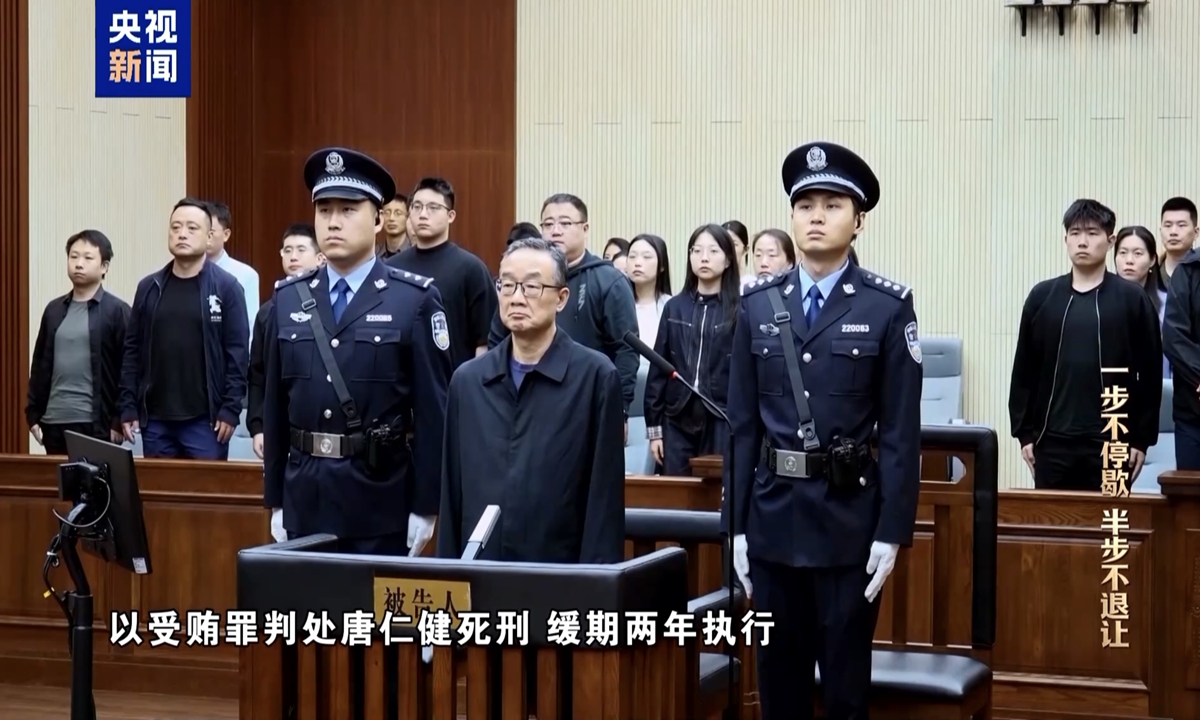
Tang Renjian, former minister of agriculture and rural affairs of China who was handed the death penalty with a two-year reprieve in September 2025 for taking massive bribes Photo: CCTV
An annual heavyweight anti-corruption documentary series premiered on Sunday, portraying through 12 cases, including details of the bribery case against former minister of agriculture and rural affairs, how discipline inspection agencies in China relentlessly advance the integrated fight against corruption.
The four-episode documentary series, titled "Never pause a single step, never yield an inch," is aired from Sunday to Wednesday. It is jointly produced by the publicity department of the Communist Party of China Central Commission for Discipline Inspection (CCDI) and the National Commission of Supervision, and China Central Television (CCTV).
The first episode released on Sunday focused on how discipline authorities have stepped up efforts to tackle both misconduct and corruption. It details how they have rigorously cracked down on cliques formed behind illicit dining and drinking, the practice of seeking favors for personal gain, and the exchange of benefits.
These efforts addressed the misconduct and corruption close to the people, allowing them to feel the efforts to uphold integrity and combat corruption as well as a clean and upright atmosphere, according to the CCDI.
In the episode, Tang Renjian, former minister of agriculture and rural affairs of China who was handed the death penalty with a two-year reprieve in September 2025 for taking massive bribes, said that discipline and rules must be taken seriously, and never gamble on luck. However, now, it is too late for regrets.
Tang, also a former secretary of the agricultural ministry's leading Party members group, has been deprived of his political rights for life, while all of his personal property will be confiscated and his illegal gains from bribery will be recovered and turned over to the national treasury, according to the verdict issued by the Intermediate People's Court of Changchun in northeast China's Jilin Province, the Xinhua News Agency reported in September.
The court stated that between 2007 and 2024, Tang took undue advantage of his various positions at both central and local levels to assist others in matters such as business operation, project contracting and job adjustment. In exchange, he accepted money and valuables totaling over 268 million yuan ($38 million), per Xinhua.
"The main bribe-givers in Tang's case mainly came from his daily circle of socializing, dining and entertainment. It exemplifies a vicious cycle where corruption issues and misconduct are intertwined and mutually reinforcing," said Zhou Dian, an official from the CCDI, in the documentary.
Since 2011, every year on Tang's birthday, different bosses have taken turns throwing him lavish celebrations, per CCTV. The venues are chosen from various tourist resorts and vacation spots across the country, with a different location each year. A large group of people would party for several days straight.
Zhou said that during the day, Tang would loudly tout his own "achievements" at meetings, while in the evening he would take his entourage out drinking and playing cards until late into the night.
The day before Tang was placed under detention for investigation, he was attending a national-level specialized meeting of the Ministry of Agriculture and Rural Affairs in a local area. After finishing the official working dinner, Tang went out drinking again, only returning to the hotel in the middle of the night, Zhou added.
According to the case, Li Yong, a Beijing antique dealer, discovered Tang's passion for antiques after meeting him. He then frequently invited Tang to antique markets to appraise items and hunt for bargains, occasionally gifting him pieces, gradually becoming one of Tang's closest confidants.
Li's antique business also served as a perfect "cover" for Tang to disguise bribe-for-power transactions. Businessmen seeking favors from Tang through Li had to buy "antiques" consigned by Tang to Li at inflated prices—this was how the bribes were delivered. Tang's share was kept by Li, who served as his personal "wallet," letting Tang withdraw cash freely whenever needed.
The documentary also features the case of Li Xianlin, former Party official of Luoshan county in Xinyang city of Central China's Henan Province. He attended a banquet with other officials in March 2025, which was against disciplinary requirements. At the banquet, one of the officials died as a result of binge drinking. To cover the case, Li and five others decided to offer financial compensation to the relatives of the deceased, Xinhua reported.
Li reflected in the documentary, "Failing to hold the bottom line set off a chain of events and hurt a whole circle of people. That's why I've been living with deep remorse ever since." A staff member of the Henan provincial commission for discipline inspection and supervision said one instance of illegal feasting and drinking cost someone's life — the lesson is profoundly tragic and painful.
The documentary series vividly reflects the discipline inspection and supervision agencies' relentless efforts to advance the fight against corruption — fostering an environment where people dare not, cannot and do not want to be corrupt — and to resolutely waging the tough, protracted and comprehensive battle against corruption, according to the CCDI.
This documentary is a prelude to a future anti-corruption campaign, Zhang Xixian, a professor at the Party School of the CPC Central Committee, told the Global Times on Sunday.
It conveys a clear message to the entire Party and all officials that the fight against corruption is an ongoing journey with ever-increasing intensity, Zhang said.
Throughout 2025, China's anti-corruption campaign has continued with undiminished intensity, targeting officials at all levels and advancing efforts to repatriate fugitives and recover misappropriated funds, per Xinhua. Official data showed that in the first three quarters of 2025, disciplinary authorities nationwide filed 789,000 cases and imposed penalties on 677,000 individuals.
RELATED ARTICLES