A visitor takes a photo with a humanoid robot developed by China's Unitree Robotics during the Web Summit annual tech conference held in Lisbon, Portugal, on November 11, 2025. Photo: VCG
The total trading volume of China's A-share market reached a new high on Monday, with the benchmark Shanghai Composite Index recording its 17th consecutive day of gains and climbing to the highest level in more than a decade.
Technology stocks extended last week's rally, with more than 70 percent closing higher on Monday.
Analysts said that the rally since the start of 2026 is a positive signal that the slow, long-term bull market is set to continue throughout the year. Meanwhile, investors are increasingly betting on China's accelerating push for technological development and new quality productive forces, which will reinforce the growth of the capital market.
Momentum in the stock market has been strong recently. On Monday, the combined turnover of the A-share market reached 3.645 trillion yuan ($519 billion), a new record high.
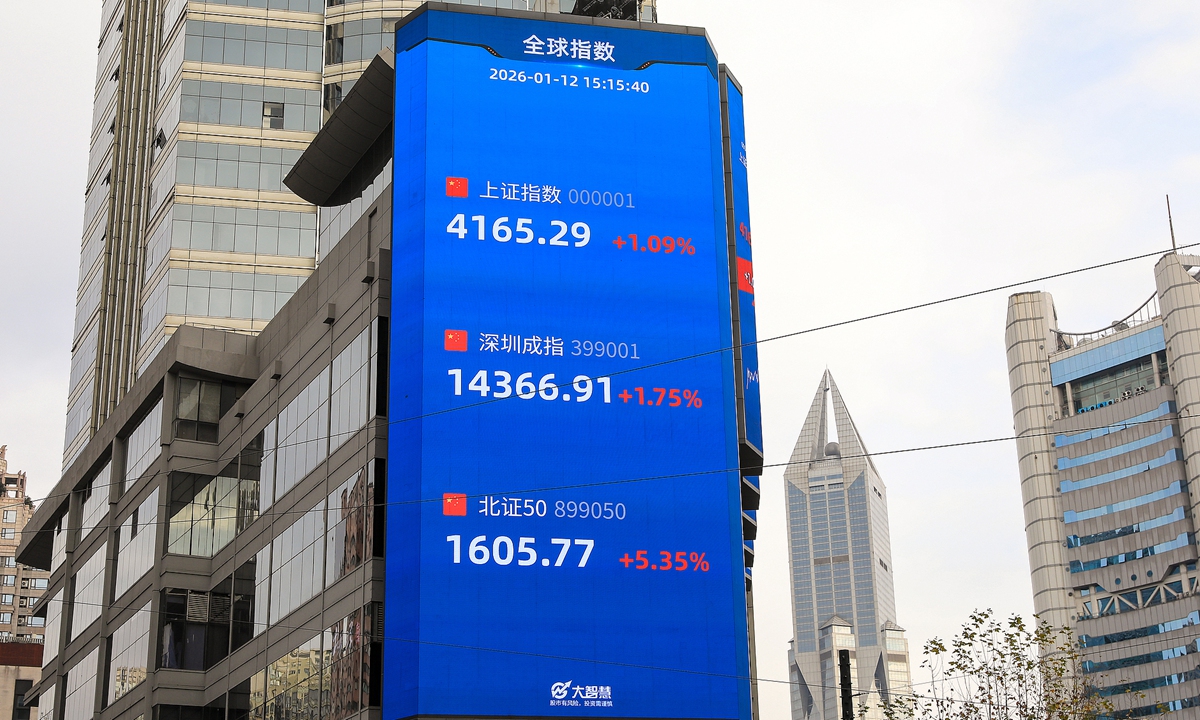
A large screen in Shanghai displays stock market updates on January 12, 2026. Chinese stocks closed higher on the day, with the benchmark Shanghai Composite Index up 1.09 percent to 4,165.29 points. The Shenzhen Component Index closed 1.75 percent higher at 14,366.91 points. Photo: VCG
The three major A-share indices all closed higher on Monday, with the Shanghai Composite Index up 1.09 percent. The Shenzhen Component Index closed 1.75 percent higher. The ChiNext Index, tracking China's Nasdaq-style board of growth enterprises, closed 1.82 percent higher.
The STAR Composite Index, which reflects the performance of stocks on China's sci-tech innovation board, commonly known as the STAR Market, closed 2.88 percent higher on Monday.
More than 4,144 stocks in the market rose on Monday, with 178 closing up by the daily limit.
"This round of the bull market is expected to last three to five years or even five to 10 years, marking the first true slow and long bull run in A-share history, in line with investors' expectations. The strong earnings effect will continue to attract retail and institutional capital," Yang Delong, chief economist at Shenzhen-based First Seafront Fund, told the Global Times on Monday.
History shows that major technological revolutions often fuel prolonged bull markets. Just as the internet era drove two decades of structural growth, the current artificial intelligence (AI) revolution is poised to become the primary long-term driver of capital market appreciation, offering strategic allocation opportunities, said Yang.
Market observers said that robotics, semiconductors/chips, computing power/algorithms and solid-state batteries will remain dominant on Chinese stock markets this year.
"The bull market will support the development of new quality productive forces, especially in science and technology. Recent surges in emerging sectors like AI, commercial aerospace and brain-computer interfaces, have attracted massive capital inflows," said Yang.
Bloomberg reported on Sunday that China is a key element of investing in Asia tech stocks, with investors betting that their momentum and outperformance against their US peers will last through 2026.
Earnings growth for a gauge of China's tech megacaps is poised for a major inflection point in 2026 when it's expected to overtake the Magnificent Seven for the first time since 2022, according to Bloomberg Intelligence.
The Magnificent Seven refers to Alphabet, Amazon, Apple, Meta, Microsoft, Nvidia and Tesla. The term was coined by Bank of America strategist Michael Hartnett in May 2023, Reuters reported in February 2025.
UBS said in a December report that AI innovation and spending are driving strong growth in China's tech sector, with earnings expected to rise significantly in 2026. This is fueling Chinese equities more broadly, helped by healthy liquidity and reasonable valuations.
"China's tech sector ramped up innovation in 2025, with notable advances across the AI value chain. New Chinese AI models have shown tech leadership, and supportive policy is reinforcing ecosystem resilience. We expect strong earnings growth in 2026 to drive China's tech stocks higher, and view China's tech sector as a high-conviction idea within global equities," read the UBS report.
Goldman Sachs Group Inc. projected that Chinese stock benchmarks will post another year of growth, with earnings supported by AI and policy measures.
The MSCI China Index, which covers all share classes across large-, mid- and small-cap stocks across China, is predicted to climb 20 percent to 100 by end-2026 from its 2025 close, said Goldman Sachs.
As investors' enthusiasm for China's technology sector surged in recent weeks, a robust wave of AI-focused companies lined up for IPOs.
According to media reports on Monday citing people familiar with the matter, BrainCo has confidentially submitted an IPO application in Hong Kong. If successful, it would become the first listed company among China's "Six Little Dragons," which also include Game Science, DeepSeek, Unitree Robotics, DEEP Robotics, and Manycore Tech.
Last week, two domestic AI start-ups - Zhipu and MiniMax - successfully debuted on the Hong Kong Stock Exchange, attracting significant attention and strong buying interest.
The listings of Zhipu and MiniMax last week "are seen as challengers to global sector leaders including OpenAI," Bloomberg reported.
"Recently, a wave of Chinese AI companies listed in Hong Kong's stock market, signaling the industry's critical transition from technological exploration to large-scale commercialization. A full-chain ecosystem has accelerated the conversion of technology into market value," Wang Peng, an associate research fellow at the Beijing Academy of Social Sciences, told the Global Times on Monday.
This year, the opening year of the 15th Five-Year Plan period (2026-30), will see more tech innovation firms list on the capital markets, accelerate growth into industry leaders, and drive economic transformation through new quality productive forces, said Wang.
RELATED ARTICLES